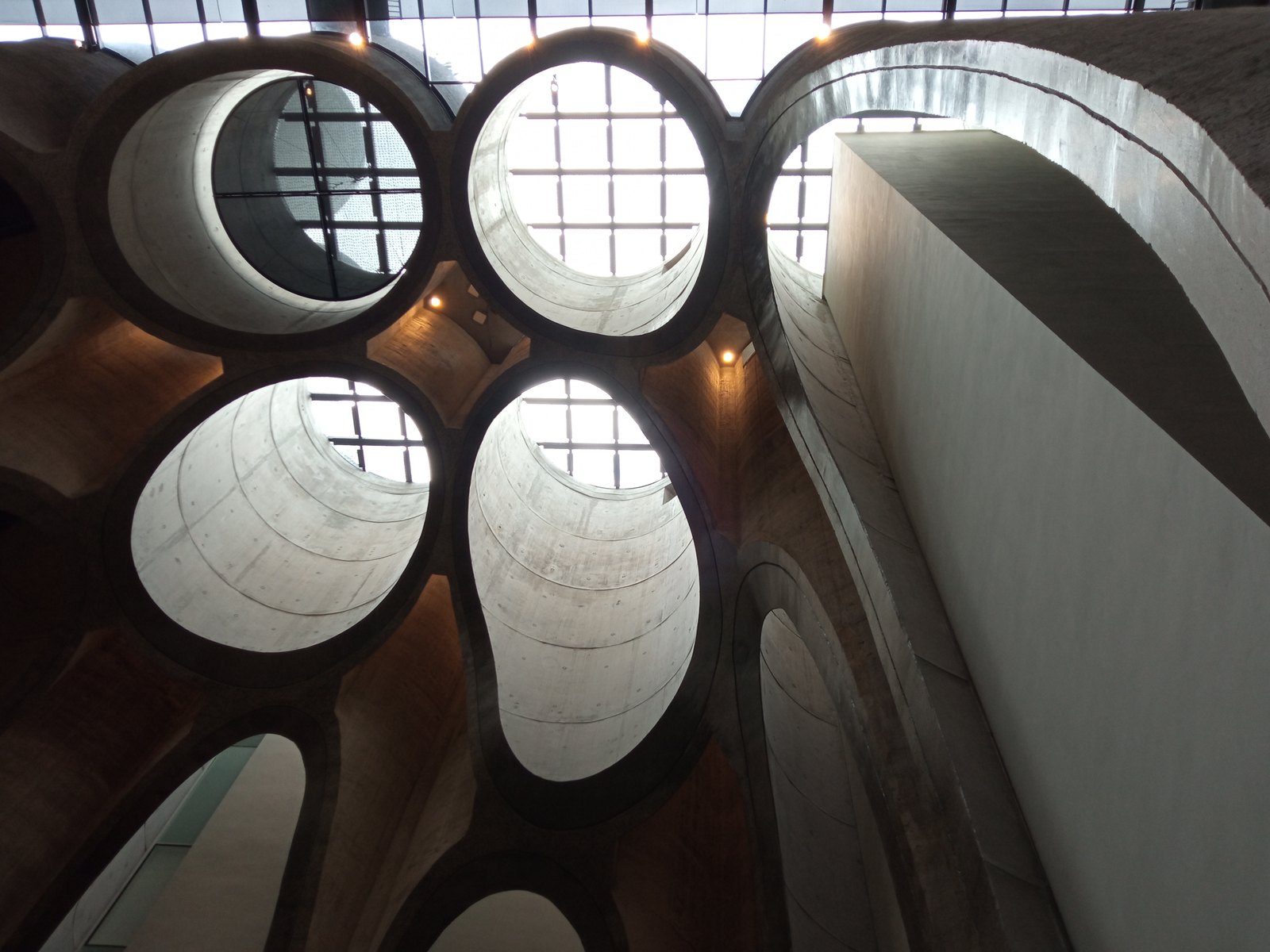
Look up at Zeitz MOCAA in Cape Town and the old storage tubes are still legible. In Michael Rowe’s January 2022 photograph, circles of daylight sit inside thick concrete rims. The cuts have turned a sealed industrial interior into a room that people can read from below. Follow the edges before trying to take in the whole atrium.
The museum occupies a converted grain silo in the V&A Waterfront’s Silo District. Its subject is contemporary art from Africa and its diaspora. Architecture is a good reason to arrive; the exhibitions deserve their own part of the visit. This guide connects the two without treating the entire waterfront complex as one attraction.
The useful details first
The museum’s visitor page, checked October 16, 2026, lists daily opening from 10 am to 6 pm, with last entry at 5:30 pm. General adult admission is R350; under-18s enter free. The page explains that African citizens can buy a reduced R199 ticket on site with the required identification. These are museum conditions, not hotel or rooftop reservations. Plan your visit.
Choose an exhibition as well as a building. The museum’s current program lists dates for each show; an exhibition pictured in an older travel story may already have ended. Allowing time for the atrium before entering the galleries is our suggestion, not a published tour duration.
Where the tubes went
Heatherwick Studio describes the original complex as a grading tower beside 42 closely packed storage silos. The architects cut a central volume through that cellular structure and adapted the perimeter for galleries. Glass over the tube openings admits daylight; artist El Loko supplied the pattern used in the glazing. The studio records the museum’s completion in 2017. Architect’s project account.
That account helps explain why the atrium doesn’t resemble a conventional hall built from columns and beams. Its shapes are the exposed edges of a previous organization. You can follow a curve upward, lose it at a cut and find another segment beyond. Reading one tube at a time makes the large room less abstract.
There’s a useful distinction between recognizing the old geometry and claiming to understand every engineering decision. The visible rim gives evidence of a cut; a photograph alone doesn’t establish how that cut was reinforced. Keep the architectural explanation attached to the design record rather than inventing a structural story from a dramatic angle.
Look closer: a circle with a thickness
Rowe’s real photograph offers three straightforward observations. The daylight openings have substantial concrete edges. A dark glazing grid crosses the bright sky above. At the right, a tall rectangular mass interrupts the field of curves.
Try comparing those shapes in that order. First trace one round opening. Then look at its edge, which turns a simple circle into a piece of a much deeper cylinder. Finally compare the cylinders with the straight vertical face at the side. The picture starts to describe several kinds of space at once: the tube, the room cut through it and the newer circulation structure.
This is a reading exercise, not a current-condition report. The photograph dates from January 5, 2022. Artworks, barriers and visitor arrangements may change; the image doesn’t establish which floor or viewing position is available on a future date.
A museum with its own purpose
The institution describes itself as a public nonprofit that exhibits, collects, researches and preserves contemporary African and diasporic art. Its collection includes photography, painting, sculpture, installation and performance; temporary exhibitions sit alongside the collection. Its own architectural account connects the atrium’s shape to a grain of corn. The museum’s story.
The grain reference is a useful starting point, but it shouldn’t become the only explanation visitors carry away. A building can be easy to photograph while the art asks for slower attention. Pick a work, read its label and consider what its material or arrangement does inside the room. That small commitment keeps the museum from becoming merely the setting for a photograph of the museum.
The 2017 opening announcement places the conversion within the waterfront’s industrial history and records the public opening on September 22 that year. Its historical account links the silo to the handling and export of grain. Old announcements establish that history; they do not establish today’s exhibitions or admissions.
Plan around the museum entrance
Use Zeitz MOCAA as the destination, with Silo Square and South Arm Road as the relevant waterfront context. The visitor page provides walking directions from the Clock Tower and parking information. A restaurant booking elsewhere in the complex does not demonstrate museum access. Keep any separate reservation in its own place in your itinerary.
For a short visit, our recommendation is simple: atrium, one exhibition you deliberately chose, then a second look at the concrete on the way out. For a longer visit, add galleries rather than collecting every possible viewpoint. The right amount of time depends more on what you read and watch than on the number of floors you pass.
The atrium makes the old building unusually visible. The galleries give that act of opening a continuing purpose.
Reference photograph: Michael Rowe, January 5, 2022, CC BY-SA 4.0, via Wikimedia Commons. The reference is documentary; any generated derivative requires its own illustration label and retained license terms.
Follow the thread
At Oil Tank Culture Park, former oil tanks receive several different architectural treatments, from preserving a container to rebuilding with its steel.
Gasometer Oberhausen turns a gas holder into an exhibition space while keeping the immense interior volume central to the experience.
The reference photograph