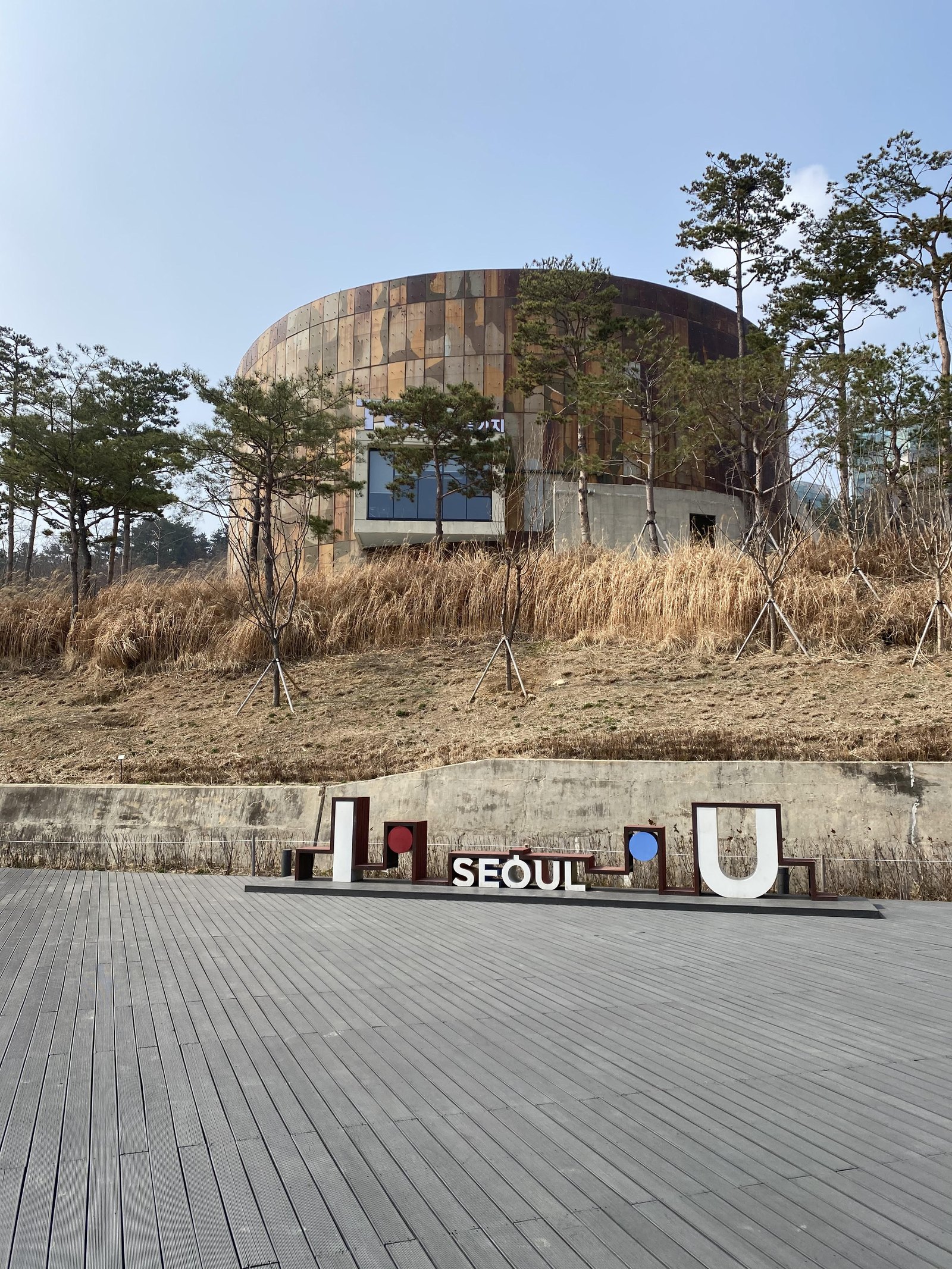
At Seoul’s Oil Tank Culture Park, a cylindrical wall can mean several different things. One tank preserves its former shape. Others were cut, opened or adapted. Another structure was built from steel removed elsewhere on the site. The repeated circles conceal different histories of reuse.
The former Mapo oil depot is now a cultural landscape near World Cup Stadium. It is worth understanding from outside as well as within. That distinction is especially practical today: the city’s current Korean park page says regular interior viewing of Tanks T1–T6 is unavailable following a management change in April 2025.
Choose an outdoor visit or a specific program
The current city park page, checked October 16, 2026, lists the outdoor park as open 24 hours year-round. It directs tank-interior inquiries to the venue operator rather than promising continuous access. If seeing inside a particular tank is essential, confirm an actual program and its conditions before traveling.
The address is 87 Jeungsan-ro, Mapo-gu. The page gives a walking approach from World Cup Stadium Station on Subway Line 6. Treat a cafe, an exhibition and the outdoor grounds as separate services. A photograph of an open tank does not tell you what will be open on your date.
A fuel reserve became public ground
Seoul’s 2017 opening announcement describes the transformation of a restricted oil-storage site into a cultural park. The announcement sets out the design roles of the tanks and the central open area. It is a useful historical document, not a live opening schedule.
The change is more specific than adding grass around old machinery. A storage reserve was organized around controlled access and the containment of material. A public park has to accommodate people moving, waiting and meeting. The preserved structures make that change of purpose visible, even when an interior is closed.
Walk around the forms rather than searching immediately for a door. Notice how a circle meets the slope, where the exterior gives way to an opening and how a path approaches it. Those relationships can explain the design without a performance or exhibition filling the room.
Six labels do not mean six identical old tanks
The city’s architectural leaflet distinguishes the tank roles. T1 became a glass pavilion, T2 a performance venue, T3 retained an original tank form, and T4 and T5 took cultural and interpretive functions. The leaflet identifies T6 as a newly built community center using steel from T1 and T2.
That last point is particularly useful. A round shape does not necessarily mean you are seeing a preserved fuel container. In T6, old material participates in a new building. Reuse can conserve an object, expose part of it or take it apart and recombine the pieces. The site puts those different decisions close enough to compare.
Try choosing one pair. Compare the idea of keeping an enclosed cylinder with the idea of replacing a wall with glass. What becomes visible? What can the room now accommodate? These are design questions; they don’t require a claim that each intervention has been equally successful for every use.
Look closer at the slope
The selected real photograph shows a large cylindrical tank above a planted slope. A concrete retaining wall separates that level from a wooden deck in the foreground. Trees partially interrupt the tank’s outline.
The ground matters as much as the steel. Without it, a close crop can make the cylinder appear to be an isolated sculptural object. The wider view shows a relationship between built containment, levels and vegetation. Look at the cylinder together with its ground rather than treating it as a freestanding sculpture.
The exterior photograph shows the cylinder and its setting. To connect that view with a particular tank’s history, compare it with the labeled site plan; the view alone does not reveal the activity inside.
Why older visit guides disagree
An older Visit Seoul feature suggests a sequence through the Culture Yard, T6, T2 and T4. It still carries historic interior hours and a temporary-closure notation. Its own caveat says details come from past information. The later change described by the direct city park page takes priority for planning ordinary interior access.
This does not mean the park itself has closed, or that no cultural activity can happen in the tanks. It means an older self-guided interior route is not a dependable promise. A specific exhibition or performance should have its own current information, including any ticket, schedule and accessibility terms.
For an outdoor architectural visit, our suggestion is to use the central yard as an orientation point, compare two tank treatments and return by the public path. Add an interior only when its actual program is confirmed. The value of the visit lies in seeing several ways an industrial structure can acquire a second use, not in collecting six open doors.
Follow the thread
Zeitz MOCAA opens a grain silo's storage cells into an atrium, making another cultural interior from the geometry of containment.
Seoullo 7017 turns another piece of Seoul's infrastructure toward pedestrians, using an elevated road's existing line to connect the city.
The reference photograph