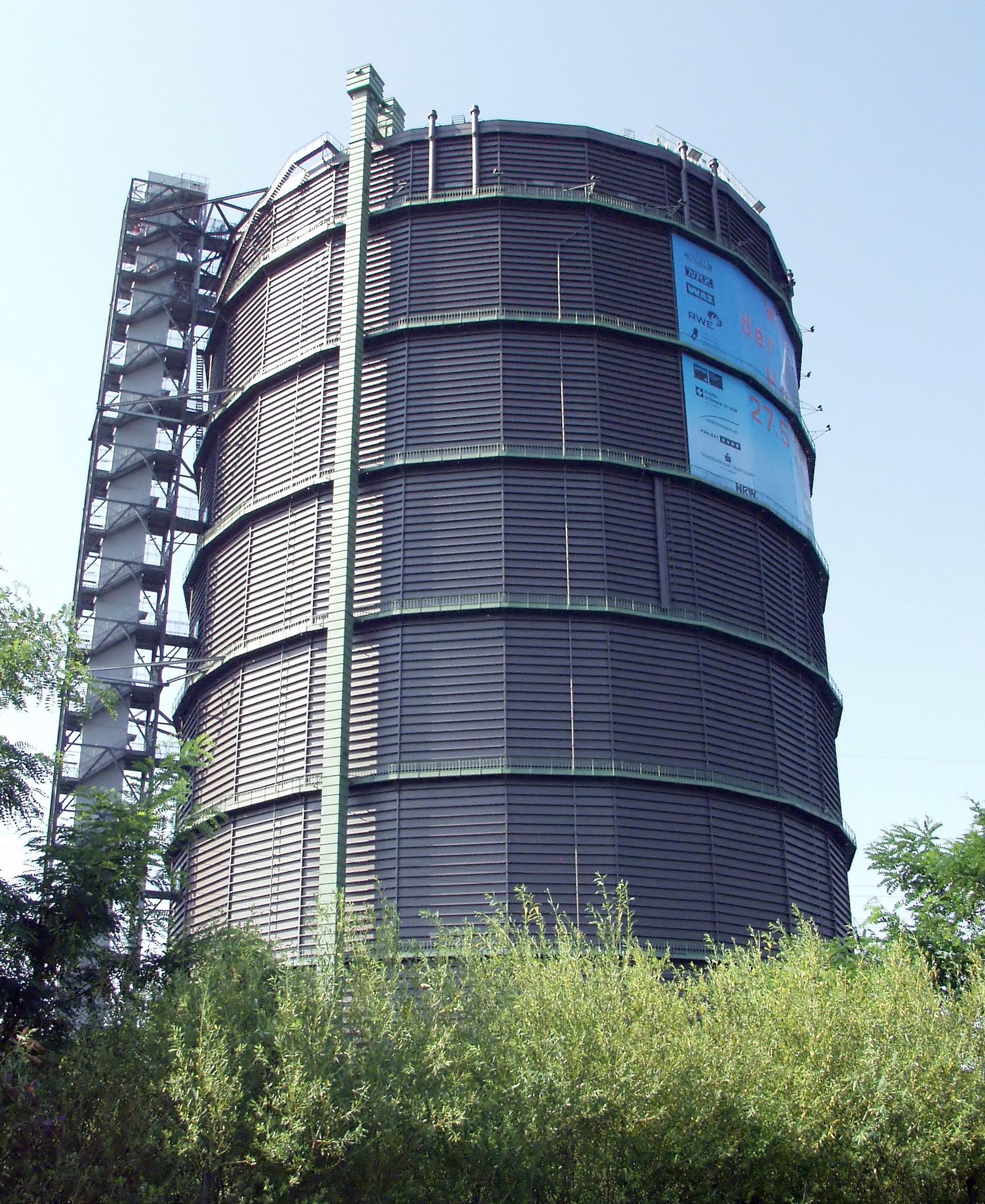
A former gas holder in Germany’s Ruhr region has become an exhibition space whose most powerful feature is the volume it was built to contain.
The Gasometer in Oberhausen has the outline of a container because that is what it was. Its tall cylindrical wall once enclosed gas used by the surrounding industrial network. Today, visitors enter for exhibitions, but the preserved shell gives every installation a second subject: the space itself.
This is a useful place to understand industrial reuse without a familiar facade doing all the work. A gas holder was built around capacity and pressure. Its conversion had to give people ways to occupy a volume that had never been intended as an ordinary public room.
Storage between factories
The operator's history explains the original problem. Local ironworks produced gas that could fuel other industrial processes, but production and demand did not always coincide. Storage reduced waste and made the system more dependable.
Construction began in 1927. The completed holder stood 117.5 meters high, with a diameter of 67.6 meters. Those dimensions are easier to grasp as a relationship than as two large numbers: the building is a broad cylinder, yet its height makes the wall feel almost tower-like from nearby. External stairs and structural divisions provide a human scale against the repeating steel surface.
The holder was rebuilt after a postwar fire and continued operating until 1988. Its eventual redundancy came from changes in the industrial energy system. The shell survived the function that had justified it, leaving Oberhausen with an enormous question about what a container could become.
The old pressure disk becomes a floor
The decisive move in the 1993–94 conversion was to fix the former gas-pressure disk about 4.5 meters above the ground. This created an exhibition level and a circular hall below. An industrial component became part of the building's new public organization.
Above it, the immense interior remained available for installations. A glass panoramic lift travels within the cylinder toward the upper interior. Roof access uses a separate external lift or the long stair route. These are different journeys; the interior lift should not be confused with direct access to the outdoor panorama.
Look for the relationship between the exhibition and its enclosure. A large image or suspended object can briefly provide a scale against the wall, but the building always exceeds a normal gallery. The conversion works with that excess. It preserves the container's defining characteristic instead of subdividing everything into conventional rooms.
The exhibition changes
Older photographs show several spectacular installations, some now long past. The current operator homepage lists Forest Worlds, running from March 20, 2026, through November 28, 2027, as checked on October 16, 2026. Do not plan a visit around a giant globe or another image found in an undated search result without checking its exhibition dates.
The documentary photograph paired with this story dates to August 2004. It shows the exterior cylinder and the stair structure in an earlier advertising context. The image can explain the architecture; it cannot identify the exhibition inside today.
Visiting the industrial shell
The official ticket page listed a €14 standard adult ticket when checked, with an additional charge for online purchase. Regular hours were Tuesday–Sunday, 10 a.m.–6 p.m., with Monday openings during North Rhine-Westphalia school holidays and public holidays. The roof is cleared before the building closes, and ticket sales end earlier as well.
Allow time for the exhibition before going up, and confirm roof and lift availability if the panorama is essential to your trip. General opening hours do not prove that every part of a large industrial monument is accessible at every moment.
Dress for the building. The operator explicitly warns that it is unheated in cold months and can become noticeably warm on sunny days. The shell is part of the experience in a very literal sense. Its size, temperature and circulation still shape the visit, decades after gas stopped moving through the system.
Follow the thread
Völklinger Hütte explains the connected ironmaking processes behind an industrial landscape, adding context to the kind of gas a holder once stored.
Oil Tank Culture Park compares several ways to reuse storage structures, including a new building assembled from steel removed from older tanks.
Sources and reporting
Researched October 16, 2026, from the linked sources. This is desk reporting; no firsthand visit is claimed.
- Gasometer industrial history
- Gasometer conversion
- Current exhibition and visitor notices
- Tickets and opening hours
The reference photograph