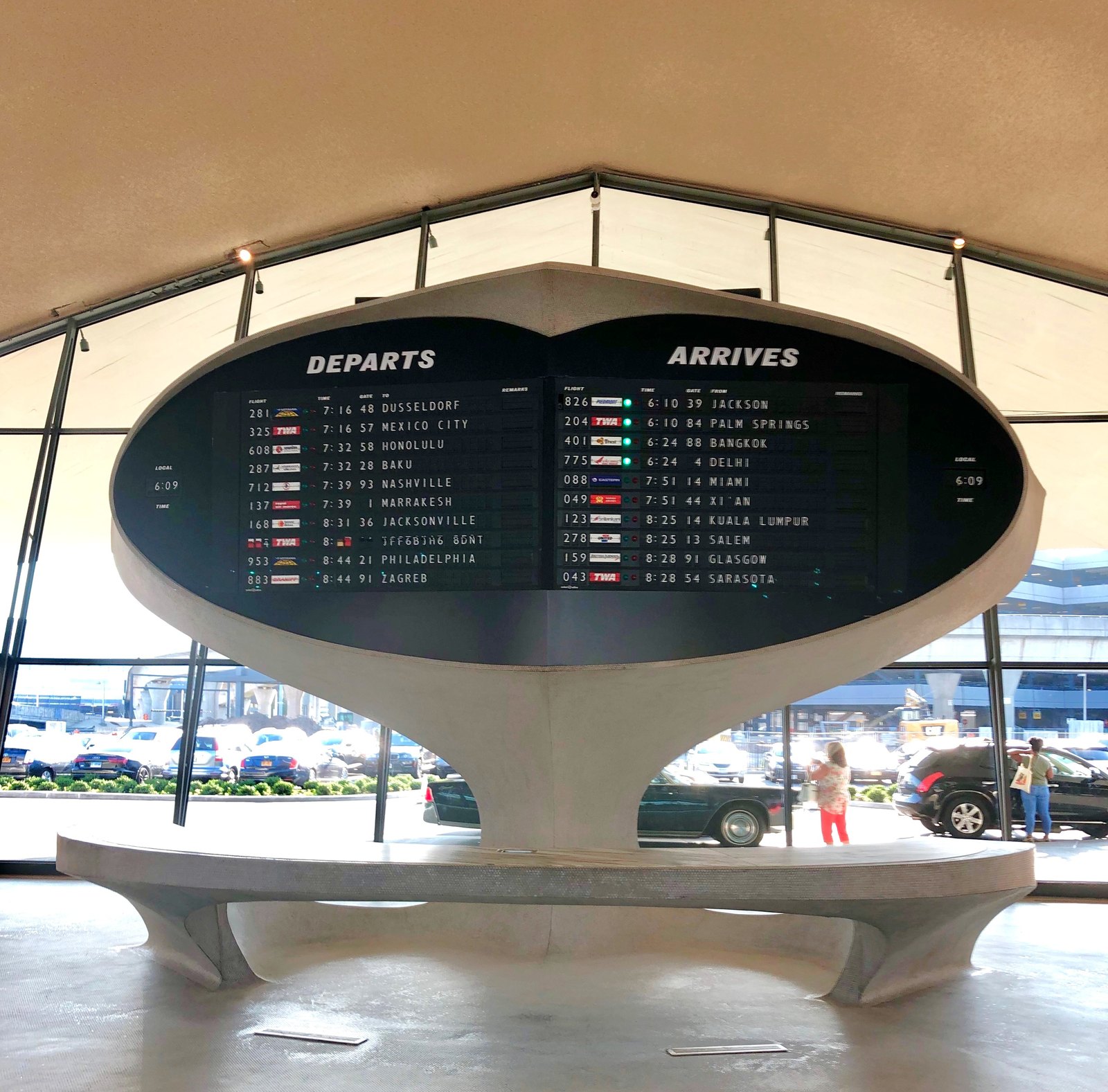
The departures board has its own sculpted frame. In the selected photograph of the TWA Flight Center, its broad black oval sits on a tapering support, with a curved bench below and the airport road beyond the windows. Even a piece of passenger information has been given a silhouette.
Eero Saarinen’s Flight Center opened in 1962 at the airport now called JFK. Today it forms the heart of the TWA Hotel, and you can explore the lobby and museum exhibits without booking a room. That makes the former terminal an architectural visit in its own right, provided you plan it as a visit outside airport security. Hotel FAQ.
What a visitor can actually do
The hotel’s museum displays are free and open to the public. They occupy several parts of the former terminal, the event center and connecting areas, rather than one conventional gallery with a single entrance. The New-York Historical Society curated the exhibits, drawing on artifacts and personal material from the airline’s history. Museum exhibits.
A sensible first visit is an unhurried look at the public lobby and those displays. A meal, pool session, day room or overnight stay is a separate choice, with its own reservation and price. You don’t need to buy a room to justify looking at the building.
The property’s listed address is One Idlewild Drive, JFK International Airport, New York. It connects to Terminal 5. For a layover, the important boundary is security: international visitors may need to clear customs, and anyone leaving the secure side must pass through screening again before their next flight. The FAQ explicitly identifies those requirements. This article does not supply a minimum safe connection time. Access and layover conditions.
A preserved terminal, with a new task
When the hotel opened in May 2019, TIME’s report described the former terminal’s long period of limited use after its 2001 closure. The new hotel added accommodation around the historic building rather than asking the old passenger hall to become an ordinary corridor of bedrooms. Contemporary opening report.
The change is interesting because airports normally reward forward motion. A departure hall organizes people toward a next step: a counter, a gate, an aircraft. A hotel lobby must also give them permission to remain. Here, the same architecture can be read at a different speed.
Look at a curve twice. First follow it as a direction of travel; then consider how it frames a place to sit. That simple comparison helps explain why this building can hold attention after its airline function has changed. It doesn’t require imagining that the 1960s airport was a more equitable or universally pleasant place to travel.
Look closer: information becomes architecture
In Warren LeMay’s 2019 photograph, the board is set inside a pale oval surround. Its central support narrows toward the floor, while the bench repeats a shallower curve below. Window mullions behind it provide a useful straight-edged comparison. The ceiling slopes rather than forming a flat background.
Those relationships are visible in the source image. The listed destinations and illuminated characters belong to a historical display; they must never be used as live flight information.
For an in-person architectural visit, try separating the object from its setting mentally. Without the windows, ceiling and bench, it is a large sign. Together, they make it part of a room designed around travel.
The small objects complicate the big picture
The museum exhibits include uniforms, travel posters, serving pieces and personal donations from former employees and their families. Recreated offices are also part of the interpretation, so an attractive period interior should not automatically be described as an untouched room. A scale model in the lobby depicts the Flight Center as it appeared in the early 1970s. What the exhibits contain.
Use those objects to test the building’s public image. A poster presents an airline’s promise. A uniform points toward the people employed to deliver it. A personal letter or log can bring a different scale into the account. The architecture is more useful when read alongside those working lives, rather than used as a backdrop for a generic story about glamorous travel.
Keep the extras separate
The hotel FAQ advertises advance-arranged group tours, but that is not the same as a regular walk-up tour for an individual visitor. Restaurant reservations, the Connie aircraft lounge and rooftop pool have separate arrangements. If one of those is your main reason for going, open its own product page before setting the rest of the day around it. Current hotel policies.
Leave enough flexibility to return to your actual departure terminal. The old Flight Center is most rewarding when you can stop looking at the clock; an untested airport connection is a poor way to arrange that.
Checked October 16, 2026. Desk research and a historical photograph, with no personal stay, booking purchase or field timing. Current terminal transport, individual amenity prices and trip-date availability are not verified here.
Follow the thread
Michigan Central Station restores the scale and ornament of a passenger station while giving its public ground floor a new role.
Old City Hall Subway Station shows an earlier moment when curves, tile vaults and chandeliers made passenger infrastructure an architectural statement.
The reference photograph