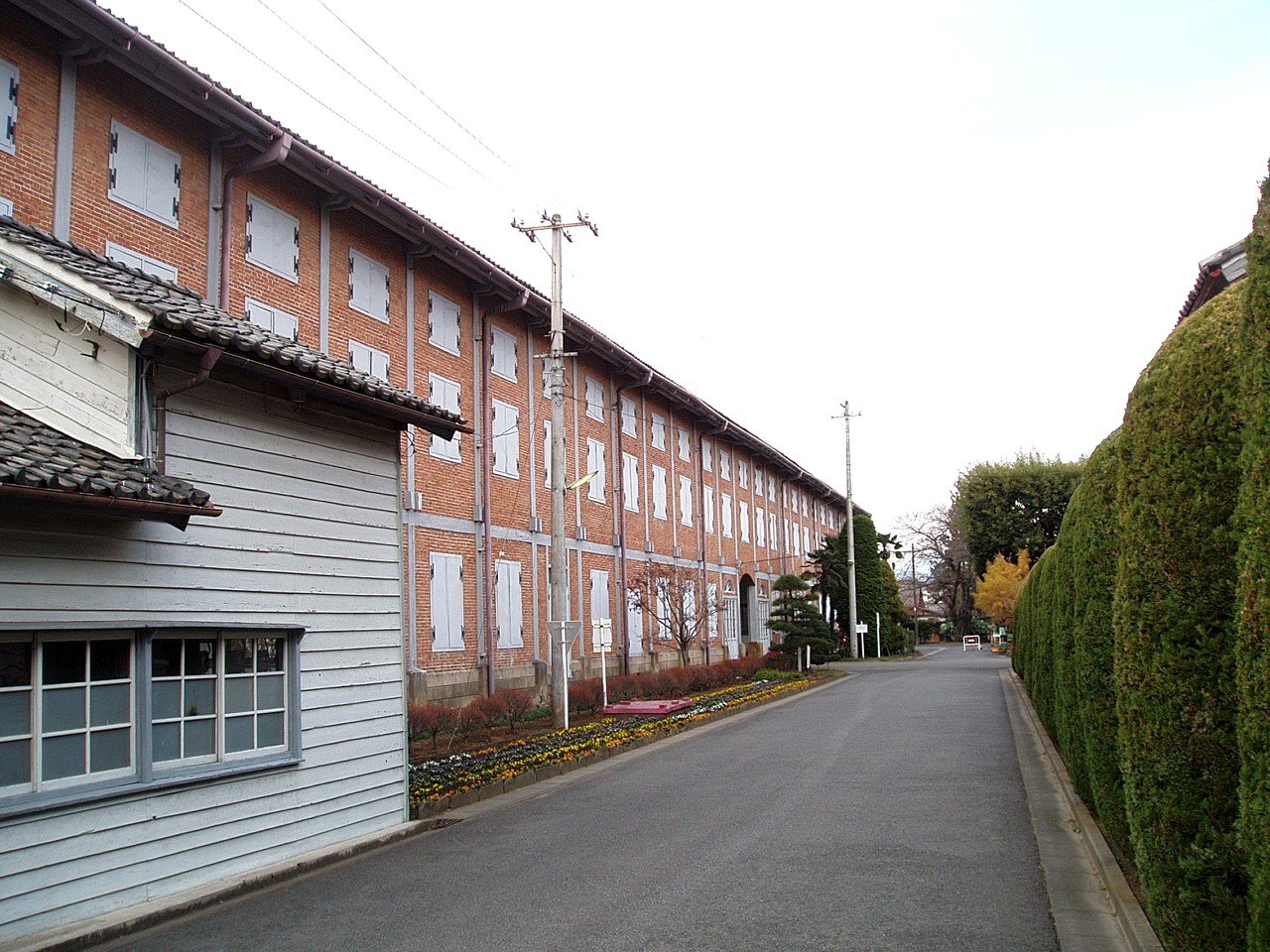
The long brick wall at Tomioka Silk Mill is easier to read if you start with what the building held. A cocoon warehouse belongs to a production chain: raw material had to be received and stored before thread could be reeled. Repeated windows and a long roof become parts of a factory rather than simply a handsome historic frontage.
Tomioka, in Japan’s Gunma Prefecture, is a preserved industrial complex that opened in 1872. Its story involves imported technology, Japanese building skills and women learning and operating the production process. Today, choose the mill itself as your destination; the wider World Heritage property includes other sites reached separately.
A museum visit with optional interpretation
The operator’s Japanese admission page, checked October 16, 2026, lists adult admission at ¥1,000. Standard hours are 9 am–5 pm, last entry 4:30 pm. A guided explanation is an additional product: the page gives approximately 40 minutes and an adult supplement of ¥200, with possible shortening in summer.
That explanation time is not the length of an entire visit, and language availability needs its own check. If understanding the process is your main reason for going, arrange the interpretation you need before assuming any departure will be in English. Building closures or conservation work can also affect which interiors are available.
An imported system built locally
The Japan Tourism Agency’s history account describes a government-operated mill using French designs and advisors. Japanese carpenters constructed the principal buildings with timber frames, red brick and plaster. It also records the model-factory role: people came to see the production system and its supporting facilities.
This is more specific than saying that a foreign factory was copied. Design, materials, building labor and instruction came together in one site. Look for the relationship between the broad industrial spaces and the smaller rooms supporting them. Production needs an organization as well as a machine.
In the real reference photograph, the East Cocoon Warehouse extends beside a paved lane. Brick surfaces alternate with pale framing and repeated shuttered openings, under a gray tiled roof. The photograph gives a clear exterior rhythm; it does not show the interior structure or the contents of a storehouse on a particular visitor day.
The workers are part of the technology
The same national history account describes women operating reeling equipment and living in on-site dormitories. Skills were taught, practiced and transferred; the workforce was not an incidental addition to a room full of machinery.
JNTO’s heritage guide describes educational and residential arrangements and the role of workers who took their skills elsewhere. Read those institutional accounts with a useful distinction in mind: a model establishment’s stated arrangements do not by themselves describe every woman’s experience or all silk work across Japan.
When looking at a machine, ask where the operator stood, what needed watching and which part of the process remained dependent on judgment. Use the museum’s labels to answer. An orderly row of equipment can make work look automatic even when training and repeated attention were central to it.
The buildings add another question: how far did the workplace extend into daily life? A dormitory, an infirmary and a production hall belong to different activities, even when one institution manages them. Keeping those spaces distinct makes the workers’ presence more visible than a general story of modernization does.
Not every machine is from 1872
The mill’s own historical overview follows later changes in management and equipment, including postwar automatic reeling. It records the end of production in March 1987. That long operating life is a reason to date equipment individually instead of treating everything inside as part of the opening installation.
Use three questions at a display: what does the object do, when was this example installed, and what changed from the earlier method? If a label answers only the first, leave the date open. A historic shell can contain technology from several decades without any contradiction.
The same applies to the photographs. A warehouse exterior and a late production machine may both belong to Tomioka while illustrating different stages. Read them as evidence of different stages rather than a single unchanged factory.
One mill within a larger silk landscape
UNESCO’s Tomioka Silk Mill and Related Sites brings together the mill and places connected with sericulture, instruction and the storage of silkworm eggs. The serial property makes the wider production system visible. It is not one enclosed attraction covered by a single walk.
For a first visit, our recommendation is to understand the mill’s cocoon storage and reeling functions before adding another site. Once you can explain what happened between those two stages, the wider connections become more meaningful. Collecting several heritage names in a day is less helpful than seeing how they relate.
Arrive in Tomioka, then walk to the mill
JNTO directs rail visitors through Takasaki to the Joshin Dentetsu line and Jōshū-Tomioka Station, followed by a walk to the mill. We have not verified a date-specific train connection, so there is no promised journey total here. Leave the transfer and local walk in the itinerary rather than treating arrival in Takasaki as arrival at the factory.
The long warehouse wall is a good place to finish the visit. After reading the process, its repetitions become less decorative. You’re looking at one part of a system that moved cocoons, skills and finished thread through very different spaces.
Follow the thread
Huashan 1914 Creative Park also uses named production buildings to make an industrial complex readable, while its cultural venues give the rooms new tasks.
Ford Piquette Avenue Plant separates an early factory's surviving structure from the later manufacturing methods commonly associated with its product.
The reference photograph