Huashan 1914 Creative Park contains a small guide to its former life in the names on its map. Sake Brewery, Rice Wine Factory, Boiler Room and Packaging Factory describe different jobs. They make a Taipei arts visit more interesting than a walk through a collection of industrial-looking buildings.
The complex began with alcohol production during Japanese colonial rule and later became a place for exhibitions, shops and performances. The outdoor grounds and an individual event are different visits. You can explore the spaces between buildings without assuming that every interior is open or included in one ticket.
Two ways to arrive
The operator’s transport page, checked October 16, 2026, gives No. 1, Section 1, Bade Road as the address. It recommends Zhongxiao Xinsheng MRT Station, Exit 1, or Shandao Temple Station, Exit 6, followed by a walk. These are urban rail approaches; no transfer from Taipei Main Station is needed merely because that station is more familiar to visitors.
Outdoor areas are listed as open around the clock. Shops and events follow their own announcements. If an exhibition is the reason for your trip, check its particular venue, ticket and last admission instead of using the park’s outdoor hours. The operator’s service-desk hours are another separate field.
The date is a beginning, not a label for every wall
The official chronology starts alcohol production in 1914. It records later expansion and says that many surviving buildings were constructed between 1929 and 1933. The distillery moved out in 1987. Arts groups advocated a cultural use in the following decade, and the current park name was adopted in 2011.
“Huashan 1914” marks the site’s origins; many surviving buildings belong to later phases. Nor does the current use erase the periods of colonial monopoly, later state management and industrial change. Choose a specific building if you want to attach a construction date or function to it.
The site’s history also includes a camphor operation. Read that as a related but distinct production story. A former refinery and a wine warehouse may share a present cultural campus without having performed the same industrial task.
Follow one former process
The operator’s building guide identifies spaces by their old uses and their current location codes. Among them are the distillery, storage buildings, a boiler room and packaging areas. Use those names as an organizing tool rather than treating each shed as an interchangeable exhibition hall.
Try choosing three connected functions: making, storing and sending out. Check which actual buildings represent them on the map. Then look at what differs between their doors, external spaces and proportions. The task is not to reconstruct an entire factory flow from appearance; it is to give the surviving buildings a question worth answering.
A large opening may suggest the movement of things, but a suggestion is not a confirmed loading history. A chimney identifies an industrial feature, but it does not prove what fuel was used in every period. Let the labeled record supply those explanations. The exterior can prompt a question without being made to answer it alone.
What the present-day map adds
The current park homepage distinguishes exhibition listings, shops and venue categories. Store entries use the same location codes found on the building plan. That makes it possible to connect a contemporary visit with the older industrial layout.
Pick an event or shop for its own subject, then use the walk between stops to read the buildings. A cultural park works partly through those intervals: a passage or a yard can continue to explain the old site while a room has taken on a different purpose. The contrast is most useful when both functions remain clear.
We have not established a single current admission price because there is no one event specified here. A price for a temporary exhibition would answer the wrong question for a general architectural walk. Equally, an empty listing in a text-only interface is not proof that the park has no events.
Look across the older photograph
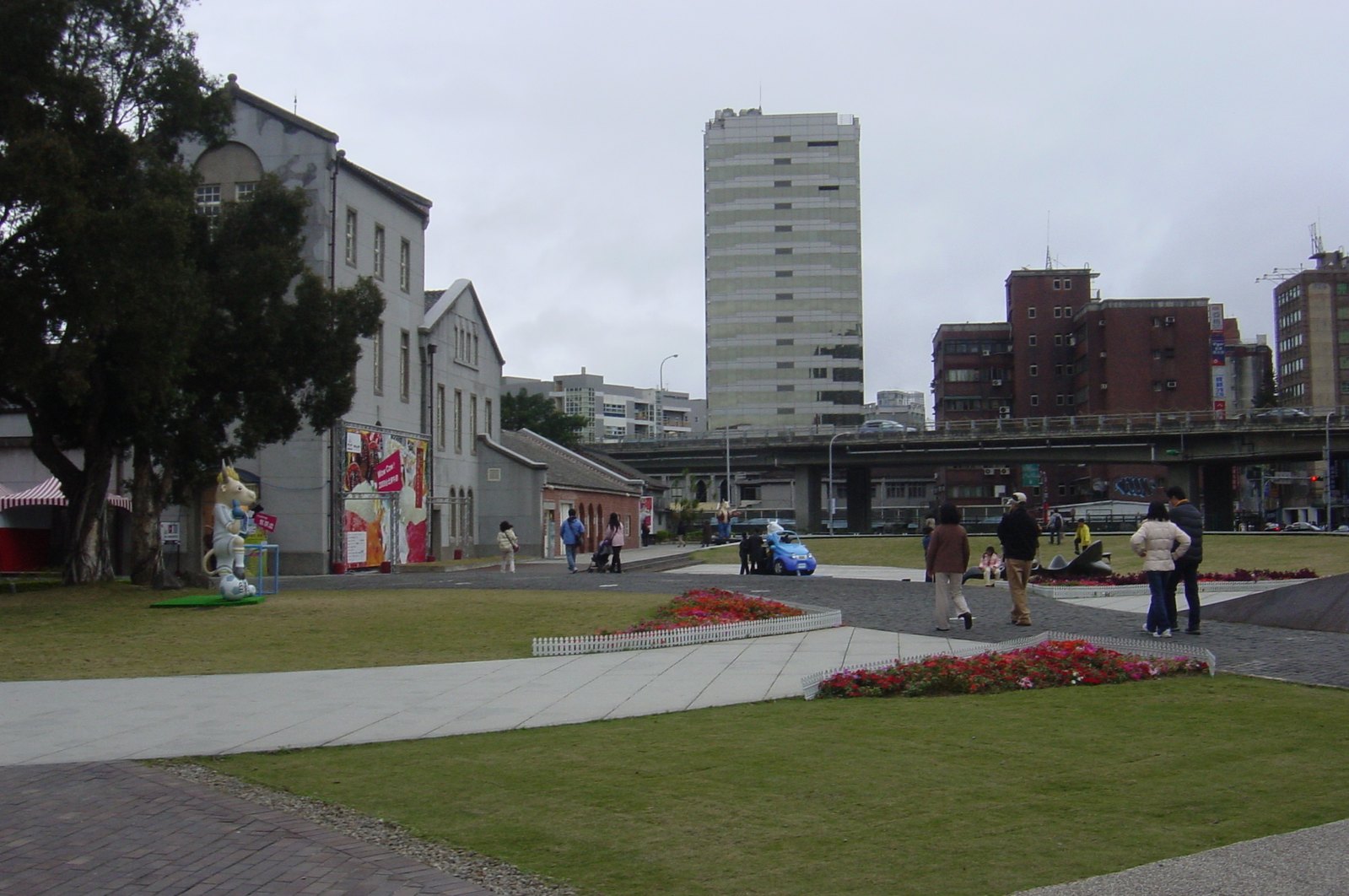
The selected real reference dates to January 2009. It shows low pale industrial buildings along the left edge, paths and lawn in front, and a taller modern building behind. People use the open ground between them. The wider frame makes Huashan’s place within a larger city visible.
The historical view places the low industrial buildings against a much taller city. It records one stage in the campus’s changing surroundings; the landscaping and visitor layout may have changed since then.
Taipei’s city tourism page describes the former winery’s current role as a venue for exhibitions and performances. Our suggestion is to keep that living use at the center of the visit. Read a building label, see something happening inside and return to the map. The old factory becomes a set of relationships rather than a decorative style.
Follow the thread
Tomioka Silk Mill follows a different production chain through cocoon storage, reeling machinery and the people who learned and operated the process.
At Oil Tank Culture Park, the individual tanks likewise need separate names and histories to explain what was preserved, opened or rebuilt.
The reference photograph