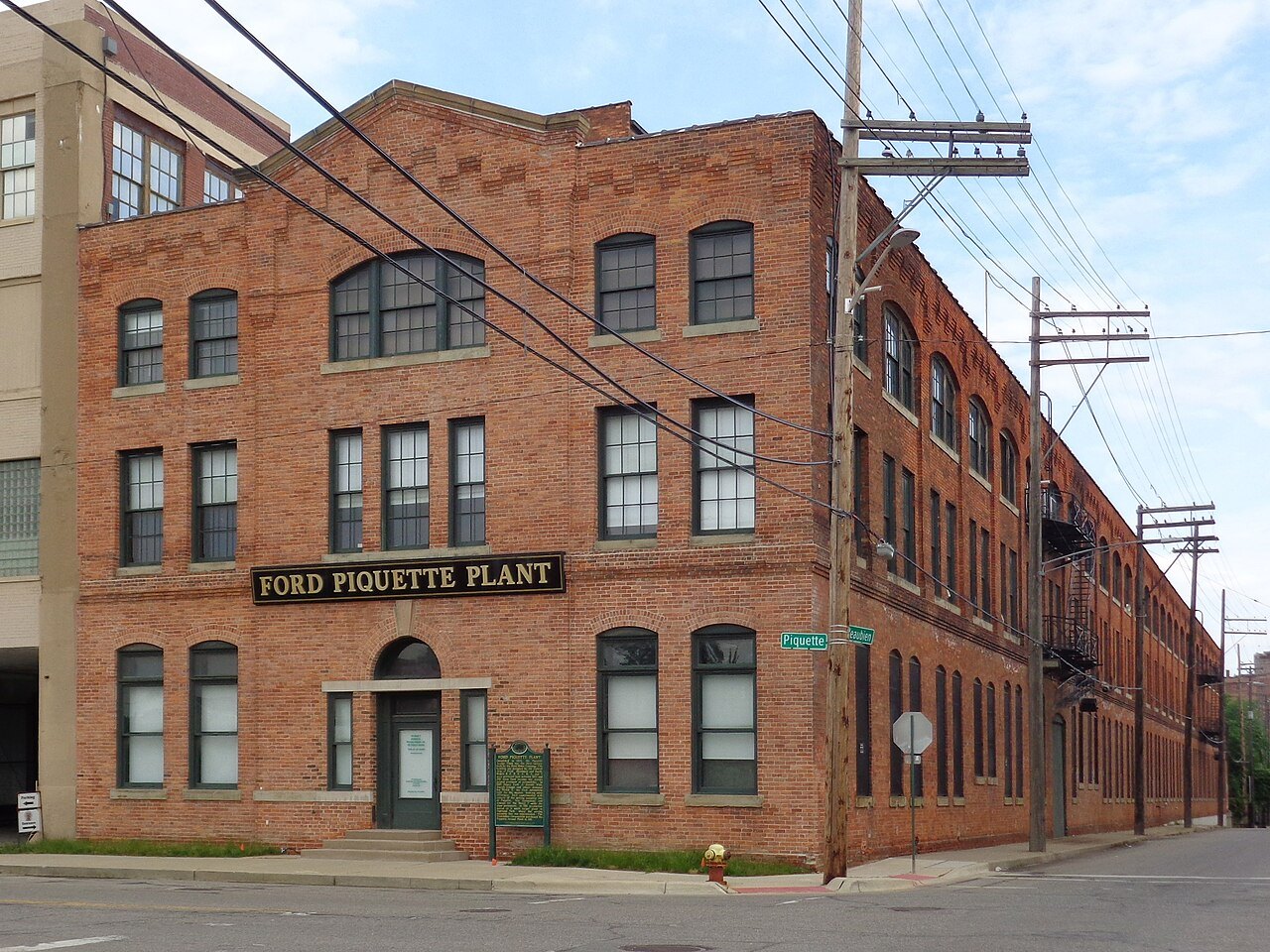
The windows repeat down a long red-brick wall. At the corner, the front is only a few bays wide; turn the building in your mind and it becomes a very different shape. The Ford Piquette Avenue Plant in Detroit was narrow, deep and built around the needs of an early car factory. Its importance is easier to understand once it is separated from Ford’s later moving assembly line.
The Model T was developed and first produced here. Ford moved production to Highland Park in 1910, where the later manufacturing story unfolded. Piquette now operates as a museum in the surviving factory. Museum history.
Plan for the present building
The museum’s visitor page lists regular hours of 10 a.m.–4 p.m. Wednesday–Sunday, with optional public tours at 10 a.m., noon and 2 p.m. The address is 461 Piquette Avenue, Detroit. The visitor entrance is in the west-side courtyard, with the ticket office upstairs; visitors needing the elevator are instructed to contact the museum. Official visitor information.
Use that courtyard instruction rather than assuming the front doorway in an architectural photograph is the public entrance. The operator also identifies parking across Piquette Avenue and an approach from the QLINE’s Amsterdam stop; this research did not verify current service or departure times.
One current-condition qualification matters. WDIV reported storm damage to the facade on September 2, 2026, quoting the museum’s president. That report does not establish the state of repairs in October. The photograph accompanying this story is from 2017 and must not be mistaken for a current condition survey. Dated local reporting.
Admission prices differed between the live HTML and the search-cached version of the visitor page during research. The price is therefore left unresolved here; use the current ticket offer before making a purchase.
A factory with daylight on both sides
The Detroit Historical Society describes a three-story, New England mill-style building designed by Field, Hinchman & Smith. Its long, narrow form and many windows brought in daylight and ventilation. Timber columns and beams supported the interior, while firewalls and a sprinkler system addressed the risk of fire. Building record.
That history gives a straightforward purpose to the repeated windows. They are part of the working design, not just an attractive backdrop for cars. From outside, compare the short front with the extended side. The facade gives an impression of solidity; the window rhythm reveals the effort to make a deep industrial building usable.
The source photograph also contains utility wires, street signs and a neighboring building. Those ordinary details help locate the factory in a city. Removing them from every illustration would make the architecture tidier while making its setting less informative.
Development happened here; the process kept changing
The museum’s history traces several early Ford models through Piquette and identifies a small experimental room associated with development of the Model T. It then follows production to Highland Park. This is the birthplace of a car, within a longer sequence of changes to how cars were manufactured. Models and development.
The distinction makes a museum visit more useful. Look at a vehicle as a set of components that had to reach one place and be assembled. Then look at the factory around it. Where was there room to work, move a part or bring in another machine? Labels and guides can distinguish a documented historical arrangement from a later display.
Avoid turning every open stretch of floor into the site of a famous invention. A preserved factory contains evidence, but its present arrangement has also been shaped by museum work and later occupants. The question is what a particular object or room can actually demonstrate.
The building continued after Ford
Ford sold Piquette to Studebaker in 1911. Other businesses followed before the preservation organization acquired the building in 2000. The Detroit Historical Society records that sequence, which is easy to miss when the Ford name dominates the facade. Later uses.
Historic Detroit’s account also follows the building through those later industrial uses and into preservation. Its more recent addition about storm damage is a reminder that keeping a factory as a museum does not freeze its physical condition. Building and preservation history.
Look at the frame as well as the collection
The museum’s own account describes a collection of early vehicles, photographs, films and original artifacts. The cars provide an obvious focus, but the factory is an exhibit at a different scale. Museum overview.
On a visit, compare one car with the room that holds it: the spacing of columns, the window light, the distances a part would have traveled. That is an editorial way to read the site, not a reconstruction of a particular shift. It keeps attention on the relationship between a manufactured object and the place that made it possible.
Piquette’s most revealing feature may be how unlike the popular image of an endless assembly line it looks. The difference is part of the history.
Checked October 16, 2026. Desk research and a 2017 photograph; no personal visit. Current repair status, admission price and selected-date access remain unresolved.
Follow the thread
Michigan Central Station tells another Detroit preservation story through a restored passenger building whose new campus use differs from its original function.
Sloss Furnaces moves from the finished vehicle to ironmaking, where furnaces, pipes and maintenance routes expose another scale of industrial work.
The reference photograph