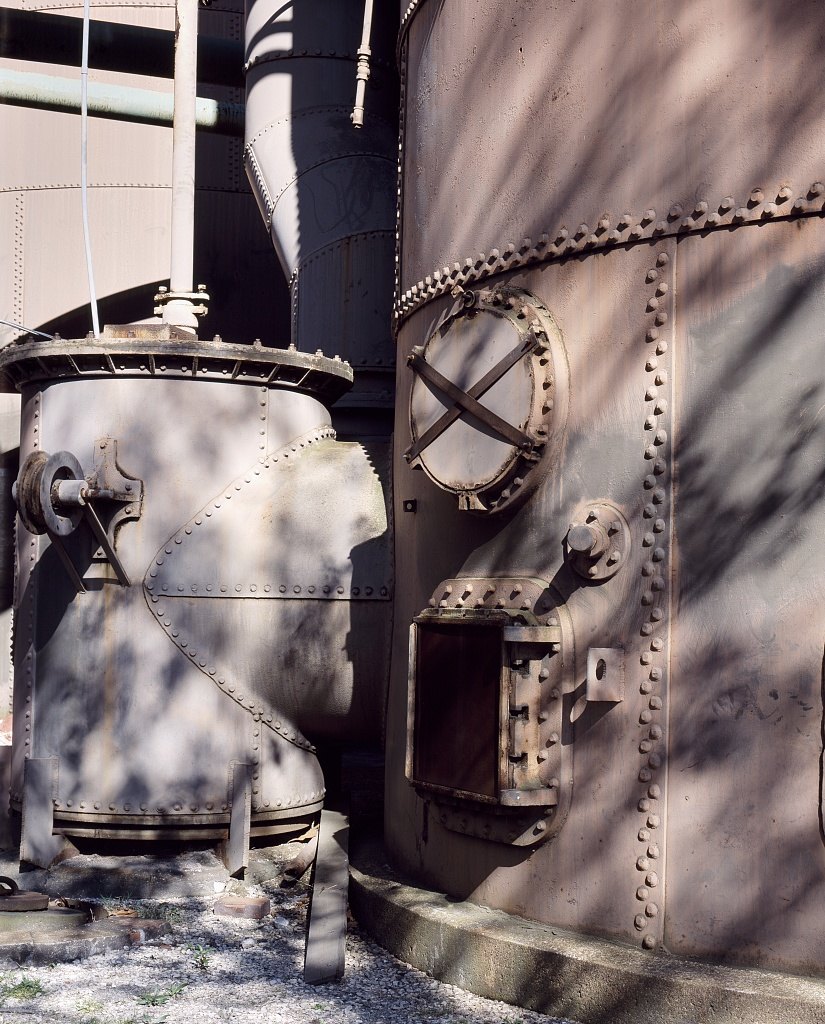
The round hatch is held shut by two crossed bars. Around it, rows of rivets follow the curve of a metal cylinder; a smaller rectangular opening sits near the ground. In Carol M. Highsmith’s photograph of Sloss Furnaces, the industrial skyline has become a set of things someone had to inspect, fasten and maintain. It’s a useful way into this former ironworks in Birmingham, Alabama: start with one fitting, then follow the machinery outward.
Sloss is now a historic site with a free self-guided visit and separately bookable guided tours. The interest lies in understanding how the parts worked together, and whose work kept them running. Plan a visit.
A short plan for the site
The operator lists self-guided opening hours of 10 a.m.–4 p.m. Tuesday–Saturday and noon–4 p.m. Sunday. Public guided tours are advertised Tuesday–Saturday at 10:30 a.m. and 2 p.m., for a fee through the booking link. Those are different arrangements; a free walk doesn’t reserve a guide. Hours and product descriptions were checked October 16, 2026. Night tours follow the event calendar rather than a nightly schedule. Official visitor information.
The address is 20 32nd Street North, Birmingham. Start at the visitor facilities to pick up the self-guided material and establish which portions of the route are available that day. An industrial photograph can include an impressive staircase without promising that the public may climb it. Official contact and directions.
The name contains a small trap
The company became Sloss-Sheffield Steel and Iron, but this complex produced pig iron rather than steel. Pig iron is an intermediate product sent onward for further manufacture; the distinction explains why a place associated with Birmingham’s steel economy contains this particular collection of furnaces and casting equipment. The site’s own history identifies iron ore, coal and limestone close to Birmingham as the foundation of the industry. Sloss history.
That gives the pipes a more legible purpose. Instead of trying to memorize every vessel, use the interpretation to trace three movements: materials arriving, air reaching the furnace, and molten material leaving it. Ask where each movement crosses another. The most useful photograph may be the one that includes an awkward connection rather than the cleanest silhouette.
The Mining History Association’s account of its 2022 visit explains the sequence from storage hoppers to measured charges, skips that carried material upward, and casting below. It also identifies the hot-blast stoves as the equipment used to heat the incoming air. Its dated photographs are helpful for reading the process, although they don’t establish today’s visitor route. Documented process and photographs.
Look closer: a surface built in pieces
In the selected historical photograph, the seams are as striking as the cylinders. Several separate curves meet in the left-hand vessel; the large cylinder on the right has a broad vertical band of fasteners. Diagonal shadows cross both. These are visible features of this particular image, not evidence that every object still looks exactly the same.
Try following a single line of rivets until it reaches a hatch, pipe or edge. That small exercise changes the scale of the picture. A giant industrial object becomes something assembled from sections, with joints that had to remain usable. The photograph alone cannot identify the function of every opening, so leave that question to the site’s labels or a guide rather than assigning a technical name from appearance.
The workforce belongs in the frame
The machinery can dominate an account of Sloss, but the operator’s history also documents racial segregation in jobs and daily facilities. It places convict leasing in the company’s coal mines, a distinction worth preserving when talking about the furnace site. The production landscape extended beyond the surviving structures. Work and segregation.
The Encyclopedia of Alabama adds the commercial context: foundry iron served manufacturers making such things as pipes, fittings and engine components. A furnace was one part of a much larger system of extraction, transport, labor and customers. Industrial context.
Keeping that wider system in mind prevents the surviving plant from becoming merely an attractive arrangement of rust. Ask whose tasks a machine reduced, whose tasks it made possible, and whose names appear in the interpretation. These questions are more revealing than an unsupported claim about how dangerous a particular walkway once was.
Metal has a present tense here
Sloss also supports a metal arts program, with classes, workshops and artists working with casting. A demonstration or workshop is its own scheduled activity, rather than something included in every ordinary visit. Metal arts program.
That reuse suits the place unusually well. The material is still something people work with, although the purpose has changed. Leave with one connection you can explain—a joint, a movement of material, a piece of equipment—and the skyline will have gained more than a caption.
Visitor information checked October 16, 2026. Desk research and historical image review; no personal visit. Current route restrictions, individual tour prices and trip-date availability remain unverified.
Follow the thread
At Carrie Blast Furnaces, surviving ironmaking structures and guided interpretation offer another way to follow the connections between furnaces, maintenance routes and workers.
SteelStacks places a pedestrian walkway and cultural campus beside blast furnaces, making the boundary between industrial remains and new public use visible.
The reference photograph