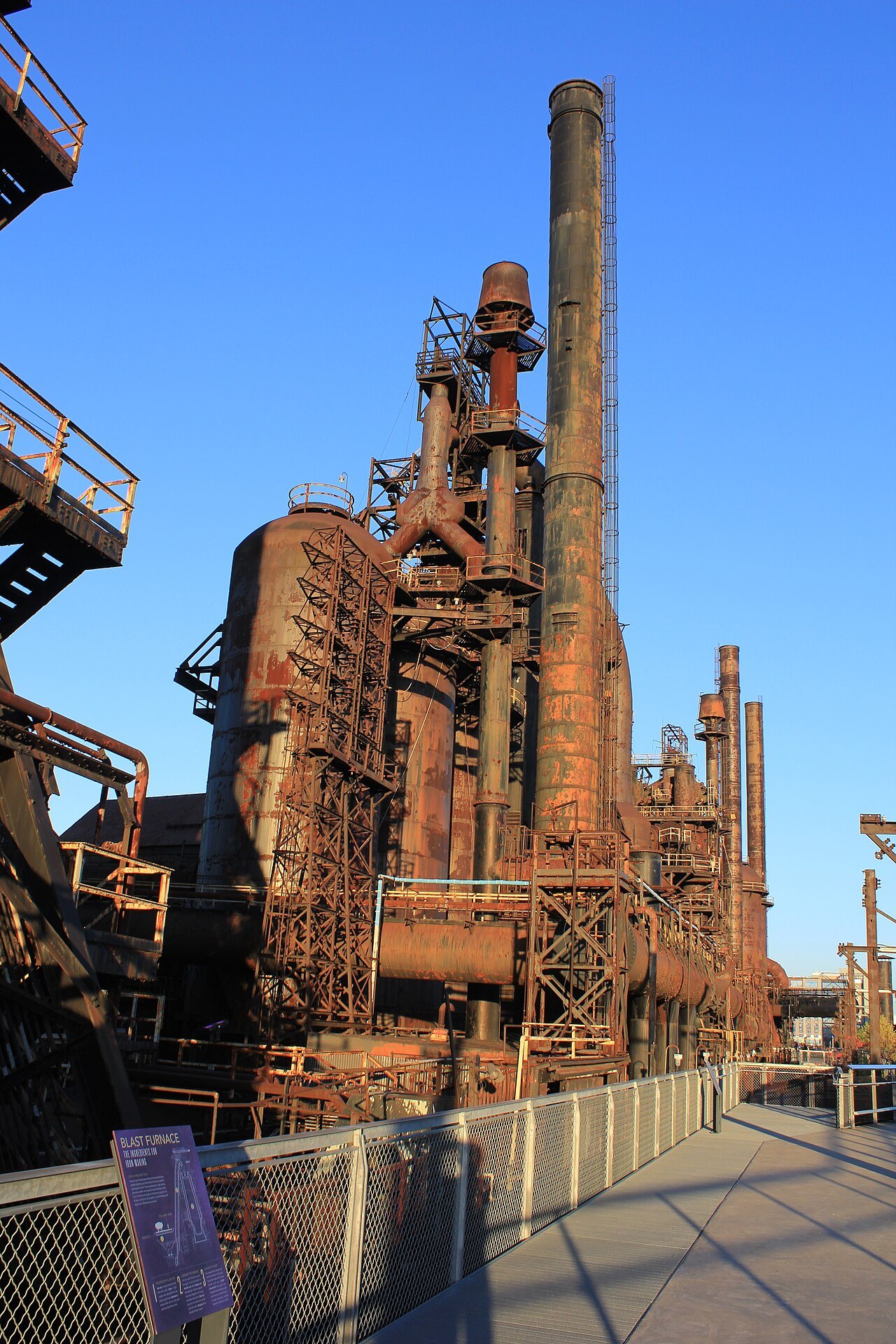
The walkway has a mesh railing. Immediately beyond it rise pipes, ladders, steel frames and a chimney tall enough to pull the eye out of the photograph. At SteelStacks in Bethlehem, Pennsylvania, the contrast is the point: a route made for today’s visitors runs beside equipment built for a very different kind of movement.
ArtsQuest describes SteelStacks as a ten-acre arts and events campus on the former Bethlehem Steel site, in the city’s SouthSide. You can come for a performance, but the industrial setting is worth reading in its own right. The useful distinction is between the campus, the Hoover-Mason Trestle walkway, and individual ticketed events. SteelStacks overview.
Three choices that can share an afternoon
For an architectural visit, begin with the Hoover-Mason Trestle, the pedestrian route beside the blast furnaces. ArtsQuest lists regular hours of 10 a.m.–8 p.m. Sunday–Wednesday and 10 a.m.–9 p.m. Thursday–Saturday. It also states that weather, lightning, high winds, heavy rain and special events can close the walkway. These are operating conditions checked October 16, 2026, rather than a promise for a particular evening. Trestle access.
For a concert, film or festival, use the listing for that event. A ticket to a show does not establish the opening hours of the trestle, and a walk beside the furnaces does not include entry to every performance. ArtsQuest’s campus page links to the current calendar. What’s on.
For help on arrival, the visitor center is at 711 East First Street. ArtsQuest lists it separately from the ArtsQuest Center and warns that programming can affect its opening. Keeping the building name with the address is more useful than dropping a single pin labeled “SteelStacks.” Visitor center details.
The walkway changes the scale
ArtsQuest dates the trestle’s opening to June 25, 2015, and identifies access at the visitor-center end and near the Gas Blowing Engine House. That is a contemporary public route alongside industrial structures, not permission to wander through all the machinery. Route description.
In the selected 2022 photograph, the route occupies the bottom right of the frame. Its clean surface and regular railing are easy to follow. The equipment beside it is far harder to untangle: horizontal pipes meet vertical cylinders, platforms interrupt the outline, and the next set of stacks recedes into the distance.
Look at the two systems separately. One organizes a visitor’s movement and distance from the remains. The other records the connections once needed by production. The route lets you study the second system without having to pretend you are walking the path of a steelworker’s shift.
Read the connections before the skyline
A wide view makes the furnaces a recognizable silhouette. A closer view makes them harder to simplify. The source photograph shows several types of structure in the same space: massive cylinders, thin ladders, diagonal bracing and platforms supported at different heights.
Choose one connection and follow it until it disappears behind another object. Then look at the interpretation nearby. Is the visible piece named? Is its role explained? If the label answers a different question from the one you started with, that is useful too; it may reveal that the most conspicuous object was only one part of the process.
The photograph does not establish that any particular ladder, platform or doorway is open today. It is strongest as a record of relationships: large beside small, vertical beside horizontal, repeated machinery beside a new pedestrian edge.
A cultural campus is an ongoing use
The present program includes indoor and outdoor performance spaces, films and community events. Discover Lehigh Valley’s overview identifies the ArtsQuest Center and Levitt Pavilion as different parts of the campus. Their schedules and ticket arrangements should be read separately. Campus orientation.
That variety gives the place more than one rhythm. A quiet walk favors the machinery and its interpretation. An event brings people together in front of the same structures. Neither experience, by itself, proves that all of the social and environmental consequences of industrial closure have been resolved. The site’s current use is a chapter in that history, not a summary of the whole city.
Historic Bethlehem Museums & Sites also treats the trestle as a place visitors can explore without joining one of its tours. Its wider program offers a route into Bethlehem’s history beyond the former steelworks. Local heritage options.
Leave room for two kinds of attention
If you are attending a timed event, our suggestion is to see the trestle beforehand, while its hours and the weather allow. Keep that walk separate from the performance’s arrival requirements; no fixed walking duration is asserted here.
The photograph’s mesh fence is a modest detail beside a blast furnace, but it explains the site’s new role. It makes a place to stand, look and understand something that was once organized around continuous work.
Information checked October 16, 2026. Desk research and a 2022 photograph; no personal visit. Event prices, selected-date availability, transit and individual access requirements remain to be confirmed.
Follow the thread
Carrie Blast Furnaces gives another preserved ironmaking site a different visitor format through guided industrial interpretation and art programs.
At Sloss Furnaces, historic ironmaking equipment shares its present with metal arts, keeping both the industrial process and later uses in view.
The reference photograph