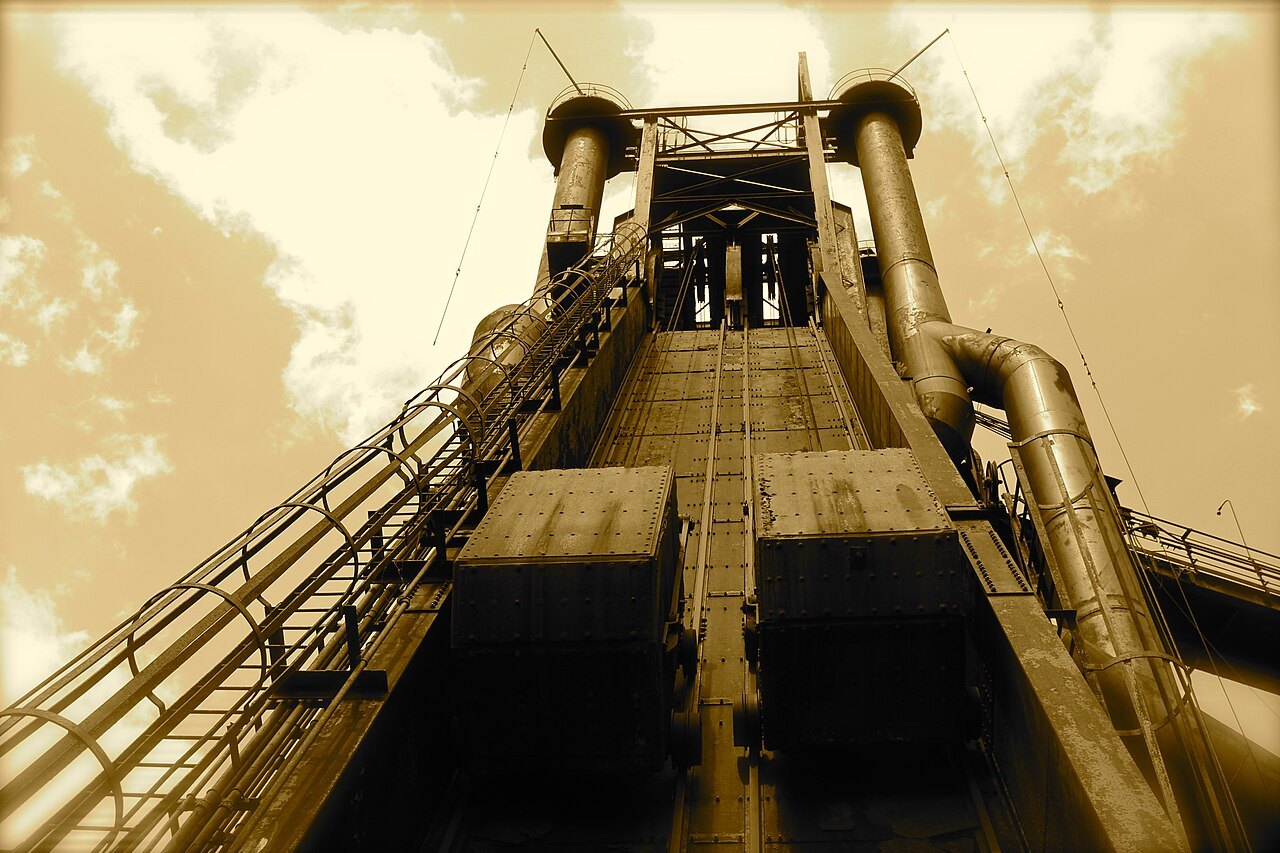
The ladder runs almost the full height of the photograph. Beside it are sloping panels, enormous round ducts and platforms that make the structure look less like a building than a machine with room for people inside it. Roy Luck’s 2013 view of the Carrie Blast Furnaces is a reminder that industrial scale depends on something quite small: a person reaching the place where a task has to be done.
Carrie, near Pittsburgh in Pennsylvania’s Monongahela Valley, was part of the Homestead Steel Works. Its furnaces made iron within that larger steelmaking system. Today the preserved site supports guided interpretation and art programs through Rivers of Steel. National Park Service account.
Choose the industrial story first
For a visit centered on the machinery and workers, the Industrial Tour is the relevant starting point. Visit Pittsburgh distinguishes it from the Arts & Grounds Tour and the botanist-led Iron Garden Walk. Those names describe different approaches to the same landscape; they are not interchangeable tickets with a guaranteed common route. Local tour overview.
Open the operator’s Industrial Tour page for the date you want. That page could not be read reliably during this research, so current prices, duration, age limits, meeting instructions and accessibility conditions are not reproduced here. An inaccessible booking page is not evidence that a tour has sold out.
Visit Pittsburgh’s history itinerary treats Carrie as a seasonal, advance-booked excursion outside central Pittsburgh. Arrange the outward and return journey around the actual confirmation, rather than assuming it works like an open city park. Planning context.
A steelworks contains more than steelmaking
The name Homestead Steel Works can blur the distinction between a whole industrial complex and an individual process. At Carrie, the surviving blast-furnace equipment belongs to the ironmaking stage. The National Park Service places the site within the wider industrial landscape and describes the subsequent work of Rivers of Steel. Industrial heritage and art.
That distinction offers a useful question for a guide: where did the product go next? A furnace photograph usually ends at the edge of the equipment. The working system continued beyond the frame, connecting raw materials, transportation, other facilities and the people who moved between them.
When examining the machinery, resist the temptation to identify every pipe from its size. Follow a labeled part of the process instead. The difference between knowing that an object is large and knowing why it had to connect to another object is the difference between scenery and an industrial explanation.
Look closer: the human scale is at the edge
The 2013 source photograph looks upward along a central structure with riveted panels. A caged ladder climbs the left side; narrow platforms and railings appear at several heights. On the right, a large duct bends away from the main assembly. The photograph has a strong warm color treatment, so its hue should not be read as the exact color of every surface.
The ladder is the useful comparison. It makes the equipment’s size legible without adding a person for scale. It also shows how much of the machine was designed to be reached, monitored or serviced. Exactly which task belonged to each platform requires interpretation; the picture cannot answer that on its own.
Keep the visitor route distinct from those historical working routes. A maintenance ladder is part of the story even when it is not part of the tour.
A deer assembled from the remains
Carrie’s later history includes a large deer-head sculpture made from material found on the property. The National Park Service dates its creation to 1997 and describes a group of artists assembling it between Furnaces 6 and 7, when their presence was unauthorized. Community efforts later supported its preservation. The Carrie Deer’s history.
The sculpture changes the way the remains can be read. Tubing and wire that once belonged to production become a recognizable animal. That transformation is specific to this site and its material; it is not simply a new object installed in front of an old building. Its history also does not grant visitors permission to enter restricted areas or alter the site.
Art can carry a worker’s story
An account of Alloy Pittsburgh describes Patrick Camut’s 2015 sculpture Stan: a composition balancing coal against a union coffee cup, made in honor of his steelworker grandfather. Other projects used performance, film and temporary installations. These are documented examples from the program’s history, not a list of works guaranteed to be on view now. NPS account of Alloy Pittsburgh.
The coffee cup provides a different scale from the ladder. One shows where a body fitted into the machinery; the other points toward the daily life around a shift. Between them, Carrie becomes more than the remains of a production process. It becomes a place where that process can be connected back to people.
Sources checked October 16, 2026. Desk research and a historical photograph; no personal visit. Current operator logistics remain unresolved, so this is a place story with a booking pathway rather than a fully verified visit guide.
Follow the thread
Sloss Furnaces makes another ironworks readable through its fittings, connected machinery and the labor required to maintain it.
SteelStacks gives blast furnaces a cultural campus and pedestrian edge, offering a different public relationship with the same industry.
The reference photograph