The former tobacco factory in Donostia / San Sebastián holds a cultural center, public spaces and the memory of the women who worked there.
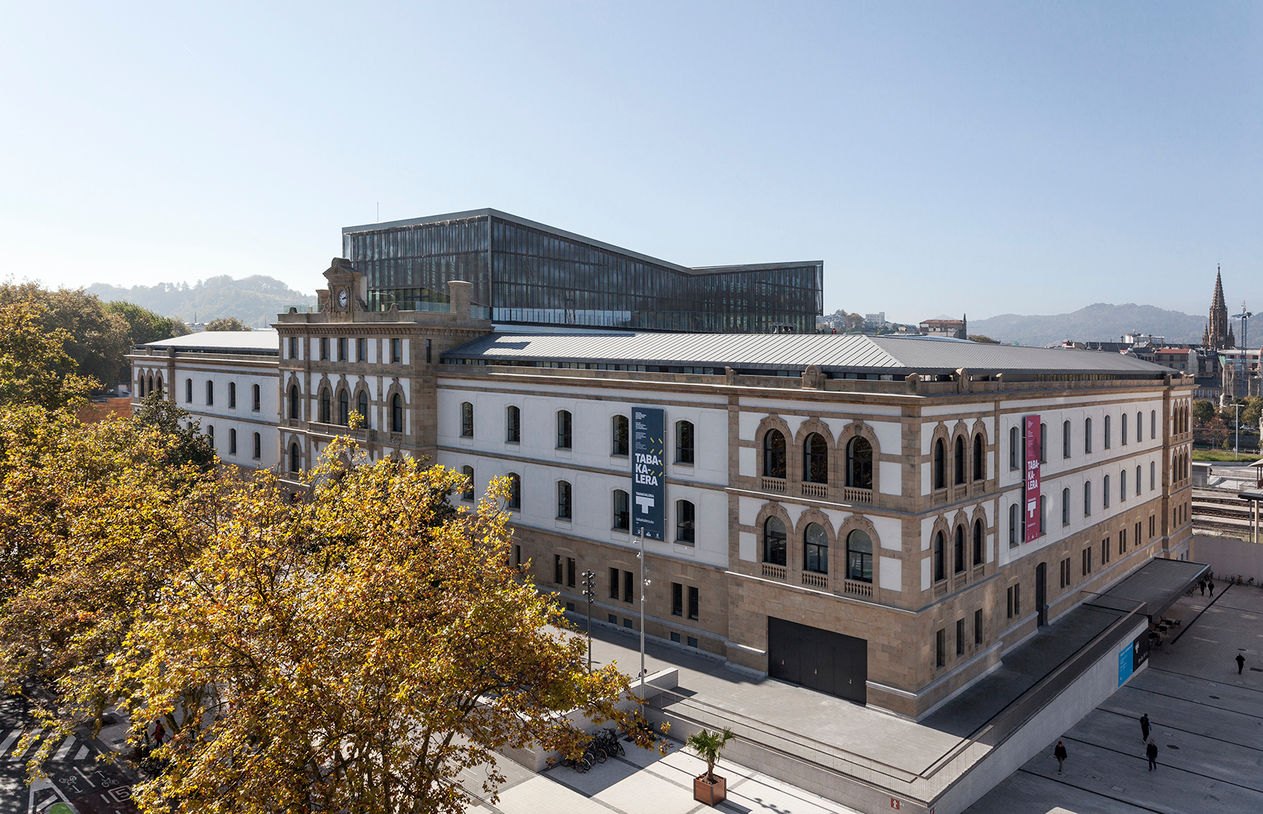
A dark glass addition rises above Tabakalera's long pale facade in Donostia / San Sebastián. The older building's repeated windows and central clock remain visible below it. From outside, the former tobacco factory shows two different moments without trying to make them look identical.
Inside, its cultural life includes exhibitions, cinema, production and shared spaces. The conversion also poses a less visible question: what should happen to the memories of a factory's workers when the building becomes a destination for a new public? Tabakalera has addressed that question through projects involving former employees, rather than leaving the history entirely to the architecture.
Visiting the building
The official destination listing gives Andre zigarrogileen plaza / Plaza de las Cigarreras 1, 20012 Donostia / San Sebastián as the address. The operator's access page identifies rail, bus and bicycle approaches around the building. Choose your arrival station and final walking route using a current transport plan; no journey time is promised here.
The opening-times page separates the building, exhibition halls, Medialab and other services. Its detailed hour values weren't readable in the retrieved page, so this article doesn't supply a universal schedule. Cinema screenings, registered activities and general circulation are different reasons to enter.
If the terrace is your priority, confirm that specific area's access for the date and weather. A building description or venue-hire listing isn't a promise that an upper room or terrace is open to casual visitors.
An industrial building with a public interior
The city's convention bureau dates the tobacco factory's closure to 2003 and its reopening as a contemporary cultural center to 2015. The operator's building page sets images of its earlier use alongside those of the refurbishment.
The exterior provides an immediate comparison. In the 2016 reference photograph, the pale facade retains a regular composition, while the upper addition establishes a visibly different layer. Tree canopies and surrounding streets make the scale easier to judge: this was a substantial urban workplace, not a small industrial object left at the edge of town.
Tabakalera combines public circulation with specialized rooms and working areas. Its open spaces connect activities with different audiences and access conditions.
The workers belong in the story
The official tourism board's women's-history route identifies the importance of women in the tobacco workforce and dates the Egia factory's opening to 1913. That labor history deserves more than a passing sentence about what the building used to make.
Tabakalera's own archive records Mañana Goodbye, a project developed with former women workers, and a related series of historical visits. The archived “History, memory and work” entry connects architecture, workers' memories and the new uses introduced by remodeling. The listed visits ran in 2016–2017; they aren't an advertised current tour.
The distinction matters because a building can survive while the knowledge of its daily life becomes harder to find. A window grid tells you about the physical arrangement. Workers' accounts can address relationships, routines and meanings that aren't visible in a facade. The two kinds of evidence answer different questions.
A cultural center still making things
The current operator site includes a creation library and laboratory, cinema and audiovisual activity, and resources for artists and creators. Those functions broaden the conversion beyond a building where completed art is displayed. Some of its work is meant to happen before there is a finished public object to see.
A film or exhibition gives a visit a destination within that larger working institution.
The terrace and glass upper structure are prominent additions, but the more consequential change may be how the building lets different groups use it. The former factory now accommodates people arriving for culture, people making it and people simply passing through its public spaces. The old workforce's history keeps that openness connected to a specific place, rather than an interchangeable industrial shell.
Follow the thread
La Friche la Belle de Mai offers another tobacco factory's cultural afterlife, spread across studios, courtyards, exhibition spaces and a roof terrace.
Le Lieu Unique preserves a biscuit factory's advertising tower, showing another way an industrial identity can remain visible after production ends.
Sources and reporting
Researched October 16, 2026, from the linked sources. This is desk reporting; no firsthand visit is claimed.
- Tabakalera destination listing
- Building
- Getting here
- Contact and opening times
- City convention bureau overview
- Official womens-history route
- History,memory and work archive
The reference photograph