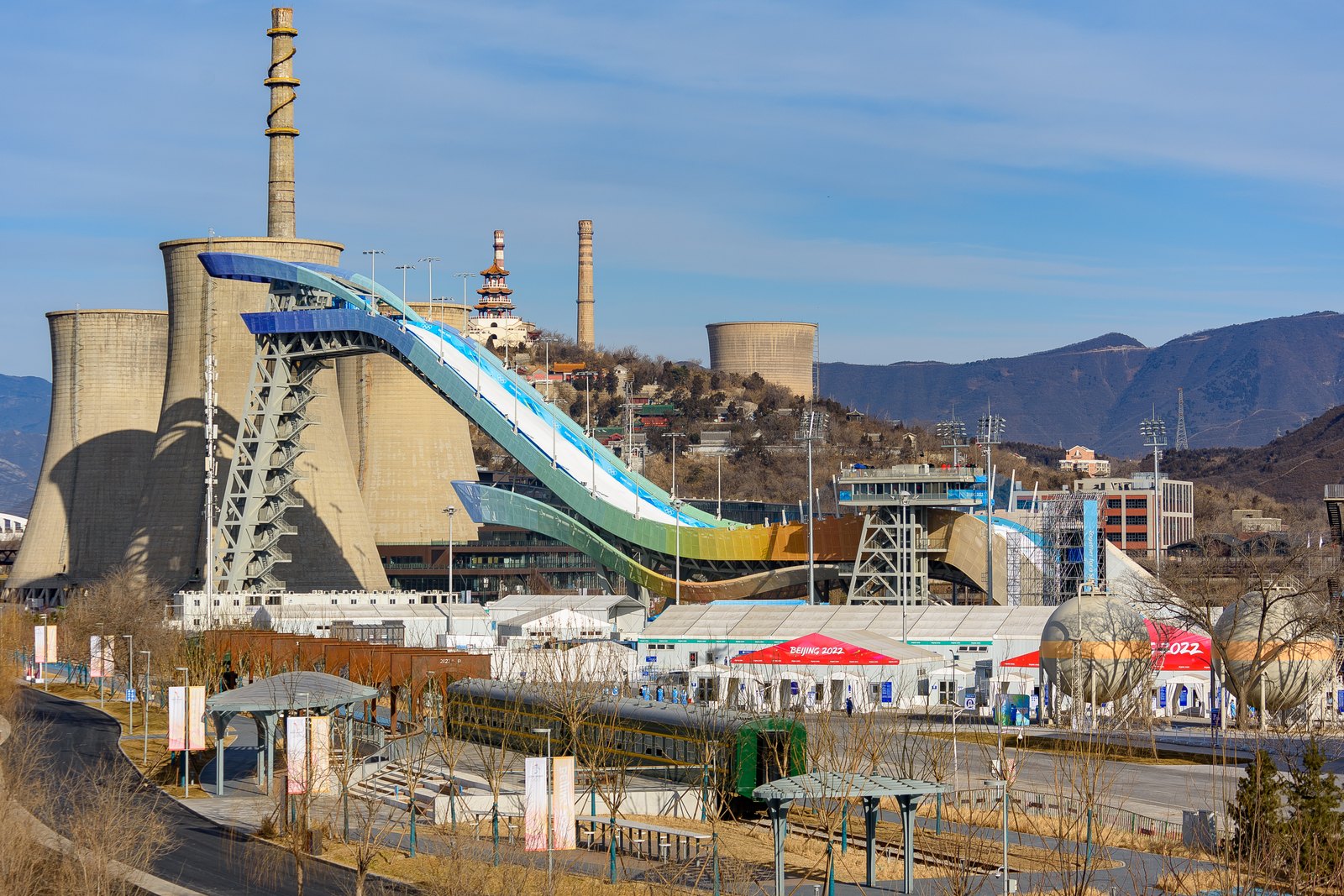
The towers behind Beijing’s Big Air ski jump belong to an old power plant. Their curved concrete shells are cooling towers, not blast furnaces, and they are not evidence of a former nuclear station. That distinction is a useful place to begin at Shougang Park: the most recognizable photograph does not show every part of the steelworks story.
Shougang’s industrial landscape now contains walking routes, cultural venues and sports facilities. A good visit means choosing among these uses. The park landscape, an elevated path and a ticketed furnace attraction have different access arrangements; one open gate does not establish access to every structure beyond it.
Start by naming what you see
The photograph accompanying this story shows the blue Big Air slope, cooling towers and mountains beyond. New sports infrastructure shares a setting with older industrial forms. No. 3 Blast Furnace is a different structure elsewhere in the park.
Look at how the slope passes beside the towers. The contrast comes from actual structures sharing a setting, rather than from an isolated industrial monument placed on a pedestal. There is enough information in that relationship without adding a story about a function the towers never had.
Beijing’s 2024 transformation account distinguishes the old power plant, the steelmaking structures and new visitor routes. It also describes former coal workshops converted for winter sports and an industrial pipeline reused as a skywalk. These are separate adaptations with separate original jobs.
That gives you a practical way to read the site: identify a structure’s former function, then look for what its present use required designers to change. Avoid assuming that every tall object made steel directly or that every old industrial interior is now a museum.
A furnace’s second ignition
No. 3 Blast Furnace has its own more recent chapter. A city report published in December 2025 describes the opening of the RE Blast Furnace No. 3 Digital Museum. Its digital “reignition” was a cultural event, not a restart of steel production. The report places the furnace’s shutdown in December 2010.
The distinction matters because a dramatic word can flatten an industrial transition. A digital presentation can explain steelmaking and draw visitors into a large structure; it is a different activity from operating that structure as a furnace.
Read the museum as interpretation built around industrial remains. Look for where a surviving surface ends and a contemporary screen, walkway or visitor installation begins. Both may be interesting, but they provide different kinds of evidence about the past.
The city report establishes the museum’s new use. It does not provide a verified ticket price or a complete current booking procedure. Those details should come from the attraction’s selected-date sales information before you plan a visit around an interior experience.
Choose a section of the greenway
The city’s June 2026 greenway guide, checked October 16, lists elevated, lakeside and hillside sections totaling 10.7 kilometers. Think of it as a menu. Choose the relationship you want to study before choosing the distance you want to cover.
Start with the part that matches your interest. The elevated section offers a different relationship with the industrial structures; the lakeside route gives a broader landscape view. Adding the hillside walk makes a more substantial outing. We have not measured a complete route or assigned a universal visit time.
The guide lists lakeside hours as 24 hours and elevated hours as 7 a.m.–7 p.m.; these apply to sections, not every venue. Put the fixed appointment first when planning. A museum reservation can determine where a walk begins, while the open landscape leaves more room to improvise afterward.
The same guide makes furnace-top access ticketed and describes a café package with a height restriction whose scope we could not establish. Check the exact product for your party. A rule attached to one elevated attraction should not quietly become a rule about walking beside a lake.
Keep the attractions separate
A March 2026 city itinerary helps show how many activities now share the site. It names the No. 3 museum and the SoReal attraction at No. 1 as distinct stops. Its suggested timetable belongs to an itinerary around a particular convention, not a statement of ordinary park hours.
Choose one booked attraction and build the walk around it. Confirm its entrance, availability and requirements for your party, including any identification or foreign-visitor booking steps. Our source check did not complete a foreign-passport purchase, so that process remains unverified.
The guide names Xinshougang (Line 11) for the south gate and Jin’anqiao (Line 6) for the north. Select the gate for your section; the park’s name alone is too broad a destination.
At Shougang, the useful question is what each structure does now, alongside what it once did. Carry that question from the cooling towers to the walkway and into whichever venue you book. The connections become clearer when the names and access boundaries stay precise.
Follow the thread
Völklinger Hütte keeps an ironmaking complex readable as a connected system, offering a useful comparison with Shougang's mix of new routes and venues.
Oil Tank Culture Park also turns restricted industrial infrastructure into a cultural landscape, with outdoor access remaining distinct from individual interior programs.
The reference photograph