Vojin Bakić’s memorial rises from a wooded Croatian landscape in curved metallic forms. Its damaged surface carries a history that an “abandoned spaceship” caption cannot explain.
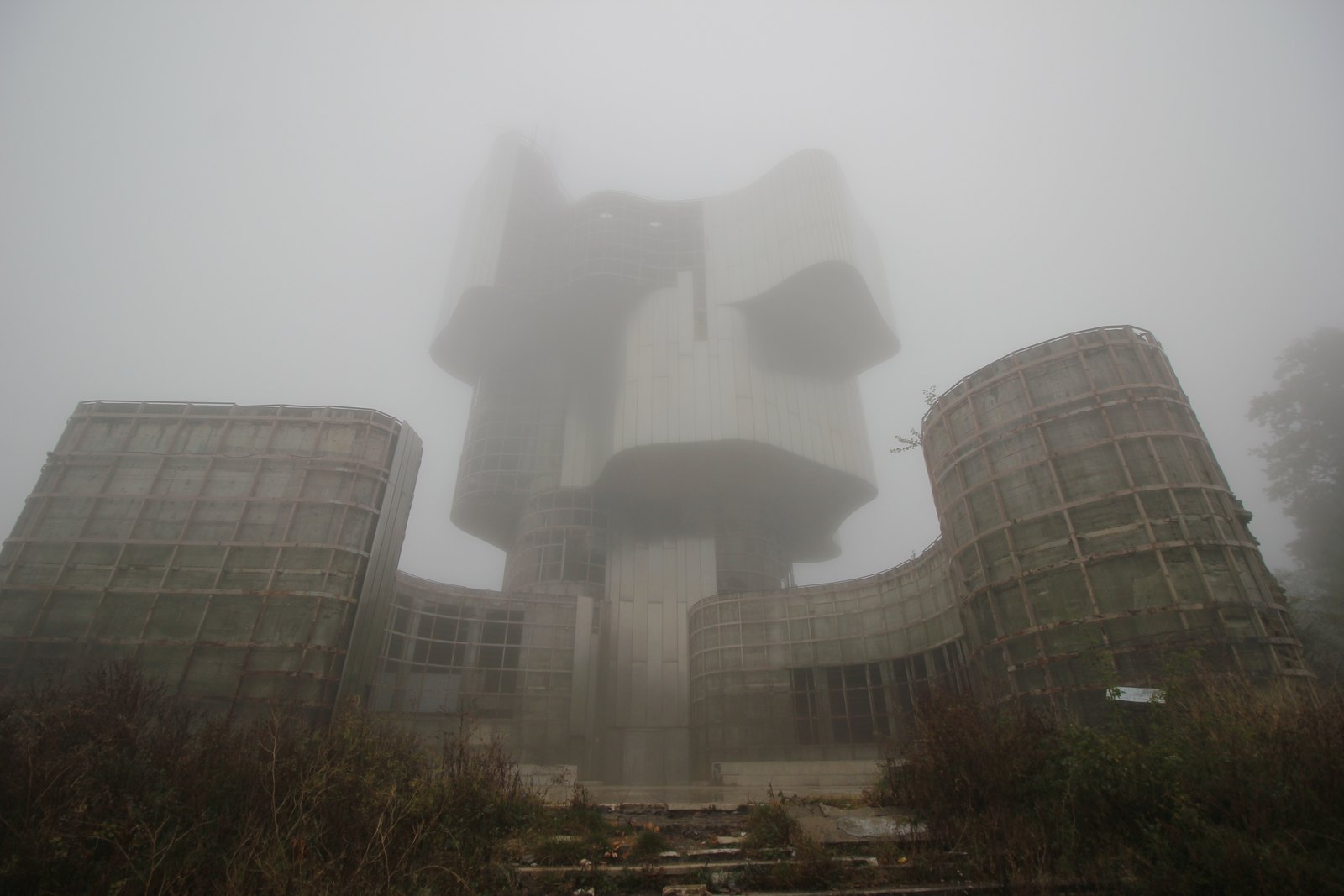
In the documentary photograph used here, the Petrova Gora monument emerges through fog. Its curved surfaces are interrupted by missing panels; low wings spread around a taller central mass. The image was taken in October 2020. It shows a particular stage of damage, not a current survey of the building.
The memorial stands in Croatia's Petrova Gora landscape and commemorates the Second World War uprising and its victims. Its sculptor, Vojin Bakić, made a work that occupies the territory between sculpture and architecture. Treating it simply as an abandoned futuristic object discards the reason it was built.
A memorial with a specific subject
The Vojnić tourism board places the monument within a forested region containing several historical sites. Its description connects the memorial to fighters and victims of the Second World War and also identifies the area's Central Partisan Hospital. The monument is part of a larger landscape of memory.
A municipal planning document identifies Bakić's 1981 monument by its dedication to the uprising of the people of Banija and Kordun. Those names matter. They anchor an abstract form in communities and events that are otherwise easy to lose in a photograph.
The abstract design does not make the memorial politically empty. It offered a different visual language for commemoration, using a building-sized sculptural form in a landscape already associated with wartime resistance. The absence of a conventional standing figure is a feature of that choice, not an absence of historical meaning.
Where sculpture becomes architecture
Art historian Ješa Denegri's essay in Oris examines the relationship between the sculptural and architectural work. Its construction photographs and plans make clear that this was more than a metal object placed on a plinth. Internal space, circulation and the wider setting formed part of the conception.
From outside, the curves resist an easy reading of floors and rooms. The central mass appears to fold and turn instead of presenting a conventional facade. In the 2020 reference, the breaks in the metallic skin reveal a second structure underneath. The smooth outer shape and exposed interior layers now appear together.
That damage should not be romanticized as the artist's intended finish. A stripped surface tells a different story from a deliberately open framework.
The condition has its own chronology
Denegri was already writing about serious damage in 2012. The reference image records another dated observation in 2020. A draft Vojnić destination-management plan for 2025–2029 discusses the potential restoration of damaged structures in the memorial area.
These are different kinds of evidence: criticism, a photograph and a planning proposal. Together they establish a continuing preservation question. They do not demonstrate that restoration has been completed, that a museum is operating inside or that the entire structure is currently safe to enter.
The planning language is particularly easy to overread. A possible future use is not a visitor service. It can tell us what local authorities are considering without proving that a door, staircase or viewing area is open today.
Before making a dedicated trip
Current interior access, road conditions, visitor facilities and an authorized route were not verified for this article as of October 16, 2026. Contact the local tourism board before building a journey around the monument. Ask specifically about lawful exterior access and any current restrictions; photographs posted by previous visitors are not permission.
Do not enter damaged interiors or cross barriers on the strength of a travel article. The nearby hospital and walking paths are separate sites with their own conditions. A regional tourism description does not certify a route between all of them.
Petrova Gora remains worth understanding even when a visit cannot be confidently scheduled. Start with its dedication, then look at the form and its damaged skin. The memorial's unusual architecture becomes more compelling when it is allowed to retain its human subject—and when the limits of what is known about it are left visible.
Follow the thread
Denkort Bunker Valentin anchors another encounter with monumental architecture in wartime testimony, using a memorial route to restore attention to individual lives.
Hamburg Feldstraße Bunker places new public uses above a wartime concrete tower, raising a different question about how difficult histories remain visible.
Sources and reporting
Researched October 16, 2026, from the linked sources. This is desk reporting; no firsthand visit is claimed.
- Vojnić tourism board PetrovaGora
- Vojnić municipal2025 planning record
- Ješa Denegri inOris77,2012
- Draft destination-management plan2025–2029
The reference photograph