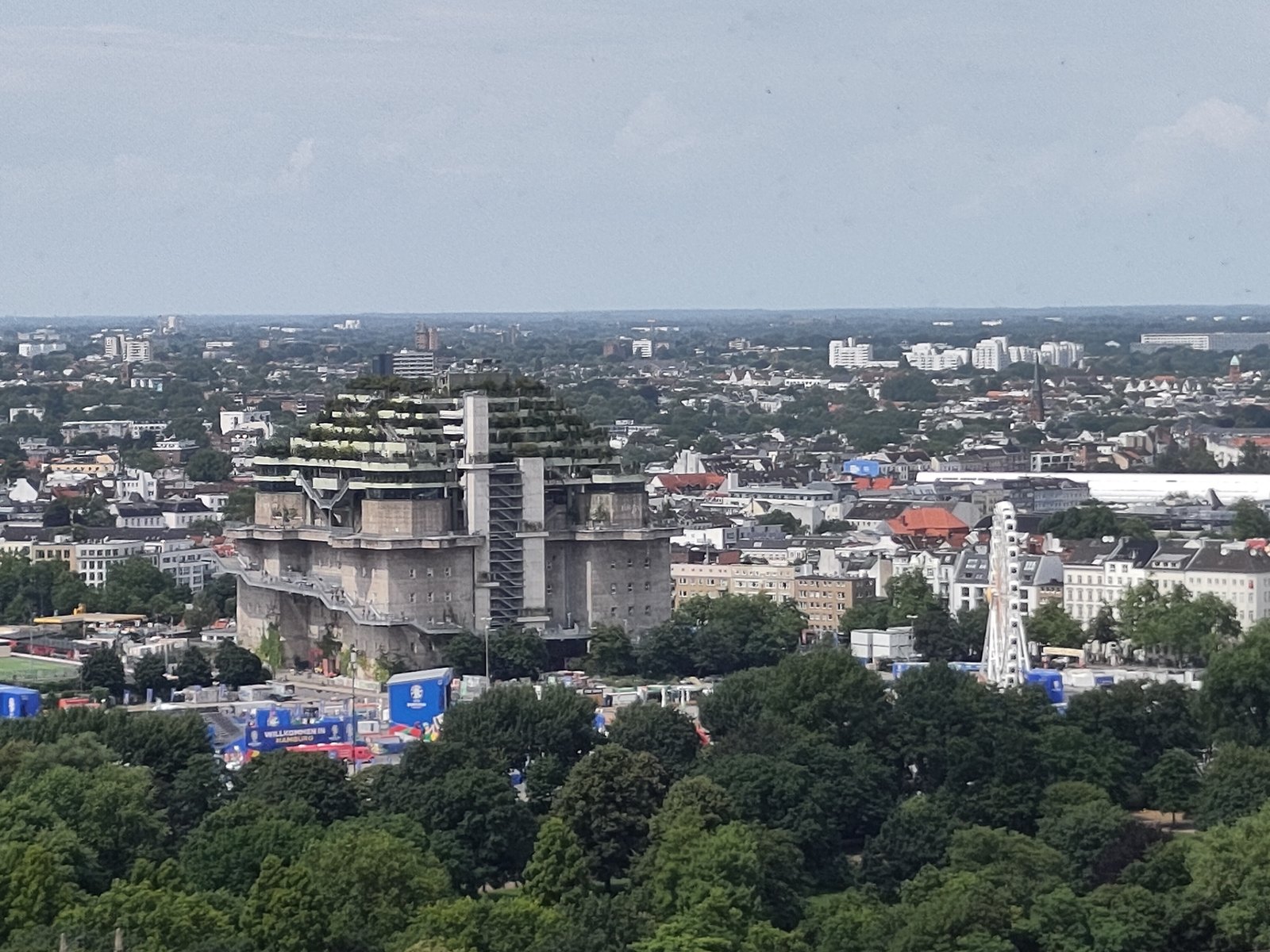
A planted path climbs around Hamburg’s wartime concrete tower. Its new public roof sits above a history that deserves more than a passing glance.
A concrete anti-aircraft tower has become one of Hamburg's most conspicuous places to go for a rooftop view. At Feldstraße, the original block now carries a stepped extension, planted terraces and a path that winds upward around the building. The outline looks different from older photographs, but the mass underneath remains unmistakable.
The city's visitor account places the building in St. Pauli and connects its wartime construction with its present cultural and hospitality uses. The rooftop is one part of an occupied building: clubs, creative workplaces, a hotel and restaurants have their own entrances, bookings and hours.
The original tower is still there
The bunker was built in 1942 as Flakturm IV, part of Hamburg's anti-aircraft defenses and an air-raid shelter. Forced labor was involved in its construction. That history is essential to reading the structure, even when the most visible recent change is a garden.
Its broad concrete base and repetitive openings were formed for defense. The new planting does not explain them. Looking from street level, trace the point where the heavy original tower meets the lighter, stepped addition. The architectural difference is unusually readable: one part was built to resist attack, the other to accommodate people spending time above the city.
After the war, the tower found new occupants rather than disappearing. Music and creative work became important parts of its identity. The city's account names venues including Uebel & Gefährlich and resonanzraum. These uses predate or sit alongside the rooftop redevelopment; the building's cultural life did not begin with the hotel.
A new route around an old mass
The operator's timeline dates the public opening of the expanded complex to July 5, 2024. Its upper levels introduced the REVERB hotel and new hospitality spaces. The planted outdoor route makes the addition visible as a journey as well as a silhouette.
Rather than entering a lift and emerging on a flat roof, pedestrians encounter the building as they climb around it. The path changes the angle of the city view and exposes the proportions of the concrete tower below. This is a useful way to understand why the building feels so much larger from close by than it does in a skyline photograph.
The operator calls the route the Mountain Trail and the upper landscape the Rooftop Garden. Those names help when checking access. A restaurant reservation is a different product from a visit to the outdoor route, and the hotel is a separate overnight stay. Match the name on a booking or access notice to the experience you actually want.
Check the hours in the original language
The official location page lists daily winter access from 9 a.m. to 5 p.m. when checked on October 16, 2026. Its English and German versions disagree about the summer closing time: 11 p.m. in English and 9 p.m. in German. For an evening visit, confirm directly instead of relying on the later time.
That discrepancy also makes a precise October closing time something to verify on the day. The pages label seasons without giving a boundary date in the text reviewed. Individual restaurants, shops and the hotel keep separate hours. No guaranteed same-day access, available lift or step-free route was independently established for this article.
The address is Feldstraße 66. Feldstraße station on the U3 provides a useful arrival point, subject to the current transport schedule. Once there, follow signs for the outdoor route and staff instructions. Weather and crowd management can affect an exposed rooftop, even when the building itself is open.
Give the view its context
The documentary image supplied with this story dates from July 2024, after the extension was added. It shows the tower as part of Hamburg's city fabric. The greenery and added floors should not be erased to recreate the isolated wartime object seen in older pictures.
The view is a reasonable reason to come. The stronger reason to stay attentive is the encounter between an architecture of war and the everyday city now occupying it. The path makes that encounter unusually physical: every turn carries visitors around a concrete mass whose original purpose remains visible beneath the new growth.
Follow the thread
Denkort Bunker Valentin takes a different approach to wartime concrete, centering memorial interpretation on the forced labor that built an unfinished submarine factory.
Lingotto rooftop / La Pista 500 also gives an inherited structure a public roof garden, with a former car test track still defining the walk's geometry.
Sources and reporting
Researched October 16, 2026, from the linked sources. This is desk reporting; no firsthand visit is claimed.
- Hamburg city architecture guide
- Operator development timeline
- Operator English location
- Operator German location
The reference photograph