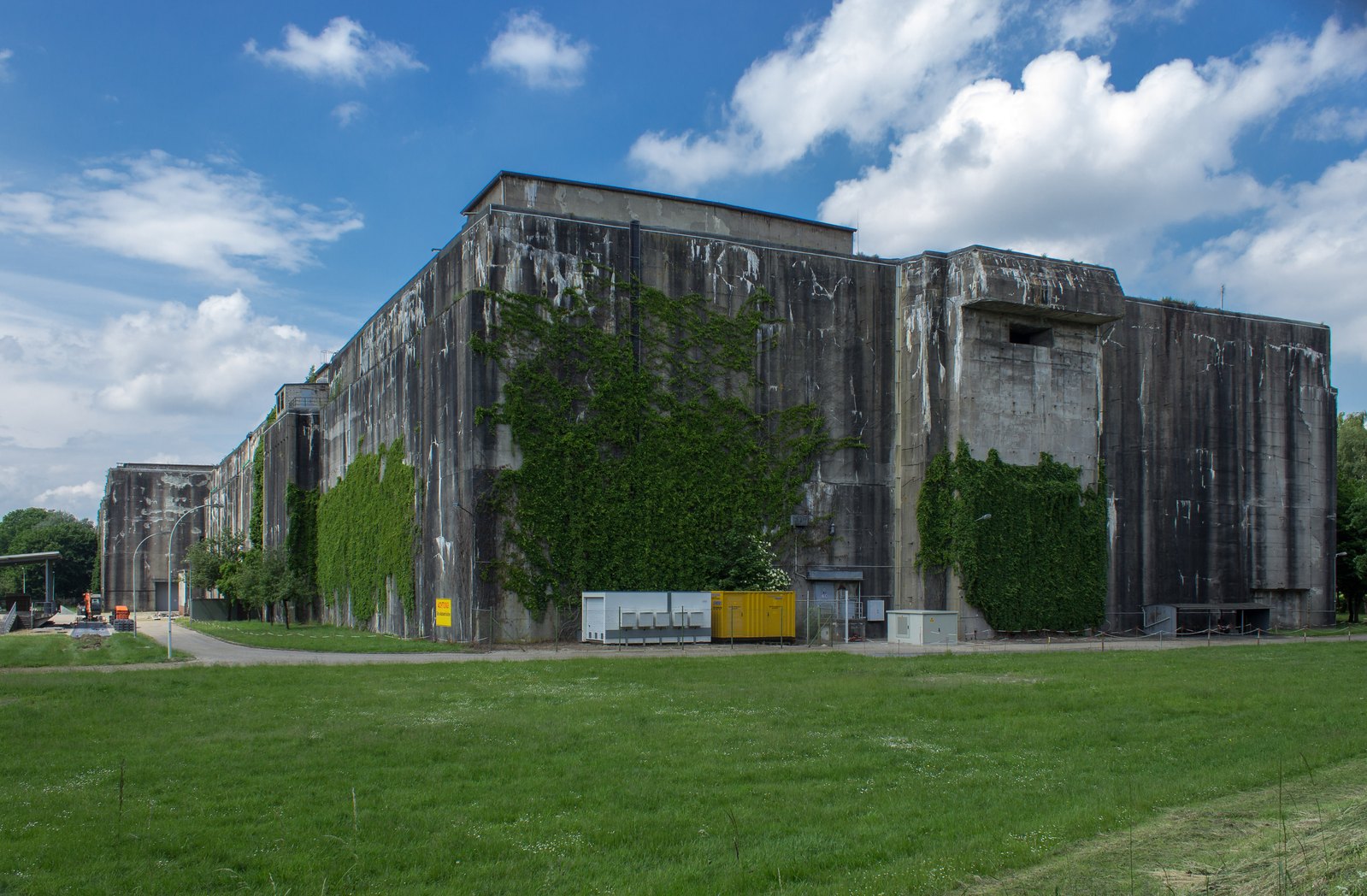
Near Bremen, an immense concrete shell preserves the evidence of a submarine factory that never produced a submarine—and the forced labor that built it.
The scale of Bunker Valentin is difficult to reconcile with its short construction history. Huge concrete walls rise beside an otherwise much smaller landscape in Bremen-Farge. The structure was intended to shelter submarine production during the final years of Nazi Germany. No submarine was ever built here.
That unfinished industrial purpose is only part of the story. The Denkort Bunker Valentin memorial centers the people compelled to build it, many of whom died. A visit belongs to the history of forced labor and persecution as much as to the history of military engineering.
A factory built through coercion
Construction ran from mid-1943 into spring 1945. The memorial describes a labor force of up to 10,000 people, including concentration-camp prisoners, prisoners of war and civilian forced laborers. Approximately 1,600 deaths are documented or estimated in its account; the full human cost is not recoverable with the precision of a construction drawing.
In late March 1945, British air attacks helped bring the project to a halt. The production line remained a plan. The surviving bunker therefore records both an extraordinary concentration of resources and the violence used to mobilize them during a collapsing war effort.
The word “unfinished” can sound almost neutral when applied to architecture. Here it needs its human context. The building did not fail because an ordinary commercial project ran out of money. It was part of a regime that used imprisonment, coercion and lethal working conditions to pursue war production.
Follow the ground-level evidence
The memorial's walking route and information center connect the bunker to the larger landscape. The marked route runs about 1.5 kilometers through 25 stations. It begins at the Vernichtung durch Arbeit memorial and combines surviving places with photographs, documents and testimony.
This format matters because the concrete shell can overwhelm everything around it. A route that returns attention to individual people and dispersed sites resists the temptation to reduce the visit to a single impressive facade. The information center on the south side introduces the project; the exhibition also restores names and faces to its history.
Read before photographing. The surfaces alone do not identify who worked here, how they arrived or why so many died. Documentary evidence gives the building those meanings. Without it, an image of massive concrete can become a misleading study in architectural spectacle.
What happened after the war
The bunker did not immediately become the memorial visitors encounter today. The English history records its later use as a naval depot, from the 1960s until 2010, and the civilian memorial's establishment in 2011. Different uses have left different traces.
The reference photograph here was taken in September 2014. Ivy, service containers and weather staining are part of that dated record. It is evidence of how the exterior looked then, not a promise that the same equipment, vegetation or access arrangement remains today. The recognizable mass of the bunker is more durable than those details.
Planning a memorial visit
As checked on October 16, 2026, the official practical page lists free admission. Guided tours have separate fees. Regular winter hours, October through March, are Tuesday–Friday and Sunday, 10 a.m.–4 p.m.; April through September extends the closing time to 5 p.m. Public holidays and special dates require a fresh check.
The page reports multimedia-guide problems and points to a free app. Check its language and download requirements before arriving.
The address is Rekumer Siel in Bremen-Farge. Plan the final part of the journey through the memorial's directions and the current transport timetable. A city-center arrival in Bremen is not the same as arrival at the site. Leave enough time for the outdoor route as well as the building.
Private, noncommercial photography is permitted under the published rules; commercial filming requires a different arrangement, and drones are prohibited. The purpose of the visit remains remembrance and understanding. The most consequential thing inside this enormous structure is the history that its unfinished production scheme tried to consume.
Follow the thread
Hamburg Feldstraße Bunker gives a wartime concrete tower a different public future through cultural venues, a hotel and a planted rooftop route.
Petrova Gora Monument approaches wartime memory through a damaged memorial whose sculptural form and preservation questions require their own historical context.
Sources and reporting
Researched October 16, 2026, from the linked sources. This is desk reporting; no firsthand visit is claimed.
The reference photograph