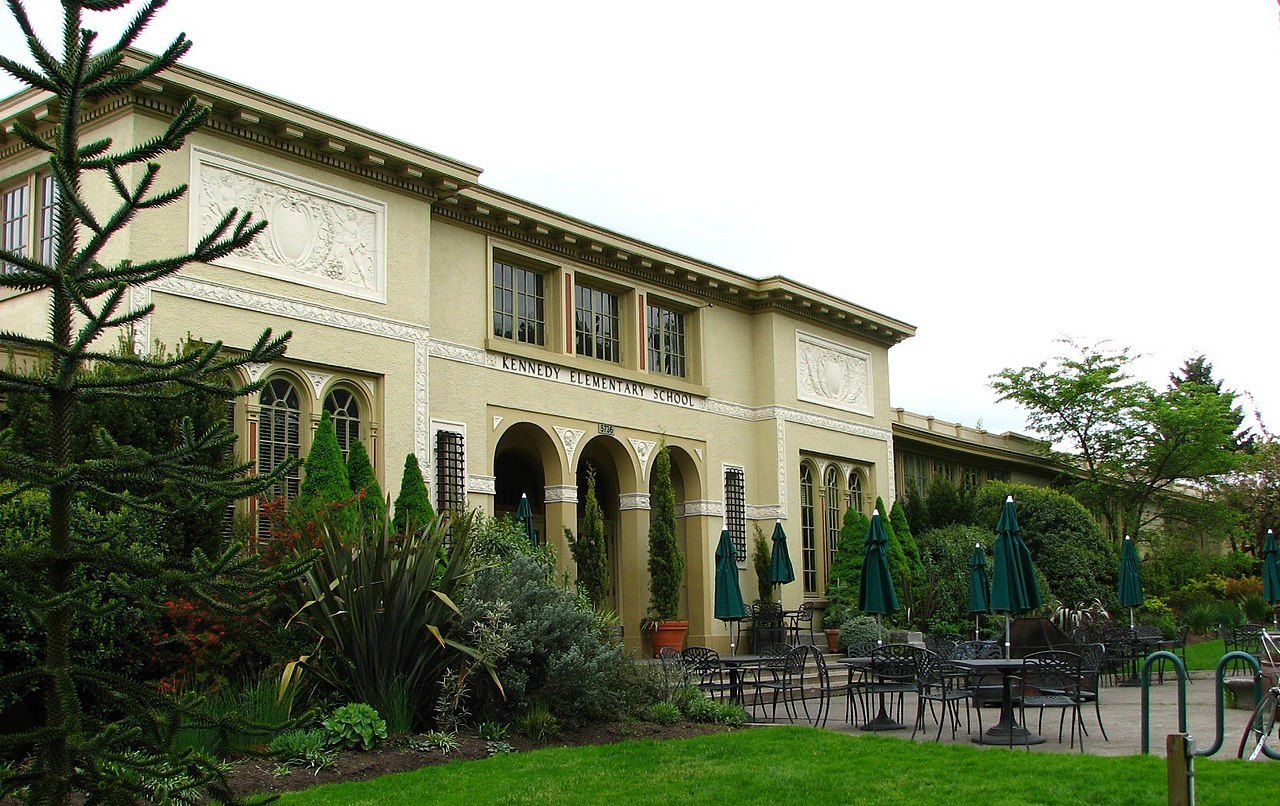
The name Kennedy Elementary School is still written across the facade. Below it, three arches open toward a courtyard furnished with outdoor tables and folded umbrellas. In Ian Poellet’s 2008 photograph, the building explains its former purpose more clearly than many converted buildings explain their present one.
The school in northeast Portland became McMenamins Kennedy School in 1997, combining accommodation, food, film and other uses. Some former classrooms retained chalkboards and cloakrooms as they became hotel rooms. The recognizable school building is a substantial part of the experience. National Trust’s preservation account.
Pick a reason to go
Kennedy School is at 5736 Northeast 33rd Avenue, Portland. It contains several businesses and activities, so there is no single museum ticket that covers every possible visit. A room reservation, a film, a meal and a public soaking session require their own current arrangements. Operator’s property information.
If the building is your main interest, use the operator’s history and art material to orient yourself, then choose an activity in an area open to visitors. A hotel corridor or former classroom is not automatically public simply because it is historically interesting.
For the soaking pool, the dedicated operator page requires reservations for non-hotel guests. It lists a one-hour public session at $10 per person for ages three and up, with younger children free, and public hours of 10:30 a.m.–7:30 p.m. Adults need identification and towels are not provided. In October–April the listed maintenance closures fall on the first and third Tuesdays. These terms were checked October 16, 2026; availability remains a separate question. Pool’s own rules and booking link.
The school had already changed its neighborhood
The present building was completed in 1915. The National Trust’s account describes its closure as a school in 1975, followed by years of uncertainty and efforts to find another use. Renovation required new services and structural work, not simply moving beds into classrooms. Building chronology.
The operator’s historical material reaches further back, describing the first portable classrooms on the grounds before the permanent school opened. It also records the distance from the early streetcar line. The building was part of a growing neighborhood, rather than an isolated architectural object. Operator’s history and art account.
That context makes the reuse more specific. A school is already designed around repeated rooms, shared corridors and spaces where groups gather. Turning those elements toward hospitality changes how they are used while leaving much of the arrangement legible.
Look closer: the entrance still speaks in school terms
The source photograph places the school name just above the arches. Larger upper windows sit between decorative panels, and the central entrance forms a clear break in the long, low facade. Garden planting partly screens the outdoor tables without concealing the front of the building.
Read the old name and the new furniture together. One identifies an institution; the other shows a different kind of everyday use. You don’t need an invented classroom memory to understand the contrast. The building supplies enough evidence of its own.
The photograph dates from 2008. Its courtyard arrangement, planting and public entrances should not be treated as a current floor plan.
Preservation took neighbors as well as a new owner
A Concordia Neighborhood Association account describes historian Melissa Darby’s work and the coalition of alumni, neighbors, community members and public officials that sought to save the school. It places McMenamins’ stewardship within that longer effort. Neighborhood account.
That complicates the easy version of a reuse story in which a closed building waits passively for one inspired buyer. Keeping a place can involve years of local attention before a commercially workable plan arrives. The later hotel does not make that earlier work incidental.
A preserved detail can belong to several histories
The National Trust’s 2015 report describes original school features alongside photographs and yearbooks donated by former students, and murals added during the new use. Those are different kinds of material: a surviving fixture, an archival object and a later interpretation. What was retained and added.
When a chalkboard survives in a guest room, it remains a real object even though the room’s purpose has changed. When a mural depicts the school’s past, it offers an interpretation rather than an unaltered window into that past. Knowing which is which makes the building more interesting, not less.
Kennedy School’s new activities work around a name the facade never stopped carrying. A meal, film or stay can put the old building back into an ordinary day, where it once belonged.
Checked October 16, 2026. Desk research and a 2008 photograph; no personal stay or visit. Current room, restaurant and film offers, individual access arrangements and selected pool slots remain unverified.
Follow the thread
TWA Flight Center / TWA Hotel also turns a recognizable public building into a hotel, while keeping its historic public spaces distinct from an overnight stay.
At SESC Pompeia, a former factory becomes a place for culture, sport and ordinary public activity through both retained buildings and new construction.
The reference photograph