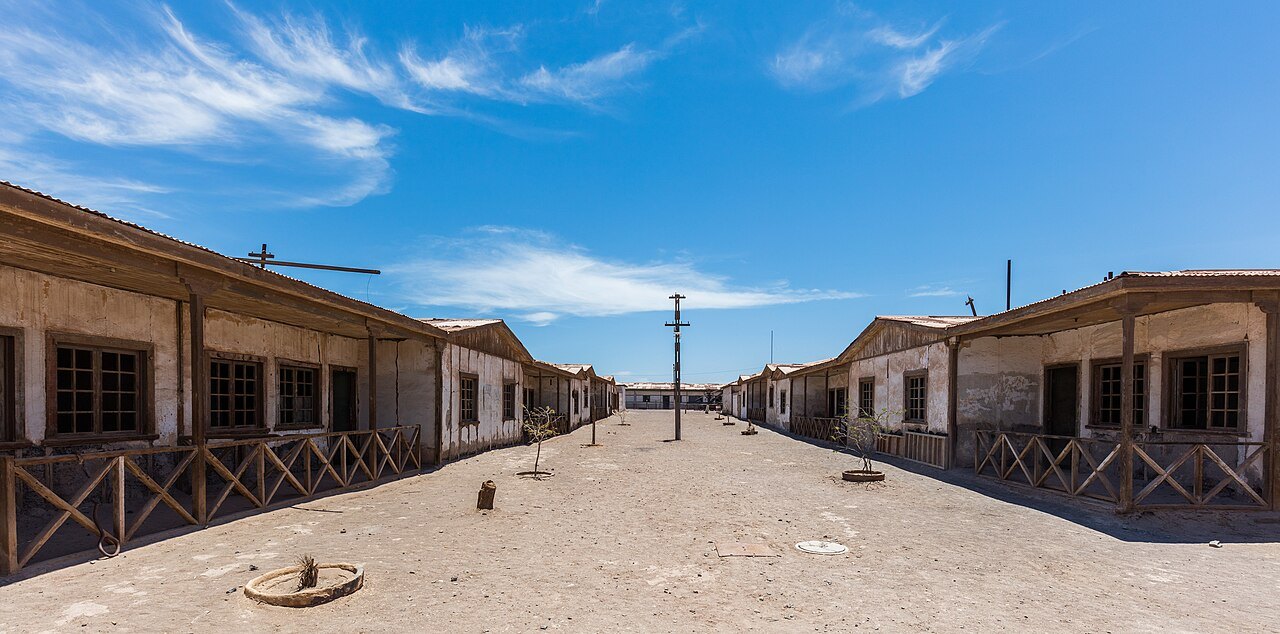
The street is sandy, but its buildings form a regular urban line. Windows repeat beneath low roofs, timber rails edge the verandas and utility poles lead toward the far end. Diego Delso’s 2016 photograph from the Humberstone and Santa Laura heritage complex in northern Chile shows an industrial landscape at the scale of everyday life.
Humberstone and nearby Santa Laura tell complementary parts of the nitrate industry’s history. UNESCO identifies Humberstone’s surviving residential and service spaces as especially important, while Santa Laura preserves more of the industrial installations. A useful visit gives each site its own job in the story. World Heritage description.
Begin at Humberstone
The operator says the ticket is purchased at Humberstone and covers both works. Published general admission for visitors aged eighteen and over is CLP 8,000. The listed hours are 9 a.m.–6 p.m. from March 16 to December 14, and 9 a.m.–7 p.m. from December 15 to March 15, with a January 1 closure. These terms were reread October 16, 2026. Rates and opening.
Bring your own drinking water: the operator states that water available at the museum is not potable. It also requires closed shoes and asks visitors to remain on the enabled routes. People with reduced mobility may request vehicle access permission at the guard office, which is not a guarantee that every building interior is accessible. Visitor requirements.
Transport from Iquique, movement between the two sites, precise entrance coordinates and current interior openings have not been verified here. Settle those practical details before treating the combined ticket as a complete itinerary.
Nitrate needed a town
The industry processed sodium nitrate for fertilizer used far beyond Chile. UNESCO’s account emphasizes the workers who came from Chile, Peru and Bolivia and formed the distinctive Pampino culture, including shared language, creativity, solidarity and labor organizing. The town was part of the production system, but its residents also made a social world within it. Industry and community.
That is why a public square or a theater can be as revealing as a machine. Production required a workforce able to live in a remote place. Shared spaces show how daily life was organized around that requirement, while their later meaning can extend beyond the company that built them.
Avoid reading an empty street as proof that the place has no living connections. UNESCO describes continuing associations with former workers, families and commemorative gatherings. The remains are also part of a history remembered outside the site.
Humberstone had another name
The operator traces the works to La Palma, founded in 1872. Following changes of ownership and a period of shutdown, it was acquired and renamed Santiago Humberstone in 1934. The renewed phase included housing improvements and communal buildings such as the theater, school and hospital. Humberstone’s history.
The change of name is a useful reminder that the settlement did not belong to one unchanging moment. A building may represent a later expansion, alteration or restoration. Use the individual interpretation to establish its place in that sequence instead of assigning every visible feature to the founding year.
Look closer: ordinary repetition
In the selected photograph, buildings on both sides follow a shared low profile. Cross-braced timber rails create a smaller repeating pattern beneath the windows. A few plants occupy circular borders in the open ground, while the utility poles provide a line through the center.
The interest lies in those small efforts to make an inhabited setting: a veranda edge, a planted patch, a window opening onto a street. The image does not tell us who lived behind a specific door, whether that building was residential or communal, or which interiors are open now. The file describes the wider heritage complex; the exact block is not identified in this package.
Those limits leave plenty to observe. The relationship between a building frontage and an open street can show how the settlement was arranged, even when an individual household story has not been recovered.
Santa Laura changes the emphasis
The operator’s account of Santa Laura follows periods of operation, interruption and modernization, including equipment moved from another works. Its industrial remains give a different view of the same regional economy. Santa Laura’s history.
Read the two sites together without merging them. A structure photographed at Santa Laura should keep that identity, while a theater or public space at Humberstone belongs to its own setting. The combined heritage status and ticket do not make the individual remains interchangeable.
For a visit focused on community life, our suggestion is to spend attention on Humberstone’s shared spaces first, then use Santa Laura to add the production story. This is an editorial sequence, not an operator-prescribed route or a fixed time estimate.
The empty streets are visually striking. Their fuller significance is that an industrial enterprise once required not just equipment, but a place where people built daily lives—and where those lives can still be remembered.
Checked October 16, 2026. Desk research and a 2016 photograph; no personal visit. Current transport, room openings, precise route accessibility and selected-date availability remain unverified.
Follow the thread
Bombay Beach, Salton Sea complicates the image of a deserted settlement by keeping a living community distinct from shoreline remains and later artworks.
At Carrie Blast Furnaces, ironmaking structures and art programs connect another industrial landscape with the people whose labor shaped it.
The reference photograph