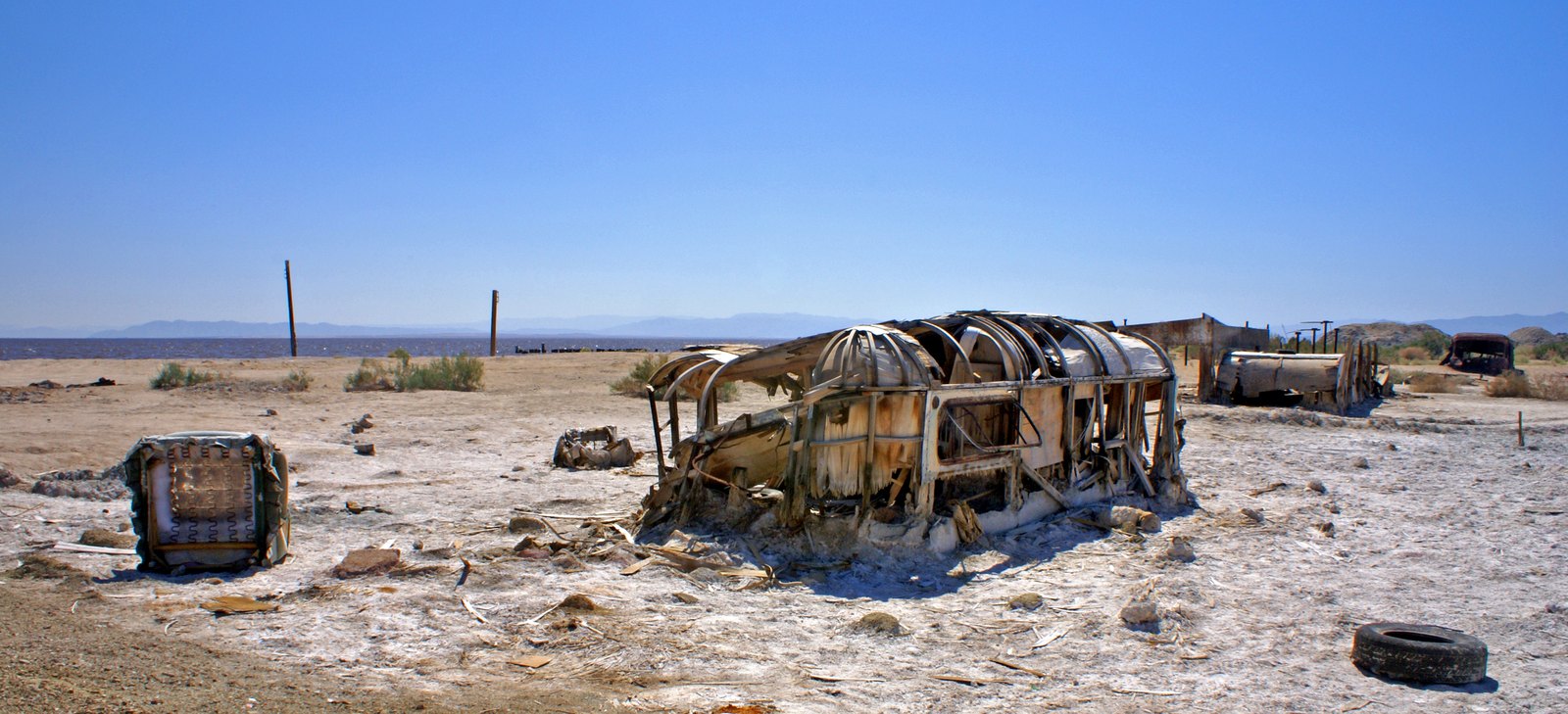
A trailer’s outer skin has fallen away, leaving curved ribs above the sand. A detached seat and a tire occupy the foreground; the Salton Sea is a thin strip beyond them. Alexander Novati’s photograph was taken in 2008. It is a powerful image of Bombay Beach, California, and an incomplete account of the place.
The photograph predates the Bombay Beach Biennale, founded in 2015. The art event’s own principles emphasize participation and respect for the local community. Beginning with that distinction changes the story: a photograph of remains is not a portrait of everyone who lives around them, and an old wreck should not automatically be labeled a present-day artwork. Biennale’s account.
The town, the shoreline and the event
Bombay Beach is a community beside the Salton Sea in California’s Imperial County. A state environmental record identifies the community separately from a proposed wetland project along the northeast shore. The administrative distinctions matter on the ground: a town, a shoreline restoration area and a seasonal arts program do not have one shared admission policy. California project record.
The Biennale describes itself as a free public event, with a season beginning in January and a concluding spring weekend whose dates circulate by word of mouth. It is not an ordinary festival offering a published ticket calendar. This research did not verify an upcoming event date, the opening of a particular installation or a guaranteed public art route.
For an art-focused visit, start with the organizers’ current information and the signs or permissions at each site. A general statement that an event is free does not make every building or vacant lot publicly accessible. Event principles and scope.
A landscape with several kinds of work
The organizers present site-specific art as a way to engage with residents and the ecological crisis. That aim does not establish that every resident benefits equally or that an environmental problem has been solved.
The art is most interesting when its relationship with the setting can be established. Who made a particular work? When? Was it intended to remain, change or disappear? A dated credit or an artist’s account can answer questions that a dramatic image cannot. If that information is missing, a careful description is better than an invented title or a claim about its meaning.
This is especially important with photographs made before 2015. Age alone does not turn discarded material into an installation associated with the later Biennale.
Look closer: what the 2008 picture shows
In Novati’s source image, the broken trailer shell occupies the center-right. Its exposed curves remain recognizable even where the wall material is gone. Upright poles and a distant mountain line divide the broad horizontal landscape, while the tire and seat provide separate foreground objects.
Those are observations of a particular dated photograph. The image does not identify the people who used the trailer, explain why it was left there or establish where a visitor can find it now. Its strongest historical information is the contrast between the remains and the waterline at that moment.
A present-day visitor should not expect to reproduce the composition. The shoreline, objects and permissions may all have changed. The photograph is useful precisely because it belongs to a date, rather than standing for a timeless “abandoned town.”
Restoration is another story happening here
A notice posted in May 2025 describes the Bombay Beach Wetland Enhancement project, covering approximately 564 acres of habitat. The record outlines plans to spread water and reinforce natural berms to retain it. It documents a project and its intended ecological purpose, not a completed result or a new visitor attraction. Wetland enhancement record.
That is a different form of site-specific work from an artwork. Both respond to the landscape, but their methods, responsibilities and evidence are different. A photograph of a striking object cannot show whether habitat work has succeeded; an administrative approval cannot tell you whether a particular path is open today.
California State Parks also maintains visitor information for the wider Salton Sea State Recreation Area. Its campground and recreation descriptions concern park facilities, rather than blanket access through Bombay Beach. Do not transfer a park listing’s amenities or opening assumptions to the whole community. State recreation-area information.
Arrive as a visitor to a community
Keep to places clearly open to the public, respect occupied properties and photograph people with their permission. Those are our recommendations for visiting a residential place; they are not a newly invented set of Biennale entry rules. For a specific event or artwork, the creator’s or organizer’s instructions are the relevant source.
The most revealing account of Bombay Beach has room for the dated ruin photograph, the art program, environmental work and ordinary residents. None needs to erase the others. The town becomes easier to understand when the frame is allowed to widen.
Research checked October 16, 2026. Historical photograph from 2008; no personal visit. Current installation locations, event dates, permissions, shoreline access and local travel conditions remain unverified. This is a place story, not a confirmed itinerary.
Follow the thread
Humberstone Saltpeter Works preserves housing and services from a former nitrate town, offering a carefully different relationship between settlement remains and public interpretation.
At City Museum, discarded urban materials also acquire an artistic afterlife, assembled into an environment visitors can physically explore.
The reference photograph