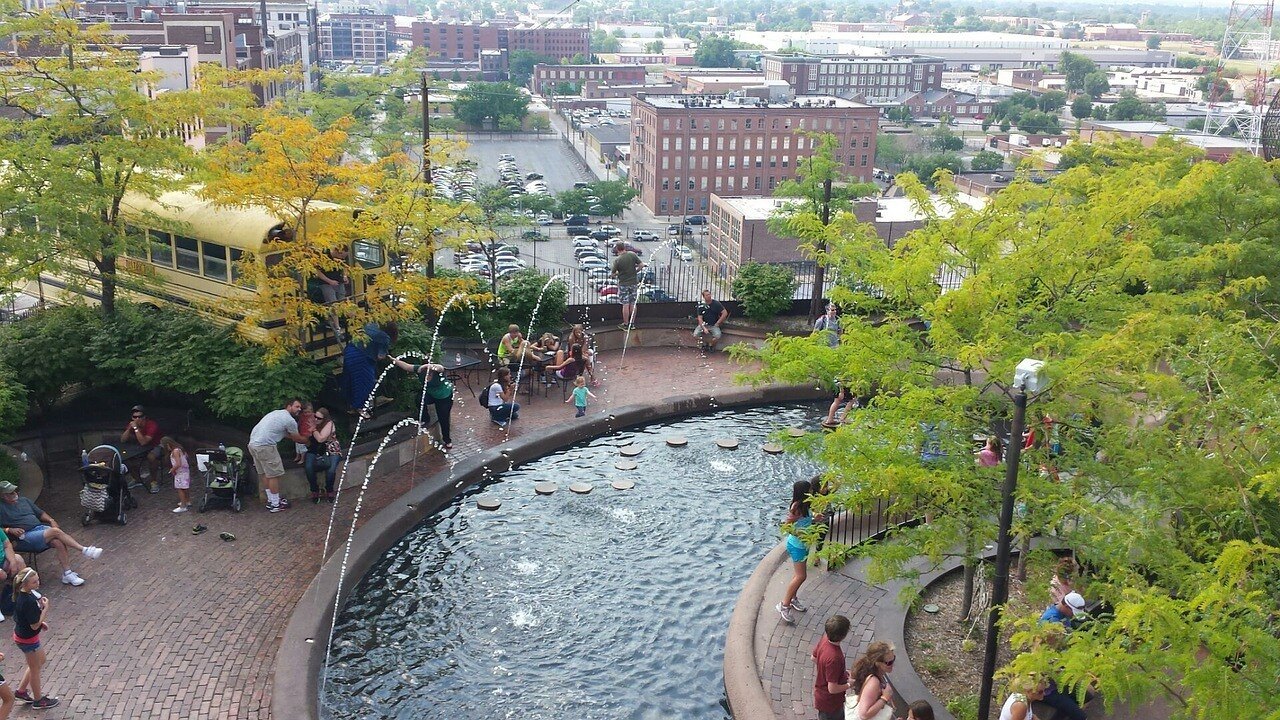
A yellow school bus sits beside a rooftop pond. Beyond its railing is an ordinary city of streets, parked cars and brick buildings. That combination, visible in the selected photograph of City Museum in St. Louis, explains the place better than a list of superlatives. Objects that belong elsewhere have been gathered into an environment you can enter, cross and climb around.
City Museum occupies a former shoe factory downtown. Artists Bob and Gail Cassilly and their collaborators built its spaces from things cities had discarded; the museum continues to develop them. It’s an artist-built playground with architectural material at its center. The museum’s account.
The practical choice comes early: decide whether you want the main museum alone or a visit that also includes the rooftop. A photograph of a roof attraction is not a promise that it will be operating on your date.
Start with the ticket that fits
The rooftop is a separate addition to general admission unless the visitor’s pass includes it. Its dedicated page lists an $8 add-on and describes opening as dependent on weather and other conditions. Treat that as a product description checked October 16, 2026; confirm the current offer in the ticket selection before buying. General admission prices and trip-date rooftop availability are not established here. Rooftop details.
For a first visit, choose a date on the museum’s live calendar instead of relying on a homepage’s “today” banner. Different pages returned different daily closing times during this research. A banner advertising an October 9 evening event also remained visible after that date. Neither provides a reliable schedule for the rest of October.
The museum’s address is 750 North 16th Street, St. Louis. Its own Serpent Lot is at 16th and Delmar; nearby lots using the museum’s name may be independent businesses. Plan your visit.
The material has another life
A conventional museum might put an architectural fragment behind a barrier. City Museum makes salvaged material part of the setting. Explore St. Louis describes a collection that ranges from architectural and industrial pieces to such unexpected objects as safety deposit boxes and buffet pans. Its visitor account places the opening in 1997. Local tourism overview.
The interesting question is what each object is doing now. Does it support movement, make a surface, mark a threshold or simply interrupt your expectations? That approach gives adults something to investigate even when their preferred pace involves more standing than crawling.
It also gives the building a double identity. The former industrial shell sets one scale; inserted passages and objects introduce another. Looking for the meeting point between them is a more productive task than trying to count every unusual thing in the room.
Look closer: the roof is a landscape
In the selected historical photograph, curved brick paving follows the pond’s edge. Water jets arc across the surface. Trees partially screen the bus, while the street grid remains visible beyond the perimeter. The picture contains a deliberate contrast between a roof used as public space and the flat roofs around it.
The bus is the immediate joke, but the curving edge does more of the compositional work. It leads the eye across the roof and toward the city. Look from the large object to the small decisions around it: planting, paving, railings and places to pause. A spectacular object still needs an environment.
This is a dated photograph, so use it to read a design, not to identify a currently open route or a guaranteed water feature. The original file’s creator and CC0 dedication are retained in the accompanying media record.
Dress for the actual activity
The operator recommends closed-toe shoes and pants suitable for crawling, sliding and climbing. It also suggests leaving bulky bags behind or using a locker. For families, a contact number on a child’s wristband is a practical precaution in a building with so many possible paths. Operator’s preparation tips.
Choose a meeting point before members of a group head in different directions. That is our planning recommendation, especially when different people want different levels of physical activity. You don’t need to attempt every passage to understand the place.
The museum’s FAQ says it accepts electronic payments, with cash-to-card kiosks available. Arrive with a payment method you can use rather than assuming every counter accepts cash. Payment policy.
A museum without a single prescribed movement
The useful way to pace this visit is to alternate. Try something physical if it suits you, then stop and look at what the structure is made from. Notice where the old building is visible again. If the rooftop is part of your plan, leave room for its conditions to change instead of making it the only reason to come.
City Museum’s reuse happens at several scales: a factory, a bus, a piece of metal, a familiar object suddenly performing another job. The collection becomes clearest when you can explain one of those changes, rather than when you’ve reached every corner.
Visitor pages checked October 16, 2026. Desk research and historical photograph review; no personal visit. Exact daily hours, admission totals, individual attraction restrictions and access needs must be resolved for the selected date.
Follow the thread
At SESC Pompeia, retained factory buildings and new sports towers make movement and everyday public activity central to the reuse.
McMenamins Kennedy School carries classrooms, chalkboards and a school entrance into a hotel and entertainment complex, preserving a more familiar institutional past.
The reference photograph