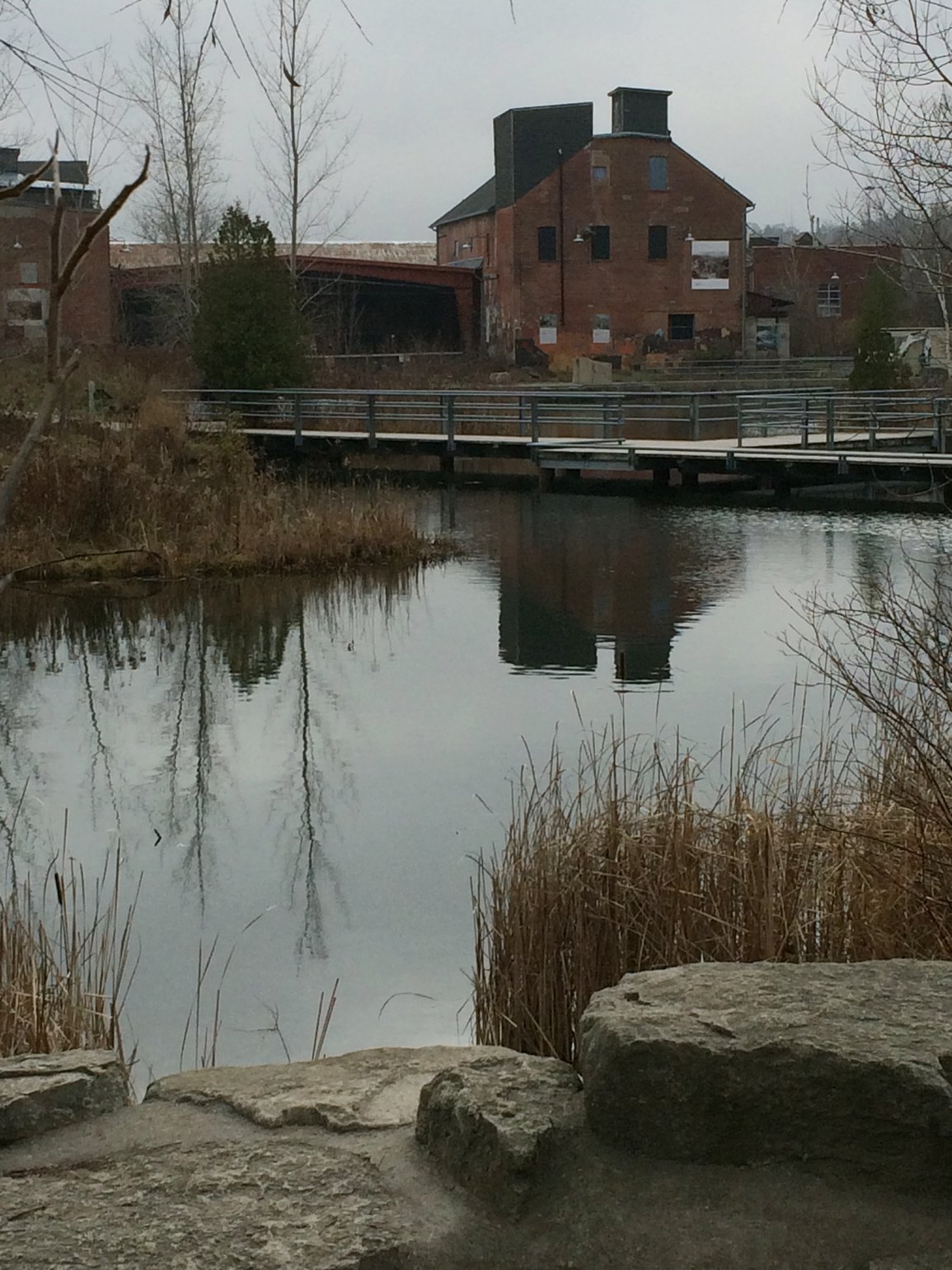
The brick building is reflected in a pond. A low crossing separates it from the water’s edge, with reeds and stones in the foreground. The December 2015 photograph of Toronto’s Don Valley Brick Works places industry and landscape in the same frame, without making one disappear behind the other.
Evergreen Brick Works occupies the former brick factory and quarry in Toronto’s Don Valley. The factory closed in 1984; the public environmental center opened in 2010. Today the site combines heritage buildings, markets, programs and access to the neighboring quarry park. The useful way to plan is to separate those parts before choosing a date. Site history.
A market morning or a history visit?
The Saturday Farmers Market lists hours of 8 a.m.–1 p.m., with the local food court continuing until 2 p.m. Its own page describes a year-round market and a vendor map updated weekly. A Saturday morning offers a different use of the buildings from a quiet weekday walk. Market details.
For interpretation of the industrial site, Evergreen lists a free Saturday History Tour, 1–2 p.m., meeting at the Welcome Desk in Building 14. The Nature Tour, 11 a.m.–noon, follows a different route, including the park. Public tours are first come, first served, with limited capacity; groups of ten or more are directed to private arrangements. Choose a tour.
The general visitor page lists the address as 550 Bayview Avenue, Toronto, and warns that different parts of the site keep different hours. Welcome services, an event room, a market and outdoor trails should not be given one blanket opening time. Visitor information.
The quarry belongs to the industrial story
Brickmaking ties a building material to a landscape. The finished brick can travel into the city; extracting its raw material leaves a different kind of trace. Evergreen’s history identifies the former works and quarry together and describes the later transformation of the industrial grounds into public space. Industrial and landscape history.
That relationship is worth keeping in view on a visit. The factory explains the manufacture, while the quarry setting keeps attention on what production required from the land. A market or a garden is a later use of that setting, rather than proof that its industrial history has vanished.
The tour page makes an important management distinction: the Weston Family Quarry Garden and Don Valley Brick Works Park are maintained by the City of Toronto. Evergreen’s history tour focuses on the industrial property; its nature tour extends into the park. Routes and responsibilities.
Look closer: a factory reflected in water
In the selected photograph, the pitched-roof brick building stands beyond a straight crossing. Its reflection fills part of the pond, while bare branches and reeds break up the edge. The industrial building remains the strongest vertical object, even in a view largely occupied by water and planting.
The scene is useful for understanding adjacency. It is not a map of the whole quarry or evidence that every path around the pond is currently open. The 2015 water level cannot stand in for present conditions.
If the industrial and park portions of the visit feel like different places, the photograph provides a way to connect them. The building and the changed ground belong to the same material history.
An environmental demonstration has limits to test
Evergreen describes the site as a demonstration of greener urban practices. Its own account also documents severe flooding on July 16, 2024, with recovery and risk reduction requiring continuing work. A mission statement and a difficult event can both belong in the story. The older flood report does not establish a current closure. Evergreen’s account.
That is a more useful basis for understanding the place than calling the project a completed solution. Look for the practices being demonstrated, then ask what they address and what still needs maintenance. The old factory remains a working public site, with the responsibilities that entails.
Getting into the valley
The dedicated transport page lists a free shuttle from the parkette beside Broadview Station on Erindale Avenue, generally every 30–45 minutes. It also identifies TTC and walking options, with weather and traffic affecting travel. The shuttle’s interval is not a guaranteed departure time. Getting here.
For mobility needs, review the specific boarding and site information with the operator. Its pages discuss a wheelchair lift as well as steps and assistance with walkers or strollers; that detail should not be reduced to a promise that every part of the journey is step-free. Paid parking is available, but published rate sections differ, so no amount is reproduced here.
The visit can be compact or fill a day, depending on the program you choose. Start with the market, history or landscape that interests you, and let the other parts add context rather than turning the whole site into a checklist.
Checked October 16, 2026. Desk research and a 2015 photograph; no personal visit. Current trail conditions, flood alerts, parking totals and trip-date transport remain unverified.
Follow the thread
SteelStacks also brings public programs into a former industrial landscape, with a pedestrian route helping visitors read the equipment beside it.
At SESC Pompeia, retained factory spaces and new sports towers make industrial reuse part of everyday cultural and public life.
The reference photograph