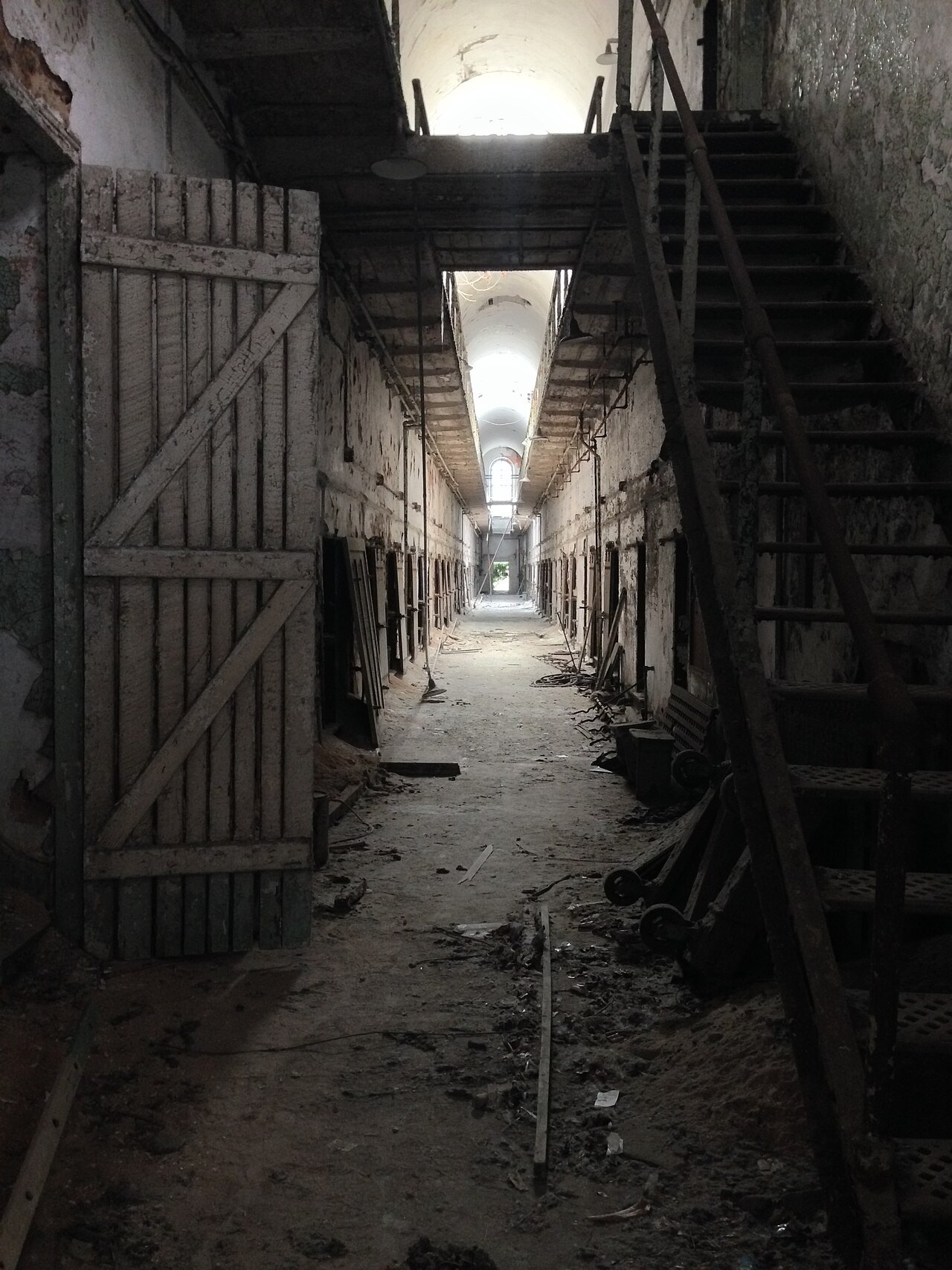
A dark stair rises beside a corridor of repeated cell doors. Above it, another tier follows the same line toward a bright window. The surfaces are peeling, but the arrangement is still clear. In a 2017 photograph of Eastern State Penitentiary in Philadelphia, the building’s organizing idea survives more readily than its paint.
Eastern State opened to its first prisoner in 1829. Architect John Haviland’s radial design put seven original cellblocks around a central hub, serving a prison system based on enforced separation and labor. The building is now a historic site that interprets both its own past and present questions about incarceration. Official history.
Begin with the daytime visit
The relevant product for the prison’s history is Daytime Admission. The operator offers a self-guided audio option and a timed Guide-Led Tour & Discussion. Its preparation page lists adult admission at $21 online or $23 at the door, checked October 16, 2026. The main audio sequence is about 40 minutes; the guide-led discussion is 45 minutes. These are program durations, not a limit on the whole visit. Tickets and preparation.
Halloween Nights is separately ticketed. Its seasonal entertainment should not be confused with the ordinary daytime program, even though it occupies the same complex. The historic-site calendar distinguishes included activities from special admission. Current program types.
The address is 2027 Fairmount Avenue, Philadelphia. The site’s preparation page directs visitors to the current hours and its dedicated accessibility information. As a planning choice, settle the kind of visit first, then the date and access needs; the appearance of a building in a photograph is not an accessibility assessment.
A plan can carry an argument
The original prison system expected separation to encourage penitence. The architecture made that policy physical through cells, controlled routes and the central arrangement. The operator’s history also records criticism and the gradual breakdown of strict isolation before the system was formally abandoned in 1913. Design and policy.
The distinction matters. Calling the building innovative describes an architectural and institutional experiment; it does not establish that the experiment was humane or successful. The Encyclopedia of Greater Philadelphia places Eastern State among the period’s most contested institutions and follows its later history through overcrowding and changing practices. Historical context.
When looking at a plan, consider what it made easy for the institution and what it made difficult for the person inside a cell. A corridor that is visually clear to a supervisor can represent a very different set of limits to someone required to remain in one room. The same geometry supports both readings.
Look closer: repetition and interruption
In the 2017 source image, the lower corridor is divided by doorways at regular intervals. Upper galleries repeat the line. The stair in the foreground cuts diagonally across that order, while daylight draws attention toward the far end.
You can read the space without imagining a sound, a smell or a particular prisoner standing there. Count a few doorways, then notice how little the view changes as it continues. Next look for the interruptions: the stair, a projecting door, the high window. The arrangement gives a concrete starting point for questions about circulation and control.
This image records a deteriorated area in 2017. It does not establish that this exact corridor is on today’s public route. The reader’s view of a historic photograph and the visitor’s permitted movement through the museum are different things.
Why the damage remains visible
Eastern State has been preserved as a stabilized ruin rather than reconstructed throughout as a pristine operating prison. A Getty Research Journal study examines how that material condition works with the site’s interpretation and art. The worn surfaces are part of the evidence visitors encounter, although they need explanation alongside them. Preservation and interpretation.
That choice creates an easy trap for photography. Peeling paint and an empty corridor can become the whole story, leaving out the people and the institution that shaped the place. Read an individual account or an exhibit before returning to the architecture. The building will still be visually striking, but its meaning will be harder to reduce to decay.
The museum extends beyond the cell
Daytime programming includes audio interpretation, guided discussion, short tours, exhibitions and art. The operator’s account connects the historic site with contemporary criminal-justice questions. Pick an additional subject after the introductory material instead of trying to consume every stop in order. Included experiences.
The original radial plan is worth understanding, but it cannot explain every period of Eastern State’s working life. Buildings acquire additions, policies change, and daily practices can depart from the original intention. Looking carefully means leaving room for those differences.
At the end of a visit, the most useful architectural question may be a simple one: who could move through this space, under whose authority, and at what cost to someone else?
Checked October 16, 2026. Desk research and a 2017 photograph; no personal visit. Selected-date opening, temporary room access and individual accessibility arrangements have not been verified.
Follow the thread
Diefenbunker uses underground separation for a different institutional purpose: keeping government functions operating during a Cold War emergency.
At Constitution Hill, former prison buildings stand beside a working constitutional court, making changes in institutional power part of the physical visit.
The reference photograph