At Constitution Hill in Johannesburg, a prison wall and a court frontage belong to the same precinct. The surviving jail buildings explain how power was exercised under colonialism and apartheid. The Constitutional Court explains what the new democracy set out to change. Reading them together is the reason to visit.
This is a working civic site as well as a museum. Decide whether you want the shorter Highlights tour or the fuller museum visit, and keep courtroom access separate from a guaranteed tour stop. A building that hears cases has a different daily life from an exhibition room.
Choose the scope of the visit
The operator’s admission page, checked October 16, 2026, lists the one-hour Highlights tour at R150 for adults and the two-hour Full tour at R200. Highlights departures run hourly from 9 am to 4 pm; Full tours leave at 10 am and 1 pm. The visitor center opens at 8:45 am, and ticket sales end at 4 pm. The site is cashless.
These are operator tour durations, not door-to-door estimates. Leave room in your own schedule for arrival and any reading after the guided portion. The booking page says individuals and small groups can buy on arrival; larger groups should contact visitor services. Specific group thresholds differ across operator pages, so confirm a group arrangement directly.
Several prisons, several experiences
The museum overview identifies the Old Fort, Number Four and the Women’s Jail as distinct parts of the former prison complex. Number Four held Black male prisoners; the Women’s Jail has its own history of confinement and abuse. The site also imprisoned people whose names never became public symbols.
That distinction should shape the way you read the displays. A list of famous detainees can establish a connection quickly, but it cannot represent everyone’s treatment. Ask whose account is attached to the room in front of you. What can a record, a personal object or a testimony explain that the architecture alone cannot?
The value of a guide is partly in making those distinctions. A yard, a cell and an administrative space may sit close together while belonging to very different parts of an institution. Resist merging them into one generalized account of “prison life.” The physical proximity makes comparison possible; it does not make all experiences equivalent.
The bricks moved into a different institution
The Court’s own building account explains that bricks from the demolished Awaiting Trial Block were reused in the court chamber, while four stairwells were retained. The Court’s permanent home opened in 2004. The design’s slanting foyer columns refer to the idea of resolving disputes under a tree.
These are deliberate architectural choices. Reused material connects the new institution to the site it occupies, but a brick cannot explain the political transition by itself. The important question is what the new space allows: public proceedings, visible circulation and a different relationship between an institution and the people who enter it.
Compare an old boundary with a new threshold. Look for what remains substantial and enclosed, then for where the newer building allows a view through. This is an interpretive exercise based on the documented design, not a claim that openness has a single architectural formula. A court’s work still depends on its procedures and decisions.
Look closer at the threshold
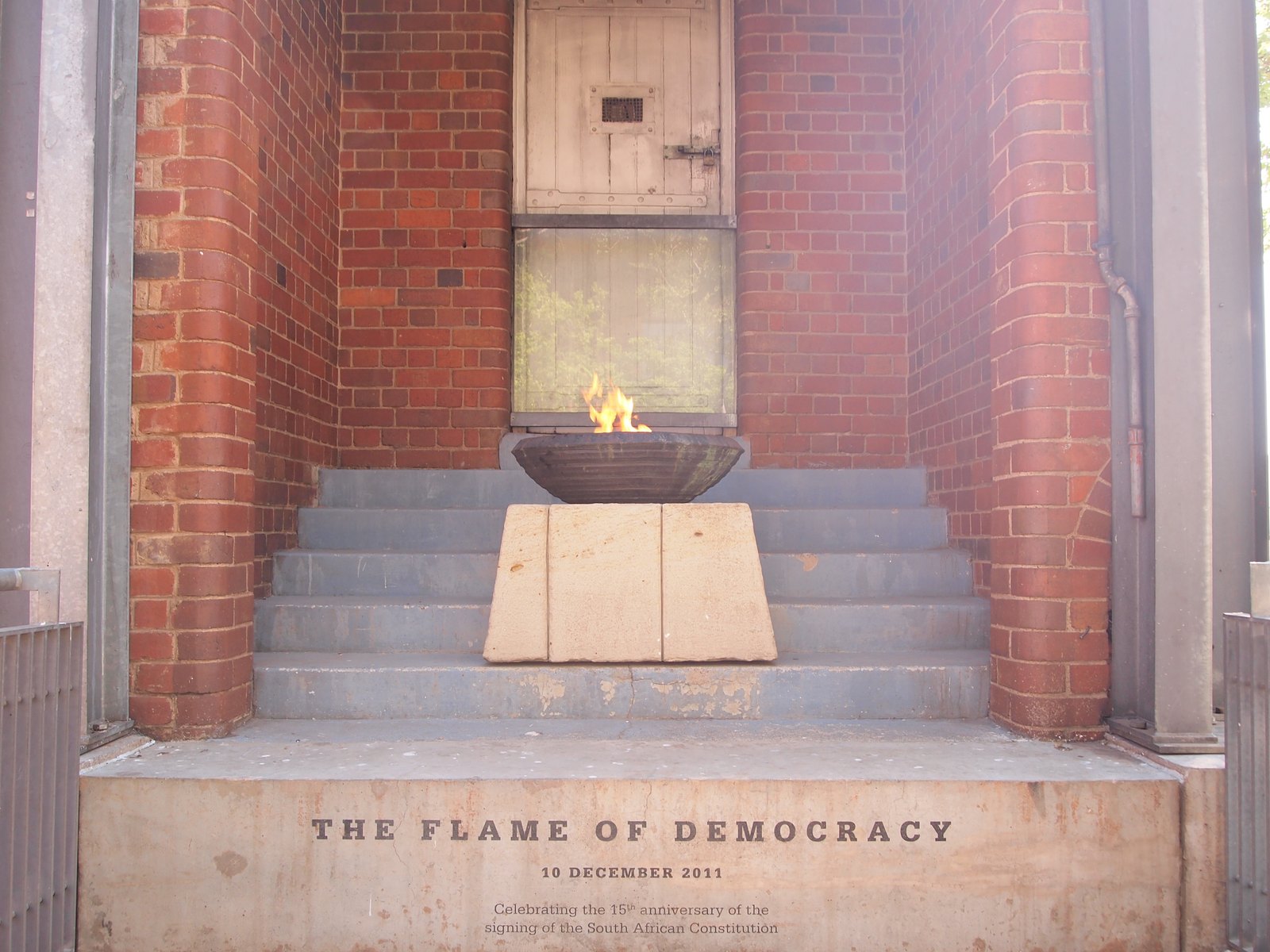
The selected real reference shows the Flame of Democracy in a brick-lined doorway, with a bowl and pedestal above a short flight of gray steps. A shuttered opening remains behind it. The inscription gives the place an explicit civic meaning; the surrounding wall keeps its material setting visible.
Read those parts separately. The flame and pedestal are an intervention. The brick enclosure and the changes in level frame the approach. A tight photograph can make the object look isolated, while the steps reveal that it occupies a route through the building.
The image is a dated reference, not a live report of access, lighting or an operating flame. Its small-scale details must not be used to invent a visitor route. Use the precinct’s visitor arrangements for that.
Reach the visitor center first
The operator’s arrival directions give the precinct address as 11 Kotze Street and direct drivers to underground parking off Joubert Street. Those details are more useful for a museum visit than using the Court’s postal address as if it were the ticket desk.
Start at the visitor center and ask which areas your selected visit covers that day. A hearing, event or temporary restriction can change the sequence. If access needs affect your choice, settle the route with visitor services before choosing a tour solely from its length. A shorter tour is not automatically an easier route.
Constitution Hill is most revealing when you keep its institutions distinct. The prison buildings deserve their own testimony; the Court deserves attention as a place still doing public work. The ground between them is part of the explanation.
Follow the thread
Cockatoo Island / Wareamah combines a former penal establishment with a later dockyard, requiring the island's different labor histories to be read separately.
Zeitz MOCAA offers another South African conversion in which a building's industrial past remains visible within a new public institution.
The reference photograph