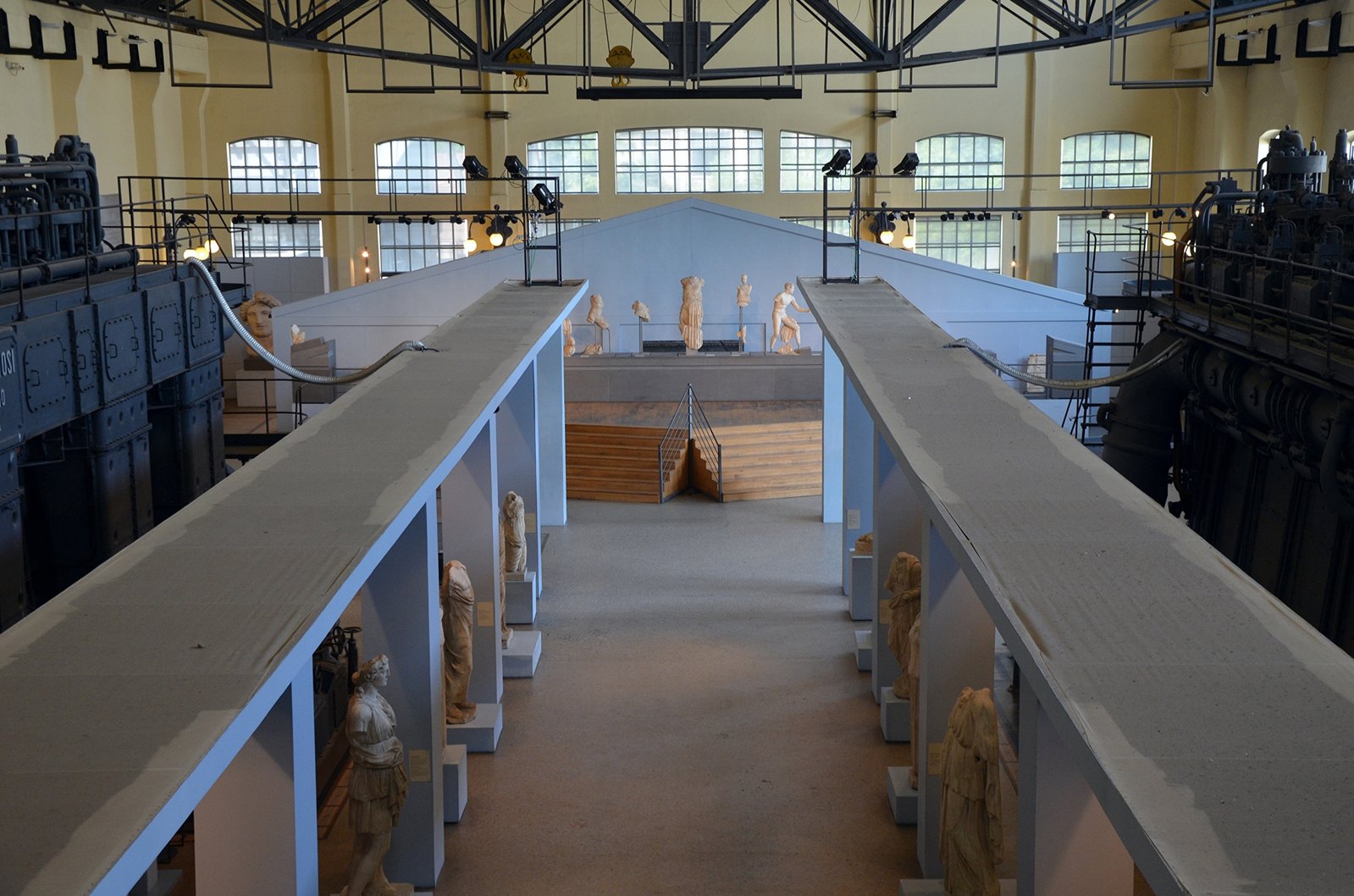
Ancient sculptures stand between the machinery of Rome’s first public power plant. The machines are part of the museum’s subject.
The Engine Room at Centrale Montemartini has two kinds of bodies: pale ancient figures and dark industrial engines. In the historical photograph, the machines flank display structures beneath a steel crane. Neither collection quite behaves like a neutral background for the other.
This museum on Via Ostiense in Rome grew from a temporary solution. Archaeological works needed somewhere to go during renovations at the Capitoline Museums. The former power plant provided the space—and an installation that made the factory difficult to ignore. If you've already seen sculpture against marble, this is a chance to see what changes when the neighboring object is an engine.
Visit at a glance
- Address: Via Ostiense 106, Rome.
- Normal hours: Tuesday–Sunday, 9 a.m.–7 p.m.; the museum lists last admission one hour before closing. Monday and holiday closures have exceptions set out on the official page.
- Visit type: an indoor museum visit, with archaeology and preserved industrial machinery in the same complex.
- Tickets: choose the current museum admission and any exhibition supplement through the official ticket information. No universal price or live availability is established here.
- Access needs: consult the museum's dedicated accessibility information for the rooms and support you need; an accessible service in one area doesn't describe every part of the building.
The practical information was read October 16, 2026.
Give the machinery its own look
The engines are so large that sculpture can initially become the measure of their size. Reverse the comparison for a moment. Look at the industrial surfaces, then at the modeled surface of a figure. One object was designed around a mechanical task, another around a human or divine image; the museum makes them share a field of view.
The power-plant account identifies Centrale Montemartini as Rome's first public electricity-generating plant. Its industrial purpose therefore belongs to the city's history as directly as the antiquities do, even though the two groups of objects come from very different periods.
The selected photograph shows substantial black engines on either side of a central display arrangement, arched upper windows and an overhead steel structure. It doesn't prove that each object remains in that position today. Use it to understand the juxtaposition, then use the labels in the room to identify the individual works and machines.
The temporary exhibition that stayed
The museum's history dates the first exhibition here to October 1997. Works from the Capitoline collections were moved while their usual home underwent major renovation. Acea had already restored the machinery and adapted the plant for museum use.
The exhibition, titled The Machines and the Gods, became a permanent museum in 2001. That sequence is more revealing than a simple factory-to-gallery description. The power station wasn't stripped into an anonymous shell before the sculpture arrived. The retained equipment helped define the experiment.
A conventional museum room can recede as you concentrate on an object. Here, trying to make the room disappear would remove much of the point. The unusually strong setting asks for a slower alternation: artwork, machine, relationship between the two.
Two histories of making
Sculpture and generating equipment both involve skill, materials and decisions about form. The comparison needn't turn every pipe into an artwork or every ancient figure into an engineering diagram. It can start more modestly: notice where an object's design makes sense for the task it originally performed.
For an ancient work, the label may explain its subject, original setting or later reconstruction. For industrial equipment, the relevant questions concern function, operation and the people who worked around it.
This approach also avoids a distracting shortcut: calling the setting a battle between old and new. Both the power station and the archaeology are historical now. The current layer is the museum arrangement, deciding how these objects should meet a present-day audience.
Choose a scope you can enjoy
An archaeology-focused visit and an industrial-history visit can share the same rooms while moving at different speeds. Rather than trying to give every object equal attention, choose a few comparisons. Start with the room as a whole, spend time with one sculpture, then inspect the equipment surrounding it.
The museum has continued to expand since becoming permanent, including a hall for the carriages of Pius IX's train. That addition belongs to a broader story of a museum growing within an industrial complex.
Leave with a final look across the Engine Room. The sculptures retain their individual subjects, and the engines retain their industrial weight. The arrangement works because neither needs to pretend the other isn't there.
Follow the thread
Battersea Power Station preserves turbine footprints after the machines have gone, showing how an industrial room can remain readable through absence.
At E-WERK Luckenwalde, the relationship between art and power generation includes renewed production, alongside the building's cultural use.
Sources and reporting
Researched October 16, 2026, from the linked sources. This is desk reporting; no firsthand visit is claimed.
The reference photograph