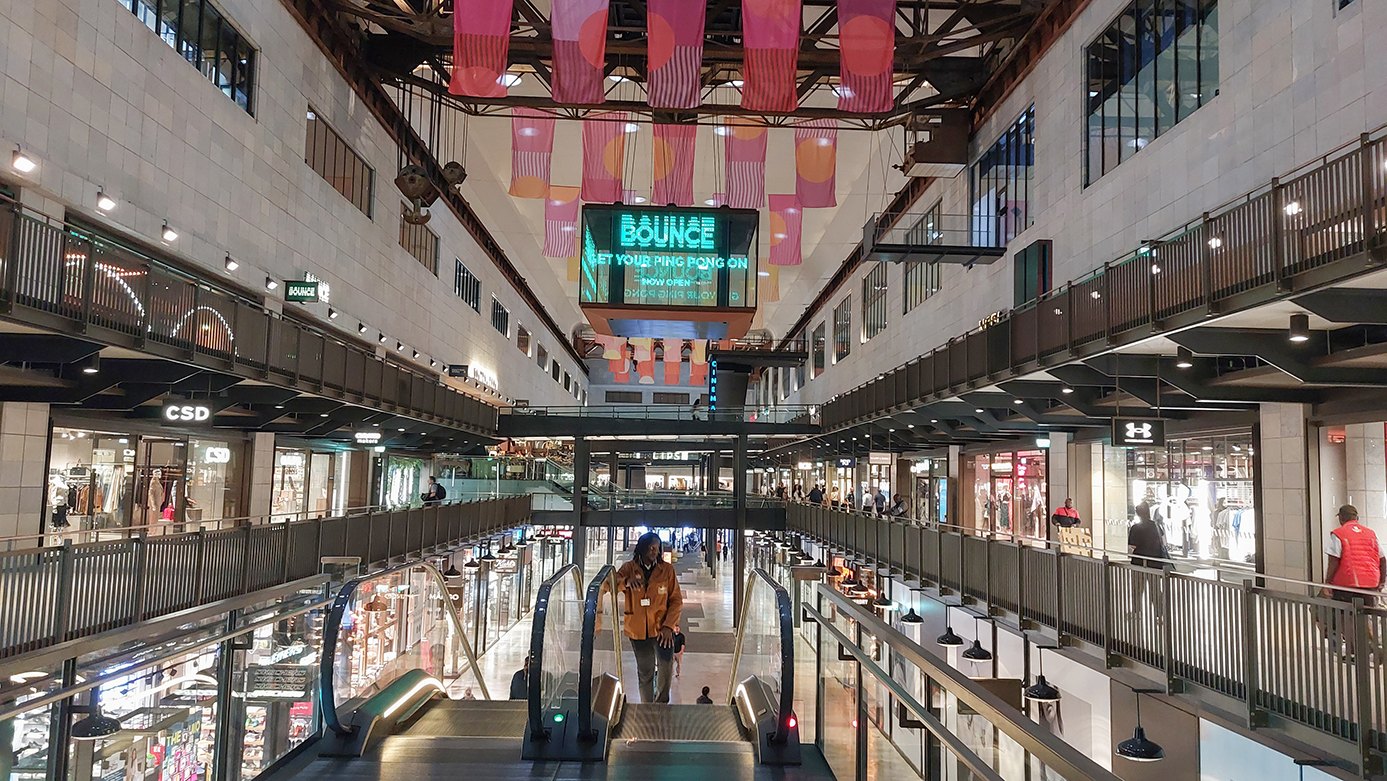
The shops occupy the old turbine halls. A line in the floor explains what used to occupy them.
At Battersea Power Station in London, the most useful thing to look at may be underneath the shopping crowd. Brick outlines mark the footprints of the removed turbines. The machines are gone, but their positions remain legible inside a building now arranged around shops, restaurants and escalators.
It's an unusually direct way of seeing an industrial conversion: an enormous object has disappeared, and the new floor tells you where to imagine it. Start with that small piece of interpretation, then look up toward the crane rails. Together, the floor and roof describe a room built to handle machinery rather than retail displays.
Visit at a glance
- Where: the public turbine halls at Battersea Power Station, south of the Thames in London.
- Access: public areas are free. The Chimney Lift, cinema and other attractions have their own tickets.
- Getting there: Battersea Power Station Underground station is on the Northern line. Follow the estate signs toward the main building; guest services are at the North and South entrances.
- A history-focused visit: the official guided tour is a separate product and includes Control Room A. The operator lists approximately 75 minutes for the tour; this is not the time needed to walk through the public halls.
- Plan around: the opening hours of the part you want to visit. A shop, a control-room experience and the public building need not keep identical hours.
These distinctions come from the operator's FAQ, checked October 16, 2026. No ticket availability is promised here.
Two halls, two design languages
The older Turbine Hall A has an Art Deco character. Turbine Hall B is more restrained, reflecting its later, 1950s design. This difference gives a walk through the building an easy subject: compare how two rooms associated with the same industrial purpose were dressed in different periods.
The restoration account identifies surviving gantry cranes and rails in Hall A, along with the restored roof glazing. In Hall B, smooth wall finishes and the old control-room instruments help explain its plainer appearance. The turbine outlines are a modern interpretive treatment, rather than surviving turbines or accidental scars.
A crane can be retained machinery; a brick footprint can explain machinery that was removed. Both tell the history, but they do different jobs. A useful question for each feature is simply: was this doing industrial work, supporting the old structure, or helping today's visitors understand it?
A power station large enough to become a landmark
Historic England lists Battersea at Grade II*. Its designation record treats the building as an important piece of utility architecture, with Giles Gilbert Scott's architectural contribution integral to its monumental form. That helps explain why the exterior can appear so composed even though the original task was relentlessly practical.
A power station needs to organize generating equipment, maintenance, fuel and exhaust. At Battersea, those demands were given an architectural identity recognizable far beyond the people who worked there. The four chimneys make the silhouette easy to remember; the huge interior volumes make its former purpose harder to erase.
The building reopened to the public in October 2022. Its current life includes work and housing as well as visitor attractions. Treating every door as part of an open museum would misunderstand the conversion: some parts invite browsing, some sell a specific experience, and some serve people who live or work here.
Original, restored, reconstructed
The chimneys need a particularly careful caption. They were dismantled and rebuilt after investigation of their deteriorating reinforced concrete. The operator describes reconstruction to the originals' specifications, overseen by Historic England. Calling them untouched originals would erase an important part of the conservation story.
The visible result invites a useful comparison. From outside, a rebuilt element can preserve a familiar outline. Inside, a retained piece of machinery can preserve material evidence. A third approach, the turbine footprint, preserves the location of something absent. Battersea uses all three.
For a wider historical overview, the heritage trail directs attention to plaques, an exhibition and pieces of original plant in the park. The former workers' film linked there offers another kind of evidence: work remembered by the people who did it. Architecture alone can't tell you how a shift felt or how jobs were divided.
Choose the room before choosing the ticket
If your interest is the scale of the building and its structural details, begin with the public halls. If it's the controls, use the official guided-tour information to select a tour that actually includes Control Room A. A reservation at Control Room B serves a different purpose; it doesn't substitute for access to A.
The photographed Hall B view shows parallel balconies, roof trusses and crane rails, with contemporary escalators below. The brick turbine outlines are not visible in that particular frame. Look for them in the building rather than expecting an image to show every feature at once.
After the halls, step far enough back to consider the whole building again. The silhouette is the familiar part. The more revealing question is how much of the old operation you can still reconstruct from the things that stayed—and the few things carefully marked as missing.
Follow the thread
At E-WERK Luckenwalde, art shares a former power station with renewed energy production, giving the machinery a different future.
Centrale Montemartini keeps its engines beside ancient sculpture, offering a useful comparison with Battersea's absent turbines and surviving floor markings.
Sources and reporting
Researched October 16, 2026, from the linked sources. This is desk reporting; no firsthand visit is claimed.
- Restoring the Power Station
- Visitor FAQ
- Historic England listing
- Discover Our Heritage
- Official Guided Tours
The reference photograph