A border station built on a grand scale now contains a hotel. The railway, the restored building and the public tour each offer a different way into its story.
Canfranc's long, symmetrical station building looks excessive for its mountain setting. That mismatch is the point. It was conceived for an international railway crossing the Pyrenees, a place where national systems met and passengers changed more than scenery. The mountain village acquired a building with the presence of a capital-city terminal.
Today, the historic passenger building houses Canfranc Estación, a Royal Hideaway Hotel. Arriving with an old photograph of an abandoned station will give you the wrong expectations. The exterior survives, but its purpose has changed; railway passengers use a newer station nearby. The municipality's history is the best starting point for understanding that arrangement.
A railway building at an international hinge
The station opened on July 18, 1928. Its scale belonged to the ambition of the Zaragoza–Pau connection, rather than the needs of a small settlement alone. Aragón's heritage record traces the building project and its protected status. This was infrastructure intended to announce that the border could be crossed through an organized, modern system.
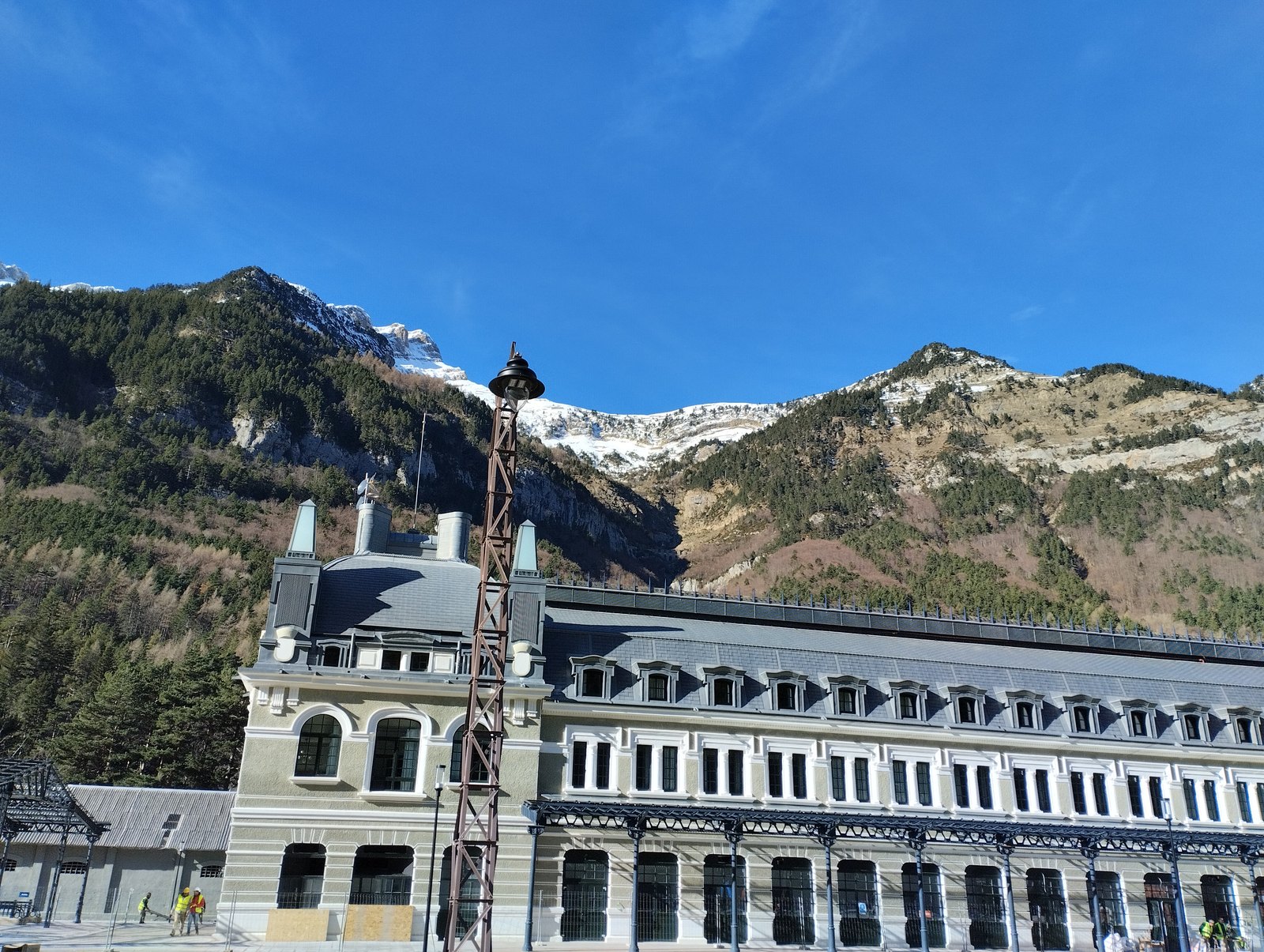
The roof, repeated windows and central pavilion turn that ambition into architecture. In the reference photograph, the building extends horizontally below steep mountain slopes. The contrast makes its proportions legible: the station spreads across the valley floor while the landscape rises around it. Its symmetry suggests a carefully managed point of passage in a terrain that resisted easy movement.
Canfranc is often introduced through stories of wartime intrigue or a spectacular decline. Those subjects deserve evidence of their own. The more immediate architectural story is already unusual: an oversized railway building survived long enough to acquire a new use without losing the outline that made it recognizable.
What the hotel conversion changes
Barceló opened the hotel in 2023. Its own account of the conversion explains the hospitality use and the effort to retain the building's identity. That is useful evidence about the operator's project, though it is naturally also a sales presentation.
For a day visitor, the change is practical. A hotel is an occupied building with private areas, reservations and working staff. A photograph of a hallway does not establish public access to it. A room booking, a restaurant reservation and a heritage tour are separate arrangements, and each should be checked through the organization providing it.
From outside, look at the rhythm of the facade and the way the central pavilion interrupts it. Those features explain the building better than treating the entire structure as an enormous prop. The repetition makes the scale apparent; the center gives the long elevation a focal point. Neither depends on an interior visit.
The public tour is primarily outdoors
The municipal guided visit is explicitly an exterior tour. It passes through the historic lobby on the way to the new railway station; it does not promise an extended tour of hotel interiors. The published description includes roughly 300–400 meters of walking and recommends advance booking.
The same page lists a standard adult price of €5 when checked on October 16, 2026. Tours are in Spanish; ask the tourism office about other languages before booking. Exact departures are handled through the booking calendar, and the office says new dates are released gradually. An empty future calendar does not automatically mean every tour has sold out.
The route is exposed to mountain weather. Bring suitable layers and check the forecast, especially if the visit is the main reason for traveling. There is no luggage-storage service on the municipal tour. Travelers with reduced mobility should ask about the walking route and its surfaces rather than infer accessibility from the hotel facilities.
Read the railway district as a whole
The old building, newer station and surrounding public spaces tell a fuller story together. Restoration has changed how visitors move through the site, and the continued railway presence prevents the historic building from becoming an isolated monument to a vanished activity.
The documentary photograph paired with this article dates from January 2023 and shows work barriers. It records a transition, not the present visitor route. Use it to study the facade and setting; use the municipality and operator for current access. Canfranc's interest lies in that passage between uses, still visible across the same mountain backdrop.
Follow the thread
TWA Flight Center / TWA Hotel gives an airport terminal a hotel use, with historic public spaces and separately booked hospitality experiences sharing the building.
Battersea Power Station also changes an industrial landmark's economy while retaining the architecture that made its former ambition visible.
Sources and reporting
Researched October 16, 2026, from the linked sources. This is desk reporting; no firsthand visit is claimed.
- Canfranc municipal station history
- Aragón heritage record
- Barceló conversion account
- Municipal exterior guided visit
The reference photograph