The Winterslag mine left two pit towers and a collection of working buildings. C-mine gives those buildings different jobs without making them all the same attraction.
Two pit towers still identify the old Winterslag mine at C-mine in Genk, Belgium. Around them, buildings once involved in mining now house cultural, creative and commercial activities. The site is easier to understand if you begin with the division of work: a mine needed many buildings above ground before anyone went below it.
Today's visitor choices have a similar division. The public Energy Building, the plaza and the ticketed C-mine Expedition are connected, but they don't share a single opening schedule or offer the same kind of access. That distinction lets you choose a surface visit, a more involved route or both.
Visit at a glance
The opening-hours page, read in full on October 16, 2026, lists the Energy Building's public opening as daily, 9 a.m.–6 p.m. The Expedition normally opens Tuesday–Sunday, 10 a.m.–5 p.m., with specified holiday exceptions.
For the Expedition, use C-mine 10 bus 2, 3600 Genk and call first at visitor reception for the audio guide and instructions. The product page recommends advance tickets and asks visitors to start within the time block purchased. No live ticket inventory or standard price was verified for this article.
Tower ascent uses stairs. The operator describes an alternative route and limited access for wheelchair users on the Expedition. Its access guidance also distinguishes the plaza's rough slate-chip areas from a smoother path around it. Plan for your chosen route rather than applying one accessibility label to the whole complex.
What a pit tower tells you
A pit tower marks a vertical connection between the workings below ground and the handling system above. At C-mine, the two surviving towers make the old industry's scale visible before you enter an exhibition. Their structure is the first thing to read against the surrounding buildings.
The site history dates commercial exploitation at Winterslag to 1917 and the mine's closure to March 31, 1988. It distinguishes the retained buildings from parts that were lost, including the coal-washing plant and cooling towers. Today's open spaces therefore aren't a complete diagram of the operating mine.
That absence is part of the story. A preserved tower can be instantly legible as industrial heritage, while an empty area may have once contained something equally necessary. Interpretation helps fill that gap without asking a present-day photograph to show buildings that no longer exist.
The Energy Building and its neighbors
C-mine's heritage account explains how different buildings were reassigned. The former bathing and lamp room now accommodates a cinema complex and other uses; the old offices house an incubator for creative businesses. The Energy Building contains visitor reception alongside cultural, design and catering functions.
Those changes preserve a pattern of many activities rather than creating one self-contained museum. The old buildings still matter individually. A shower and lamp room belonged to the preparation and return of a shift; a machine building supported the mine's technical operation. Their new occupants don't make those original distinctions disappear.
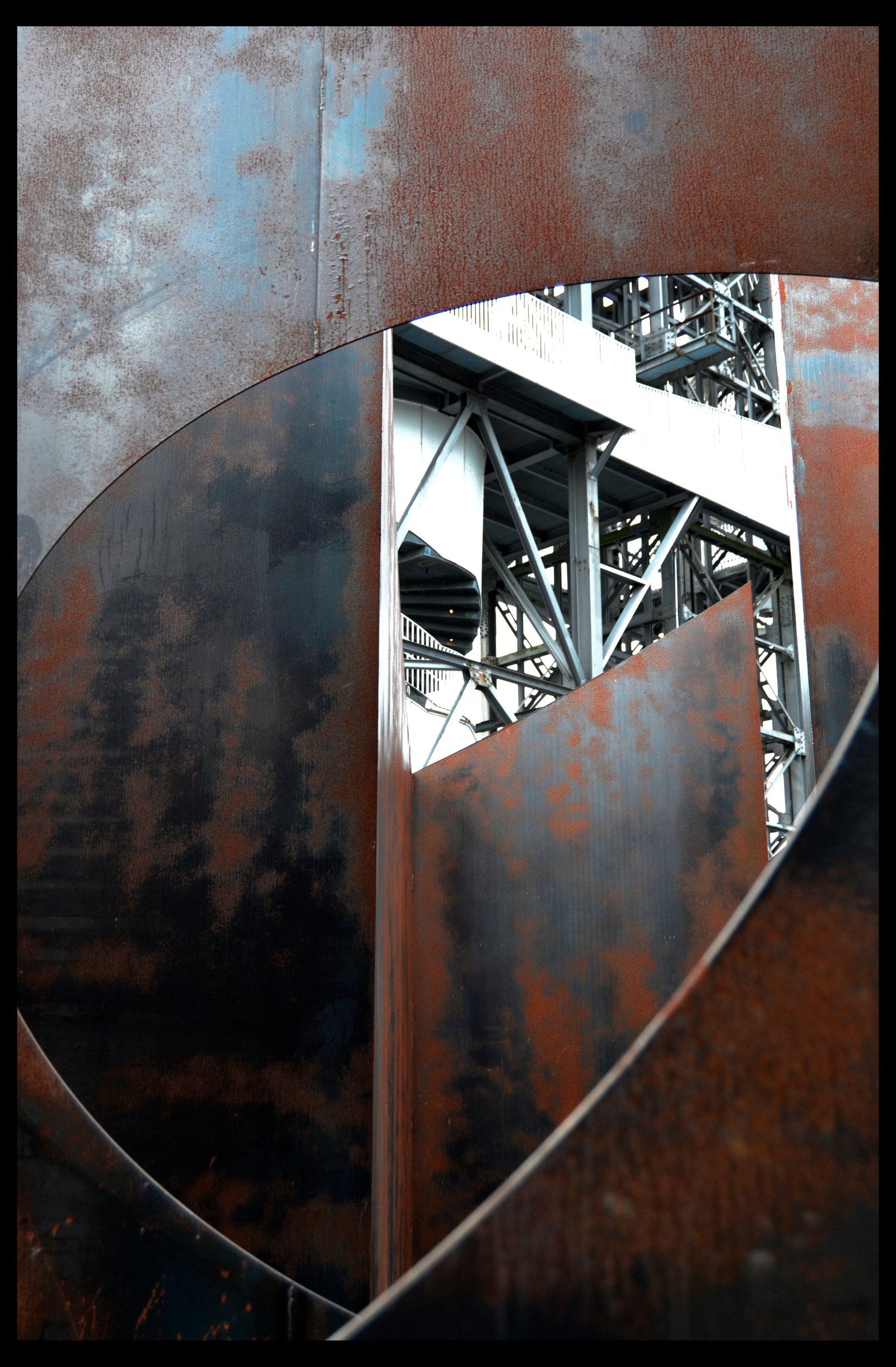
The selected detail photograph places rust-colored steel panels around a view of a shaft tower's bracing. It is a deliberately partial view, not a survey of the site. You can use it to compare the heavier foreground shapes with the finer structural members beyond, but not to identify every machine or visitor entrance.
What the Expedition adds
The official product describes a route of about 1.5 kilometers through underground passages and installations toward the pit tower. This visitor route shouldn't be confused with access to the original network of deep coal workings. Its purpose is an interpreted experience of mining, with an audio guide and constructed installations.
The strongest reason to give C-mine time is that the change of use remains distributed across a whole place. It takes more than a tower to explain a mine, and more than a gallery to describe this cultural district. Walk between the buildings and the separate jobs begin to come into focus.
Follow the thread
Grand-Hornu frames another Belgian coal complex through formal courtyards and workers' housing, revealing a different architectural expression of industrial ambition.
Völklinger Hütte expands the question of connected machinery into a preserved ironmaking complex, where pipes and platforms reveal relationships between processes.
Sources and reporting
Researched October 16, 2026, from the linked sources. This is desk reporting; no firsthand visit is claimed.
The reference photograph