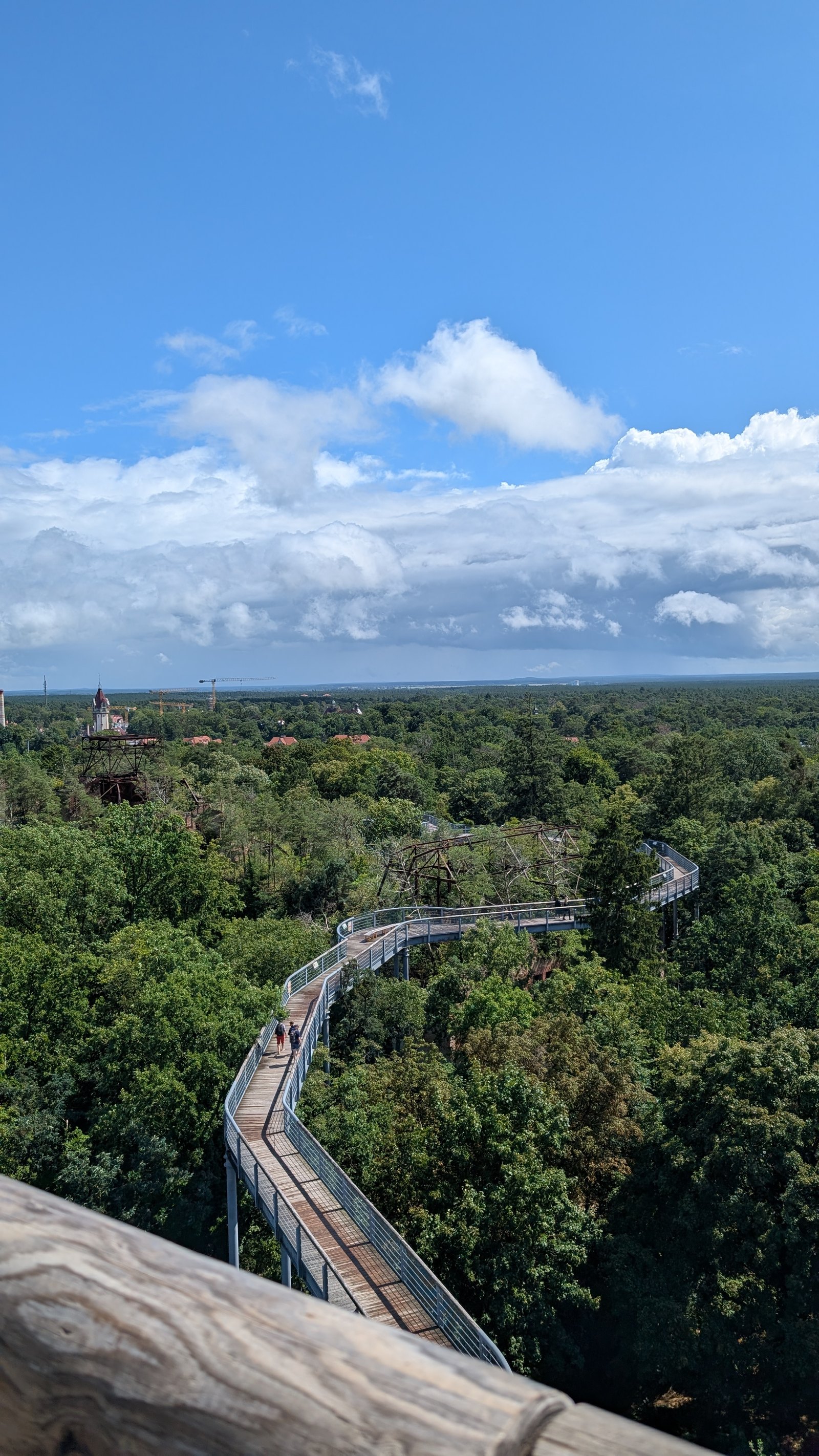
A treetop walkway crosses the former sanatorium landscape outside Berlin. The legal visitor route and its building tours offer two very different views of the same place.
At Beelitz-Heilstätten, a modern walkway curves between trees and over the remains of a sanatorium building. From above, roofless rooms and new growth share the same frame. The contrast is striking because the landscape was once part of the medical idea: fresh air, woodland and carefully organized buildings were supposed to help patients recover.
Today, the relevant visitor attraction is Baum & Zeit, with a managed park, treetop route and separately booked tours. Beelitz-Heilstätten is a larger district with a complicated history. A ticket to this attraction does not turn every nearby building into an open site.
A hospital landscape in the forest
The operator's history begins with the purchase of woodland in 1898 and the first patients arriving in 1902. The institution treated tuberculosis and other illnesses in separate parts of a deliberately planned complex. Gender divisions and medical functions shaped the arrangement of its buildings.
Outdoor resting areas formed part of the period's treatment regime. The forest setting was therefore functional as well as scenic. Looking at the remaining pavilions as isolated picturesque ruins misses the wider plan: paths, service buildings and planted spaces supported an institution with many daily needs.
The complex later served military medicine, including the Soviet armed forces after the Second World War. These changes did not happen uniformly across every building. The area's present mixture of reuse, restoration and surviving ruins is more complicated than the phrase “abandoned hospital” suggests.
The elevated route reveals a different layer
The treetop walkway opened in 2015. It extends for more than 700 meters and crosses the ruined Alpenhaus, where trees have grown above and within the damaged building. The operator describes a lift serving the walkway and the tower levels.
From that route, the building becomes a landscape of walls, openings and vegetation. The elevated view exposes relationships that a ground-level photograph can hide: how close trees stand to masonry, where a room has lost its enclosure, and how new growth occupies an old architectural footprint.
The reference image for this story was taken in August 2025. It shows the curved walkway, railings and trees. It records the managed visitor infrastructure as well as the historic setting.
Interior tours are a separate choice
The official tour page lists several routes through particular buildings. These differ in minimum age, accessibility, duration and cost. They are guided visits, each with a named meeting point; they do not establish free access to the interiors outside the booked route.
When checked on October 16, 2026, the standard Alpenhaus and old-surgery tours were each listed at €12.50 in addition to park and walkway admission. Their published conditions included helmets and limits on photography. Interior routes are not barrier-free. The operator offers private English-language tours on request; confirm an actual arrangement before relying on English interpretation.
The distinction makes a real difference to the day. Someone mainly interested in trees and architecture from above may choose the walkway. Someone seeking medical interiors needs a specific building tour. A photo tour is another product, with different time and usage conditions. Read the product name before comparing prices.
Check the seasonal calendar
The opening-hours page listed regular October hours of 10 a.m.–6 p.m. when checked, with exceptions on October 30 and 31. Later months contain closed periods and evening-event schedules. Last admission is normally an hour before park closing, so an arrival near the stated closing time will be too late.
Consult the ticket page for the park tariff that applies on your date. Winter rates and special events are separate conditions. Follow the operator's arrival directions rather than treating its postal address as a guaranteed navigation entrance.
The strongest visit connects the new route with the old institution: a place once designed around the benefits of its woodland now uses the forest to reveal its buildings from an unfamiliar height. Take the advertised paths, choose any interior tour deliberately and let the larger history complicate the easy photograph of nature taking over.
Follow the thread
Canfranc International Station also challenges an outdated abandoned-site image, with a hotel conversion and a separately defined public heritage visit.
At Evergreen Brick Works, a former quarry and brick factory likewise bring historic buildings and a changed landscape into the same visitor experience.
Sources and reporting
Researched October 16, 2026, from the linked sources. This is desk reporting; no firsthand visit is claimed.
- Baum&Zeit treetop walkway
- Baum&Zeit history
- Official building tours
- Seasonal opening calendar
- Park prices and tickets
The reference photograph