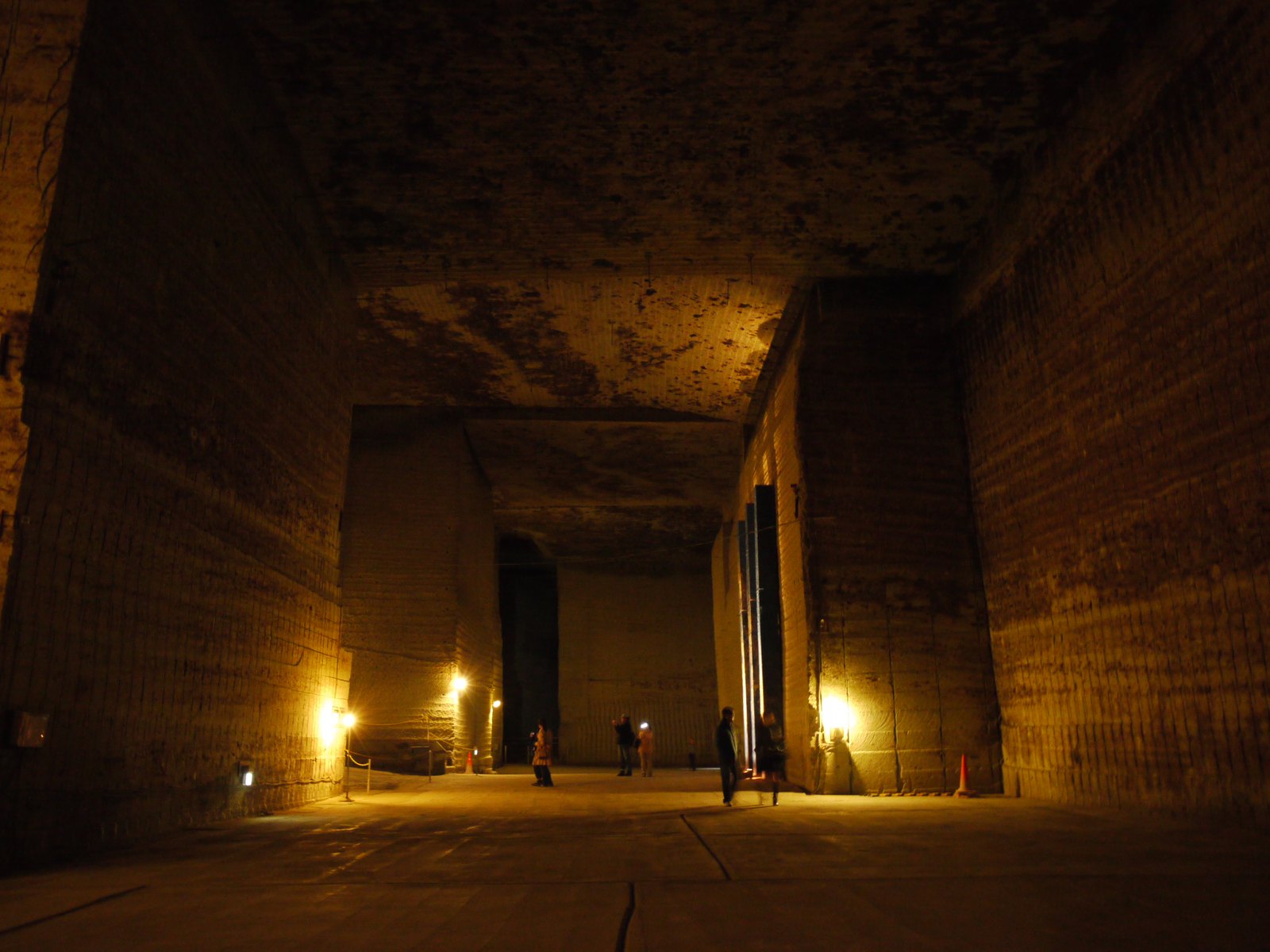
At Ōya History Museum outside Utsunomiya, the room is what the quarry workers didn’t carry away. The former underground stone workings have broad ceiling planes and enormous square masses between the passages. Their geometry is the first clue that this is an excavated industrial space rather than a natural cave.
The museum explains the production of Ōya stone. You can visit the underground area, but the practical questions matter: stairs, a cold interior, a cash payment and a return journey from the district. Several English tourism pages still quote an older adult price. The museum’s own Japanese access page gives the revised figure.
Before you descend
Checked October 16, 2026, the museum’s access page lists adult admission at ¥1,000 following an April 2026 increase, and cash-only payment. It gives April–November hours of 9 am–5 pm, last entry 4:30 pm; December–March hours are shorter. Wheelchairs and strollers cannot use the ordinary underground route. Visitors with walking difficulties should ask about the separate, advance-booked weekday arrangement rather than assume access.
Bring a layer. The museum homepage explicitly asks visitors to do so. Its displayed temperature is a changing reading, not a forecast for your visit. Check dated notices too: a closure notice for a past typhoon is not evidence that the museum is closed today.
What the quarry removed
The museum’s exhibition description separates geology, extraction methods, transport and mechanization. It identifies Ōya stone as a volcanic tuff and explains that hand tools preceded machine cutting. The underground area reaches roughly 30 meters below ground and covers about 20,000 square meters. These are descriptions of the workings, not a promise that every part is on the visitor route.
The distinction changes how to look at the place. A building is usually explained through the material assembled to make it. Here, start with the missing material. Every open volume raises a question about the blocks taken out, the work needed to move them and the stone left between excavations.
You don’t need to identify a precise extraction method on every wall. Tool marks can be visible without their date being obvious. Use the exhibits to connect a technique with a documented example, rather than assigning every groove in a photograph to handwork or a particular machine.
Look closer at the square edges
Urawa Zero’s March 2010 photograph shows a high rectangular ceiling, a broad square pillar near the center and warm lights along the lower walls. Visitors provide a scale cue at floor level. The upper surface looks far more regular than the outline of a typical natural cavern.
Follow one corner where a wall meets the ceiling. Its change of direction is an effective way to see the excavation as a sequence of surfaces rather than a single enormous void. Then compare the lit lower wall with the dimmer stone overhead. Lighting makes the space theatrical; the squared geometry carries the industrial story.
Those observations belong to this dated image. They don’t locate a permitted viewpoint for your own photograph or establish which side areas are open. A picture may make the floor appear straightforward while telling you almost nothing about the descent required to reach it.
Stone had a life above ground
The local heritage record identifies the museum as the former Kaineriyama quarry, with extraction beginning in 1919. That specific name is helpful: “Ōya” also describes a wider district and other stone-related sites. A ticket or tour for a different quarry is not automatically a visit to this museum.
The local tourism council describes later uses including rice storage, concerts and weddings. Those changing uses help explain why a working void can acquire the visual language of a hall. They don’t mean a concert, wedding setup or temporary installation is included on an ordinary museum day.
This is a useful place to think about the distance between a finished stone block and the landscape that supplied it. Above ground, cut stone can look reassuringly solid and complete. Underground, the same trade becomes a set of absences. The room is one part of a much larger material story.
Getting there without confusing the sites
The museum is at 909 Ōyamachi, Utsunomiya. The heritage page describes the bus connection from Utsunomiya toward Ōya/Tateiwa, getting off at Shiryōkan-iriguchi, the museum entrance stop. Use the museum name when navigating; its own site warns that entering the broad street address alone can send drivers into the wrong part of the surrounding area.
Check the return departure before starting the underground visit. A journey planner’s arrival time doesn’t answer when the next service back leaves. We haven’t verified a date-specific bus timetable here, so there’s no invented final departure or guaranteed connection.
For photographs, read the museum’s current equipment and commercial-use conditions. An open public route is not permission to block a staircase or set up a tripod. The documentary reference below is separately licensed by its photographer; that doesn’t turn it into evidence of present museum rules.
Choose Ōya for an encounter with the space created by extraction. Read the exhibits, then let the ceiling become stone again rather than scenery.
Documentary reference: Urawa Zero, March 22, 2010, CC BY 2.0, Wikimedia Commons. Any AI derivative is an editorial illustration, not a current-condition photograph.
Follow the thread
Sovereign Hill mine experiences separates original mine workings from sound-and-light interpretation, adding another way to think about what an underground visitor experience actually shows.
Evergreen Brick Works connects a finished building material with the quarry landscape that supplied it, bringing the story of extraction back above ground.
The reference photograph