The elephant’s moving parts belong in a shipbuilding district. The workshops and halls explain why this particular fantasy lives here.
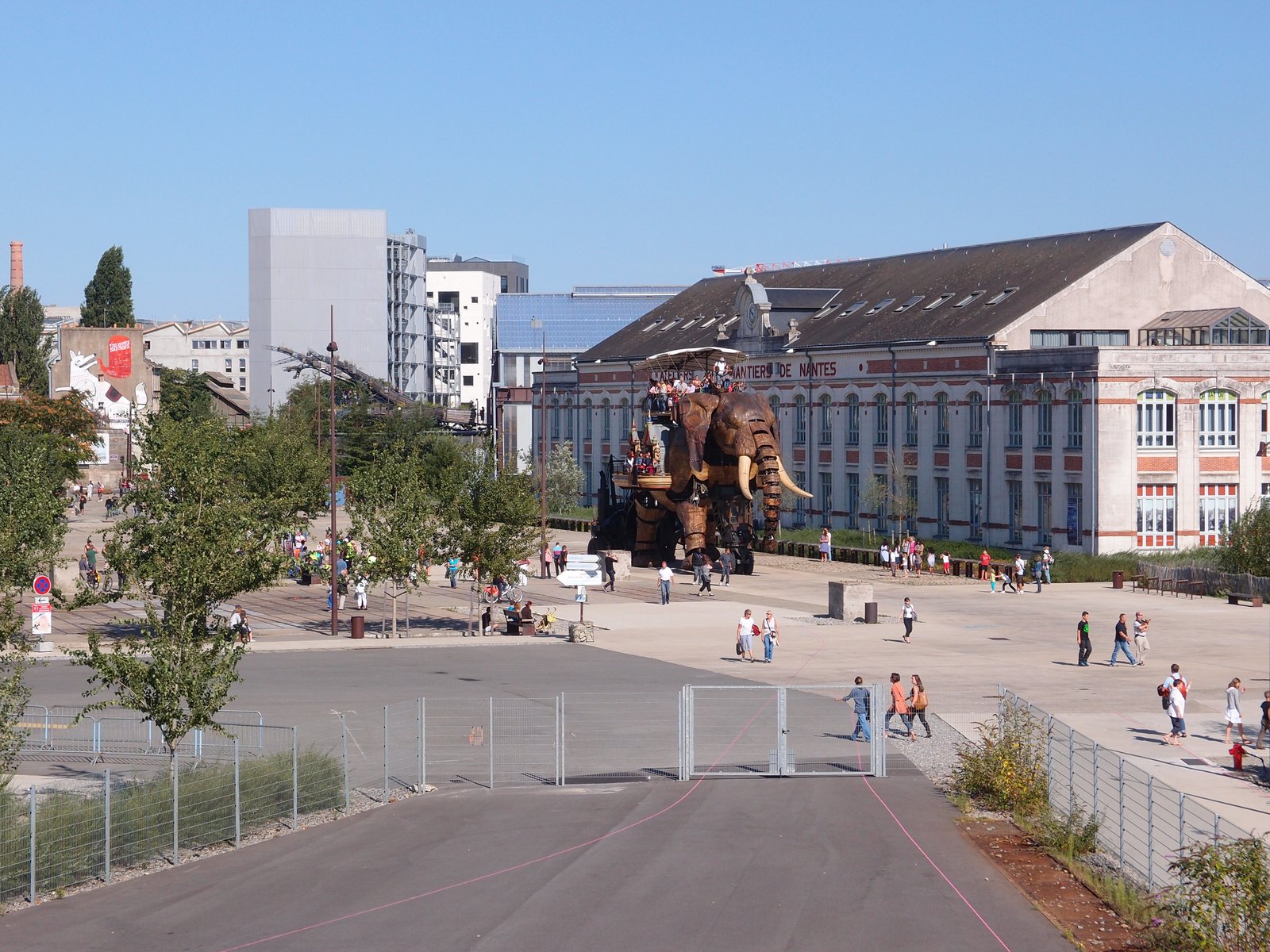
A wooden elephant stands in front of a long industrial hall on Nantes' former shipyard island. Its tusks, passenger balconies and mechanical body make a peculiar neighbor for a building once associated with making ships. The pairing is the starting point of Les Machines de l'île: large things are still being designed, assembled and set in motion here.
You can watch the Grand Éléphant from the surrounding public spaces, book a ride, or spend time with the smaller mechanical creatures in the Galerie des Machines. Those choices lead to different experiences. The elephant's size is immediate; the gallery and workshop views make the work behind the spectacle easier to follow.
Choose your visit
The official ticket page, checked October 16, 2026, treats the Grand Éléphant ride, Galerie des Machines and Carrousel des Mondes Marins as separate attractions. Standard individual admission is listed at €12 per attraction; reductions and combined passes have their own conditions.
An elephant ride is listed as 30 minutes on its specific page. That isn't a total duration for the island, gallery or carousel. Elephant operation is weather-dependent. Booking a ride doesn't eliminate the need to arrive at the correct boarding point.
The site is at Parc des Chantiers, Boulevard Léon Bureau, Nantes. For public transport, the operator identifies Chantiers navals on tram line 1 as an approach. Construction affects the district, so use the access page and current calendar for your actual travel date. The article doesn't promise a particular vehicle route through ongoing works.
The old halls give the elephant room
Les Nefs are former shipbuilding halls, retained within the island's redevelopment. Samoa's project account describes the conversion as a covered space continuous with the public spaces outside. In 2007, the machine-building workshop and exhibition gallery were placed within that large industrial structure.
That arrangement is worth looking at before concentrating on a single creature. The old roof provides a big shared enclosure; newer rooms and working spaces sit beneath it. The site can accommodate making, displaying and moving the machines without pretending the industrial structure was built for them.
In the historical reference photograph, the elephant occupies the open space in front of the hall. The long roof and repeated windows establish scale, while people on the ground and passenger levels give two different comparisons. The image dates from 2012. It explains the setting, rather than documenting today's construction barriers or route.
Watch the legs, not only the trunk
The Grand Éléphant description gives the animal a height of 12 meters, roughly 39 feet, and explains that passengers can see the moving gears associated with its legs. The operator describes a hybrid drive introduced in 2018. Wood, steel, hydraulics and control remain part of the object even when its movement seems animal-like.
That visible machinery gives you a second way to enjoy it. Follow one motion: the relationship between a leg and the body, or the way the passenger structure sits above the animal's outline. You don't need to solve the mechanism. Noticing where motion comes from is enough to make the creature feel less like a prop and more like a constructed performance.
Watching from outside and riding are therefore different pleasures. The first offers an overall view of the moving form. The second brings the machinery closer and changes the relationship between the passenger and the ground. Neither should be described as a substitute for the other.
Inside the mechanical menagerie
The Galerie des Machines presents machines made by the theater company La Machine. Its staff explain how the creatures work, and the gallery connects sketches and prototypes with operating objects. The emphasis is on an evolving workshop world rather than a finished collection of static models.
Some pieces refer to the Heron Tree project. A prototype or scale model is evidence of research and design; it isn't proof that the full tree has been built. Keep that distinction in mind when older travel features describe future plans with the certainty of completed attractions.
A useful way to divide your attention is to choose one creature for its form and another for its mechanism. A moving bird invites different questions from an elephant carrying people. The common subject is how a designed movement persuades you to read a machine as alive.
Leave space for the shipyard
A visit can easily become a sequence of ticketed attractions. Between them, look back at the halls and open working-scale spaces that made the project possible. The human-made landscape is as important to this story as the human-made animals.
If you combine attractions, choose the specific products first, then fit the public-space walk around the booked times. The carousel changes operating modes by period, so a discovery visit doesn't necessarily include boarding its ride elements. The operator's current ticket page explains that distinction.
The elephant is an improbable continuation of a place built for large-scale construction. It doesn't reproduce shipbuilding. It keeps the act of making something enormous visible—and lets that enormous thing walk out into the city.
Follow the thread
Le Lieu Unique follows another Nantes factory into cultural use, with a surviving biscuit-brand tower explaining the building's former public image.
F60 Visitor Mine preserves a real mining machine whose vast steel frame gives mechanical movement a very different purpose and scale.
Sources and reporting
Researched October 16, 2026, from the linked sources. This is desk reporting; no firsthand visit is claimed.
The reference photograph