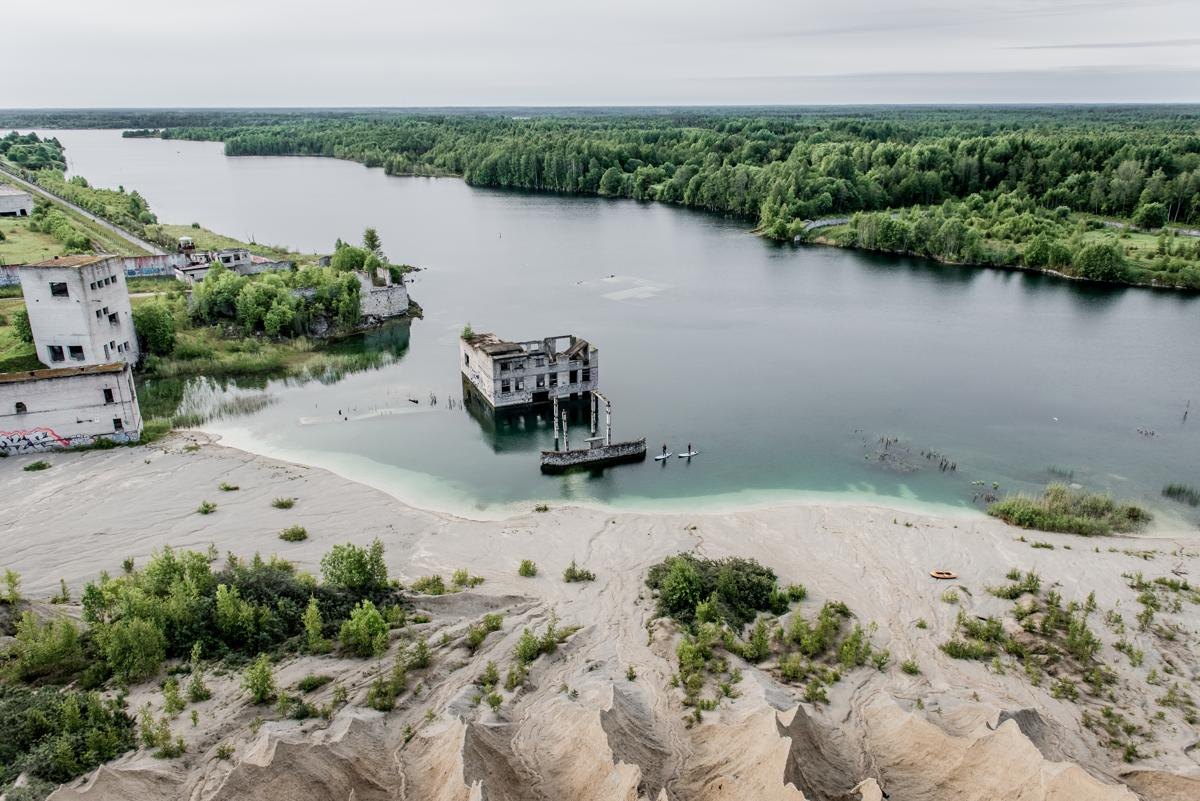
Water now occupies a place where limestone was once extracted. Beside Rummu Quarry, west of Tallinn, an artificial hill and the former prison complex make the landscape look difficult to explain at a glance. The regional tourism authority describes the quarry filling after extraction ended, submerging structures and creating a destination for divers. Visit Harju's quarry overview.
The familiar phrase “underwater prison” compresses several places into one. For a visit, separate the quarry landscape, Murru Prison Museum and any activity on or under the water. They raise different questions about access, time and booking, and a photograph of one doesn't tell you what is included in another.
The useful starting points
| Part of the visit | What it offers | What to establish |
|---|---|---|
| Quarry | The water, artificial hill and altered industrial landscape | Admission and pedestrian entrance for your date |
| Prison museum | A closer account of the institution and its spaces | Self-directed access, audio guide or a booked tour |
| Water activity | A separate perspective from the lake or underwater | Named provider, season, meeting point and requirements |
Visit Harju lists the quarry at Haapsalu mnt 13, Rummu, and the prison museum at Haapsalu mnt 11. Use the entrance supplied by your chosen operator; the two address listings are not a reason to assume that every booking uses the same gate. Quarry listing, museum listing.
Access note, checked October 16, 2026: the operator's pages don't provide a consistent opening schedule we could verify. Confirm current admission and hours for the spaces you want to visit.
Start with the question the photograph leaves out
An image of a building surrounded by water makes you ask what happened. At Rummu, the essential first answer is quarrying. Water occupies an excavated landscape, rather than a town suddenly relocated into a lake. The former quarry and prison belong to the same setting, but a view across the water is only one way into its history. Quarry background.
If you're mainly interested in landscape, give yourself permission to focus on the relationship between the hill, water and surviving structures. Try looking for boundaries: where land was cut, where a built edge interrupts the shore, where a structure continues below the visible waterline. Treat those as questions to explore with the site's information, not as evidence of a particular building's purpose.
That distinction improves photographs too. A wider frame can explain more than a close crop of a dramatic ruin. Include enough of the surroundings to show that you are looking at a changed working landscape. Water clarity, light and viewing angle vary, so don't build your expectations around seeing every underwater feature in a promotional image.
Give the prison its own part of the visit
Visit Harju's museum description identifies cells, punishment areas, workspaces and other rooms as part of the visit. It describes audio-guided, guided and independent ways to explore. A separate listing advertises an advance-booked private tour with a former prison officer. Those are different formats; confirm which is actually offered for your date and language. Murru Prison Museum, private guided tour.
Choose a guided format if your main interest is how the institution worked. A room's dimensions alone can't explain its rules or the experiences of the people held there. A guide's account provides a perspective, which is worth identifying as a perspective rather than treating it as the entire history.
For a self-directed visit, use the available interpretation to connect a room to a function before moving on. Ask what the room was for, who could enter it and what evidence supports that explanation. This gives the visit a structure without turning it into a hunt for the most unsettling image.
There is no need to make the prison more theatrical to make it interesting. The contrast between a place of confinement and today's leisure setting already asks a substantial question: how should a site present a difficult past when its landscape has become an attraction?
Water activities need a separate plan
Visit Estonia lists a guided diving experience with its own provider, advance booking and a seasonal window. The described package includes instruction, equipment and quarry admission. That supports one specific activity listing; it does not establish that all water activities operate whenever the grounds are open. Diving experience listed by Visit Estonia.
If diving is the reason for your trip, arrange the activity first and build the rest of the day around its confirmed meeting time. Ask the provider directly about participation requirements and conditions. If it is only an appealing possibility, decide whether a land-based visit would still justify the journey if the activity isn't available.
The same planning principle applies to any equipment rental: a photograph of people on the water doesn't establish today's service, weather conditions or availability. Choose an actual product and provider rather than treating “Rummu” as one all-inclusive experience.
Planning from Tallinn
For public transportation, search your travel date in Peatus. We haven't verified a complete bus itinerary, the exact visitor gate or a return departure to Tallinn. Match the arrival stop and final walk to your operator's entrance instructions before committing to the trip.
If driving or arranging a transfer, use the address for your chosen visit above and get its meeting-point details. For a transfer, agree on the return pickup location and time too. Save those instructions alongside your booking so a general map pin doesn't become your only reference on arrival.
For another place whose visible appearance conceals several separate chapters of history, read about Teufelsberg in Berlin. Its artificial hill is part of the story too.
Research checked October 16, 2026. Official visitor information: Rummu's operator.
The reference photograph