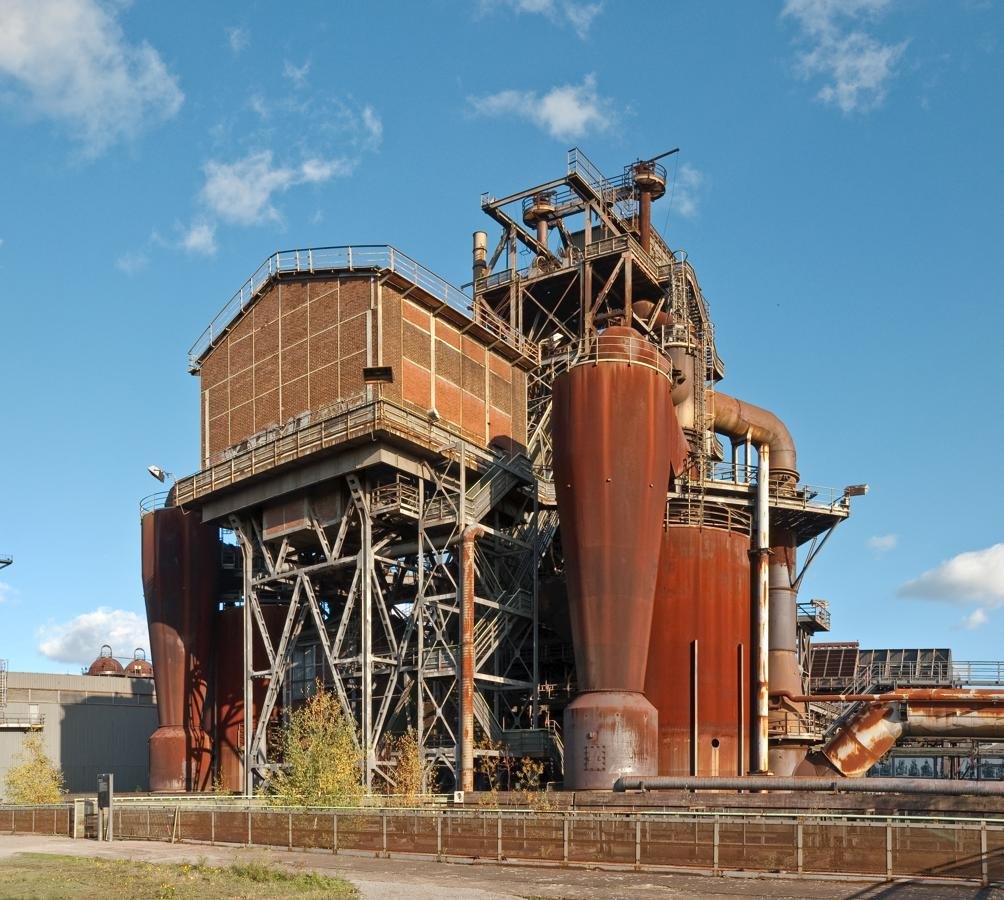
At Landschaftspark Duisburg-Nord, the machinery remains in the landscape and the landscape has become part of the experience. Former industrial spaces contain gardens and vegetation; after dark, colored light picks out the ironworks. Arriving before sunset gives you a chance to understand the shapes before the lighting changes their appearance. That's our recommendation for a first visit. Landscape design, light installation.
One current restriction is easy to miss: the operator's separate notice says Blast Furnace 5 and its observation deck close at dusk until further notice. The park's evening lighting and an evening climb are therefore different plans. Current furnace notice.
Visit at a glance
| Plan this | What to know |
|---|---|
| Address | Emscherstraße 71, 47137 Duisburg, Germany |
| Admission | Park entry is free; particular events and activities can charge |
| Normal tram approach | 903 from Duisburg Hbf toward Dinslaken; leave at Landschaftspark-Nord |
| Final approach | Approximately ten minutes on foot according to the park |
| Full lighting | Listed for Friday–Sunday and North Rhine-Westphalia public holidays; the opening page also includes holiday eves |
| Monday–Thursday | Reduced program, normally the three chimneys |
| Furnace access | Daytime only under the current dusk-closure notice; weather can also close it |
The official directions, admission page and opening schedule provide the basic plan. For an actual departure, use DVG; the time the lights switch off is not a transit timetable.
Choose the evening you actually want
The light installation by Jonathan Park began in 1996. The operator describes red, green and blue as references to heat, gas and water. This makes the colors part of the site's interpretation, not simply a bright background for photographs. About the installation.
The distinction between the full and reduced programs matters more than the phrase “open at night.” If you want the wider blast-furnace complex illuminated, choose a listed full-program evening. If a weekday is your only option, expect a more limited display rather than the arrangement shown in every dramatic night photograph.
The park's schedule lists illumination from dusk until 1 a.m. Some older explanatory text on the light-installation page also mentions 3 a.m. in summer, while its own timetable says 1 a.m. We'd plan around the earlier published finish and check with the visitor center if a late-night visit is essential. Neither statement is a reason to leave the return journey until the last minute. Published lighting times.
Give daylight a job
Our suggested sequence has three parts: get oriented, investigate one piece of the old works, then return to a familiar viewpoint as the light changes. This is a flexible way to organize the visit, not a surveyed walking route with guaranteed timings.
Start by finding the visitor center and the entrance you intend to use on the way out. Then choose one industrial structure to understand. With a little daylight left, look for a ground-level view you would like to revisit after dark. That way, the evening adds something to a place you have already begun to read.
There is a useful photographic exercise here too. Frame the same structure once before and once after the lights come on, from a permitted path. Compare which connections remain legible and which disappear into shadow. The difference can be more revealing than trying to fit the entire site into a single image.
What the furnace did
Blast Furnace 5 produced pig iron by smelting iron ore with other materials at high temperatures. The operator's interpretation explains how material moved downward through zones of increasing heat before molten products collected below. The furnace's shape belonged to that process. Blast Furnace 5.
Rather than memorizing every component, start with the direction of movement: material arriving, descending and leaving in another form. Then look at the structures supporting that sequence. A production site becomes easier to understand when you give the machinery a verb.
The furnace's final shift was on April 4, 1985. It later became a public viewing attraction, opening in that role in 1994. These dates explain why the site can contain both equipment with a very specific industrial purpose and routes intended for visitors. Furnace history.
The climb uses an iron staircase. It isn't a step-free viewpoint, and it isn't necessary for appreciating the park. If stairs or heights aren't comfortable for you, build the outing around the ground-level structures and gardens rather than treating the top as a compulsory finish.
A park that kept its earlier shape
The landscape design retains industrial spaces while giving vegetation room to develop. The operator describes planted gardens alongside former storage areas where plants establish themselves more freely. Paths and boardwalks make these different spaces legible to visitors. How the landscape is organized.
Look for that difference between a maintained garden and growth occupying a former working space. Both can appear green in a distant photograph, but they tell different stories about how the site is cared for. The question isn't simply whether nature has “taken over.” Ask where people are guiding it, where they are allowing it room, and which industrial boundaries still shape the result.
For another approach to preserving the Ruhr's industrial structures, Zollverein in Essen makes an interesting comparison. Its museums and production buildings help explain a different set of choices about public use.
The furnace closes before the park does
The general opening page still describes unrestricted daily access to the furnace. The more specific notice, however, says damaged lighting has made evening operation unsafe and closes both the furnace and observation deck from dusk. The notice says daytime access remains available. Follow that restriction and any signs on site, not the broader evergreen description. Operator's closure notice.
Snow, ice and bad weather can also close the furnace. If the climb is central to your plans, check the current status before traveling and allow enough daylight to return to ground level. An evening photograph from a high viewpoint may describe an earlier visit under different conditions.
Getting back to Duisburg
The park's directions put tram 903 below Duisburg's main railway station, reached by following the blue-and-white underground signs. At Landschaftspark-Nord, signs guide the walking approach. Drivers should note that Duisburg has two streets called Emscherstraße; the park is in Obermeiderich. Arrival details.
For the return, select your travel date and destination in the transport planner before entering the park. Leave time to reach the stop, and avoid making the final available connection your only option. We have not verified a dated last departure, so this guide doesn't promise one.
The lights are the second view of Landschaftspark. Give yourself a first one in daylight, and you have something to compare them with.
Visitor information checked October 16, 2026. The dusk closure takes precedence over older general access wording.
The reference photograph