Below the city.
A forest of concrete columns beneath Houston. Follow three small clues through a room built to hold water.

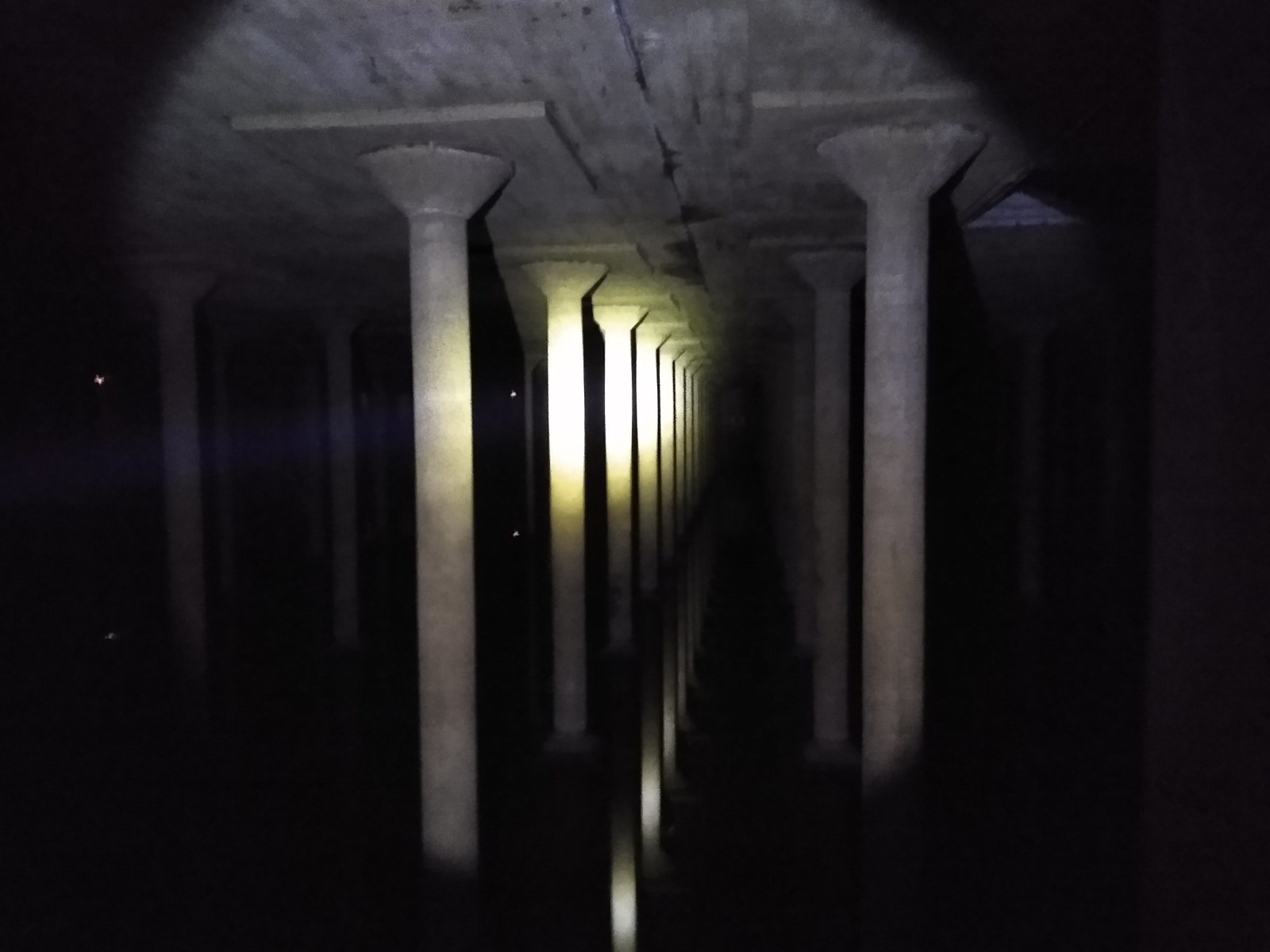
The Buffalo Bayou Park Cistern, photographed on 22 December 2022. Light and reflection make the room's limits difficult to read.
Photo: WhisperToMe / Wikimedia Commons · 2022-12-22 · CC0 1.0 · Resized and compressed for the web; no objects added or removed.Look closer.
Choose a detail to see what it reveals. Every observation is also explained below.
1. The columns widen at the ceiling
Follow the nearest column upward: its narrow shaft opens into a broad head. The same shape repeats farther back, revealing the room's regular structure.
2. One row becomes a vanishing point
The illuminated columns grow smaller and overlap toward the middle of the frame. Their repeating shape makes the depth of this enormous room easier to read.
3. Light continues into the reflection
Below the central row, reflected light repeats the vertical forms. The image alone cannot establish the water depth.
Start with the ceiling
The first clue is above eye level. Each slender column spreads into a broad, shallow head where it meets the ceiling. In this photograph, the nearest pair is easy to separate; farther into the room, those same forms overlap until the structure becomes a narrow band of light. Follow one row backward and the apparent maze starts to resolve into a grid.
This is the Buffalo Bayou Park Cistern, a former municipal drinking-water reservoir built for Houston in 1926. Buffalo Bayou Partnership records 221 concrete columns inside an underground space of 87,500 square feet. Its size served a practical purpose: storing drinking water and supporting the pressure needed for firefighting. The repetition that makes the photograph so striking began as infrastructure.
A floor that refuses to stay still
Look down the middle of the image. Pale vertical streaks continue below the columns into the dark surface. The reflection makes it hard to place the bottom of the room at a glance. The brightest strip seems to run almost to the edge of the frame, while the outer columns disappear into shadow. A photograph cannot tell us the water depth, or reproduce the sound of the chamber; it can show how little visual information we need to imagine a much larger space.
Follow the illuminated row from its broad foreground columns to the narrow forms at the back. The spacing appears to compress as the columns recede. Nearby, the shadow hides much of the structure while the reflection extends the visible pattern. The room is regular, but the light makes different parts of that order easier to notice.
A different kind of reservoir
A leak ended the reservoir's working life. During the development of Buffalo Bayou Park, the partnership identified a new use for the chamber and opened it to visitors in May 2016. The conversion included a perimeter walkway and guardrails, allowing people to experience the room from its edge. That distinction matters: a dramatic underground photograph can suggest abandonment even when a place has an organised public life.
The operator now describes the Cistern as a setting for tours, performances and art installations. This image records an earlier visit in December 2022, rather than today's lighting or programme. The concrete is the subject here; the official visitor page is the place to check what is happening inside it next.
Sources & further reading
- Buffalo Bayou Partnership — opening announcement, 10 May 2016
- Buffalo Bayou Partnership — Cistern tours
Sources reviewed for this edition. Photography dates are shown separately.

A second angle reveals the visitor edge of the former reservoir. Photograph: 22 December 2022.
Photo: WhisperToMe / Wikimedia Commons · 2022-12-22 · CC0 1.0 · Resized and compressed for the web.
