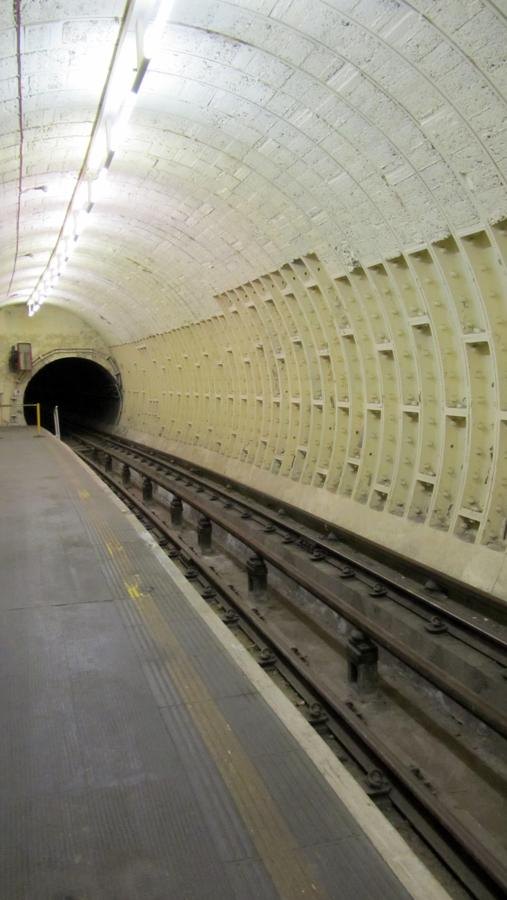
The name above the entrance says Strand Station. The name most people search for is Aldwych. Both belong to the same closed London Underground station, where surviving details reveal a transport plan that never quite found its intended place in the city.
Aldwych is associated with London Transport Museum's Hidden London program. But a tour mentioning the Aldwych branch doesn't necessarily take you into Aldwych station. Start with the exact product, then check its current joining instructions.
Before you book
| Check | Why it matters |
|---|---|
| Exact tour title | Look for Aldwych: The End of the Line in the museum's catalogue |
| Actual site entered | A Holborn tour covers a different part of the former branch |
| Joining point | Use the instructions for your booked tour, not the museum's Covent Garden address |
| Access requirements | Confirm stairs, age limits, footwear and luggage rules before paying |
| Date and price | Check the selected session; this guide does not confirm ticket availability |
Start with the London Transport Museum booking catalogue. Its indexed descriptions distinguish Aldwych from Holborn, but we couldn't retrieve complete current booking conditions during our October 16, 2026 check. If those conditions aren't visible to you either, ask the museum before purchasing.
Aldwych and Holborn are different visits
The former branch connected Holborn with Aldwych. That shared history can make search results confusing: two pages may discuss the same railway connection while offering access to different spaces.
The distinction is explicit on London Underground Tours' Aldwych page: it says that tours booked through that site do not enter Aldwych and directs readers interested in the branch toward Holborn.
Before comparing prices, confirm which station the ticket enters. Keep the joining instructions with the booking.
The museum's main building is another separate destination. Buying a museum visit and buying a tour of a disused station are different planning decisions. Don't assume one gives you a place on the other.
A terminus left off to the side
Transport for London's archival research guide explains how a railway merger left the proposed Strand terminus on a branch rather than the main through route. The branch opened in November 1907. Instead of becoming a major destination, it operated as a shuttle from Holborn.
The guide records repeated discussions about closure and extensions. A connection toward Waterloo was considered more than once but never completed. The station's difficulty wasn't simply a building in the wrong place; it was a piece of network whose hoped-for connections didn't materialize.
That is a useful thought to carry underground. A corridor can represent an intended movement as well as a movement that actually happened. Ask the guide which spaces served passengers and which were built in anticipation of a different future.
What the surviving architecture tells you
Historic England's listing for Aldwych identifies Leslie Green as the architect and records the red glazed exterior, early signage and surviving ticket-hall features. The listing specifically notes the old Strand name.
That name is worth noticing because it brings the station's different identities into one view. Renamed Aldwych in 1915, the building kept evidence of its earlier life. A station name can change faster than the materials carrying it.
The listing also documents original lift enclosures and machinery. Their survival doesn't establish working lift access for visitors.
For a closer look, choose one ordinary feature: a sign, a ticket window or a route between spaces. Ask what action it was designed to prompt. Buying, entering, waiting and moving between levels were routine tasks. The architecture becomes easier to understand when you read it through those tasks rather than treating everything as a mysterious relic.
Shelter, storage and a station on screen
Aldwych's history continued beyond its passenger role. Historic England records wartime shelter use and storage of British Museum objects, followed by later filming and events. Passenger service ended in 1994, with the cost of renewing the lifts among the reasons for closure. Historical listing
Those different uses are a reason to ask questions about what you see. Is a particular feature part of the original station, a later alteration or something associated with another use? An aged-looking surface alone can't answer that.
If you recognize the setting from a film, enjoy that connection without letting it replace the station's history. A camera can borrow a place's appearance and give it another name. A good tour helps separate the screen version from the structure you are standing in.
Find the station, then confirm the meeting point
The historic building is at the junction of Strand and Surrey Street. That location is supported by TfL's archive guide and Historic England's address record. It is a reliable starting point for finding the exterior; it is not confirmation of the door or pavement where a particular tour checks people in.
Route your journey to the meeting point on your ticket and allow time to find the group.
We haven't independently verified the current meeting door, luggage provision, stair count or minimum age for the standard tour. If stairs or baggage affect your decision, ask the museum before booking.
What to notice without going underground
The exterior still gives you something to read: the station identity, its street-facing scale and the contrast between an entrance designed for passengers and its changed purpose. View it from the public street, leaving doors and pedestrian routes clear.
Aldwych rewards a specific kind of curiosity: how a city changes its plans while leaving parts of the earlier plan in place. For a very different structure shaped by a former technical purpose, follow the story to Teufelsberg in Berlin.
Research checked October 16, 2026. Current tour logistics remain subject to confirmation with London Transport Museum. No personal visit or current ticket availability is claimed.
The reference photograph